
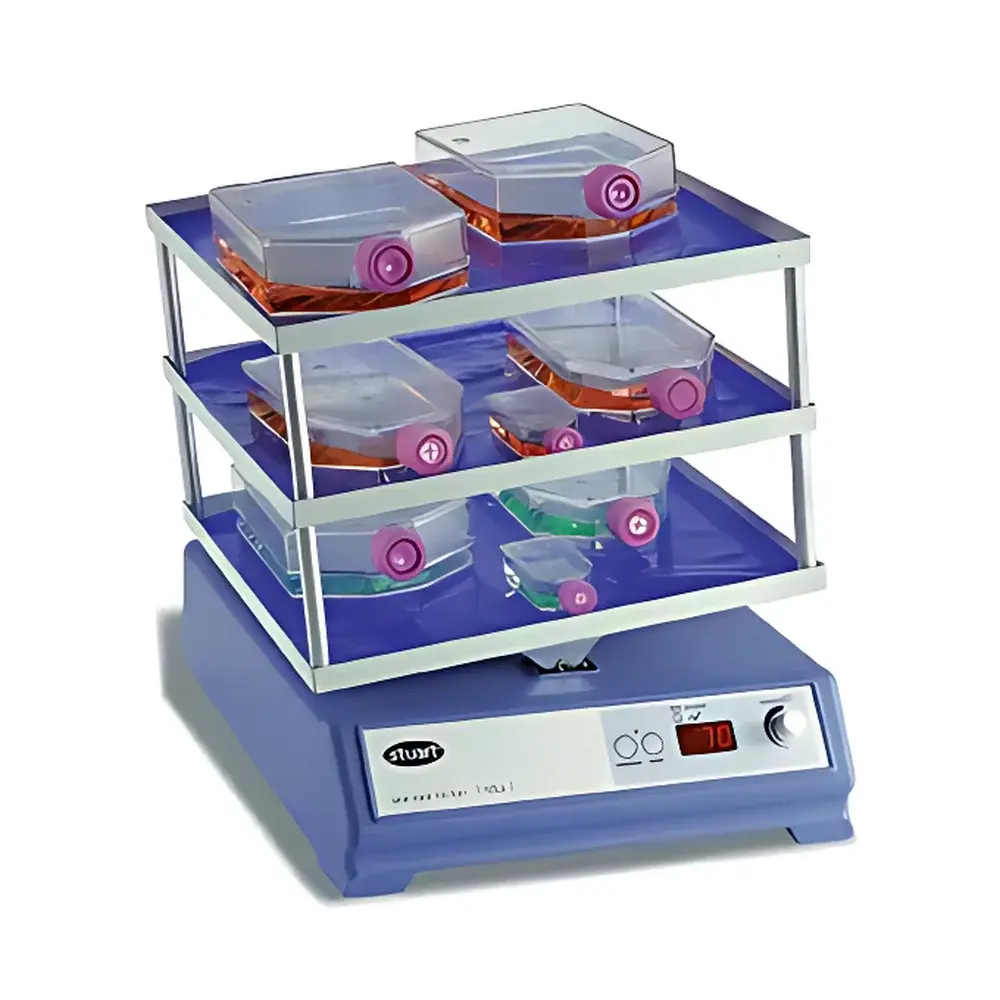
Stuart SSL3 & SSL4 Standard Universal 3D Orbital and Rocking Shakers
| Brand | Stuart |
|---|---|
| Origin | United Kingdom |
| Model | SSL3 & SSL4 |
| Shaking Motion | SSL3 – 3D orbital rotation |
| Platform Dimensions | 355 × 355 mm |
| Speed Range | 5–70 rpm |
| Tilt Angle | SSL3 – manually adjustable 3°–12° |
| Max Load Capacity | 10 kg per platform |
| Operating Temperature Range | Ambient +4 °C to 40 °C |
| Max Relative Humidity | 80 % RH |
| Power Supply | 230 V / 50 Hz, 50 W |
| Net Weight | 10 kg |
| Platform Surface | Biocote® antimicrobial coating |
| Multi-tier Compatibility | Yes (SSL3/1 kit supports up to 2 stacked platforms) |
| Control Interface | Digital encoder knobs with bright LCD display |
| Safety Features | Non-slip rubber matting, magnetic platform locking system |
| Compliance | Designed for GLP-compliant laboratories |
Overview
The Stuart SSL3 and SSL4 Standard Universal Shakers are engineered for precision, reproducibility, and operational flexibility in life science laboratories requiring scalable sample agitation under controlled environmental conditions. These shakers employ distinct mechanical agitation principles: the SSL3 utilizes a true 3D orbital rotation—generating gentle yet uniform circular motion with variable tilt—to minimize foam formation during sensitive nucleic acid extraction, blotting transfers (e.g., Southern/Northern/Western), and hybridization protocols. In contrast, the SSL4 implements a reciprocating rocking motion that induces laminar wave-like fluid displacement ideal for suspension cultures in T-flasks, roller bottles, or multi-well plates—preserving cell viability while ensuring homogenous nutrient/gas exchange. Both models feature robust cast-aluminum chassis, low-noise brushless DC motors, and continuous-duty operation validated across temperature ranges from ambient +4 °C to 40 °C and humidity levels up to 80 % RH—making them suitable for integration within incubator cabinets or environmentally regulated rooms.
Key Features
- Genuine 3D orbital motion (SSL3) with fully manual tilt-angle adjustment (3°–12°) via calibrated vernier scale for process optimization across diverse vessel geometries and viscosities.
- Controlled reciprocating rocking action (SSL4) at fixed 7° amplitude—engineered to replicate physiological shear profiles in adherent and suspension cell culture workflows.
- Digital speed and timer control via high-resolution encoder dials; real-time parameter feedback displayed on high-contrast backlit LCD—enabling precise protocol replication and audit-ready documentation.
- Biocote® silver-ion antimicrobial surface coating applied to all exposed platform and housing surfaces—reducing microbial colonization risk in shared lab environments without compromising material integrity or regulatory compliance.
- Tool-free multi-tier expansion capability (via SSL3/1 accessory kit): two independently lockable platforms secured by rare-earth magnets, delivering tripled effective sample area (up to 3× 355 × 355 mm) with consistent motion transmission across layers.
- Integrated non-slip elastomeric matting and edge-retention lip design prevent lateral displacement of flasks, tubes, or microplates—even during extended overnight runs at maximum rated load (10 kg).
Sample Compatibility & Compliance
Both SSL3 and SSL4 accommodate standard laboratory vessels—including 250 mL to 2 L Erlenmeyer flasks, Corning® roller bottles, Nunc™ cell culture dishes, and deep-well microplates—without adapter requirements. The rigid 355 × 355 mm platform ensures flatness tolerance ≤ ±0.1 mm over full surface area, critical for uniform mixing in high-throughput screening applications. Units comply with IEC 61010-1:2010 safety standards for laboratory equipment and meet electromagnetic compatibility (EMC) requirements per EN 61326-1. Their sealed electronics and corrosion-resistant finish support use in ISO Class 7 cleanrooms and GMP-aligned bioprocessing support areas. Documentation packages include Factory Acceptance Test (FAT) reports and can be extended to support IQ/OQ validation per ASTM E2500 and FDA 21 CFR Part 11 when paired with Stuart’s optional data logging software.
Software & Data Management
While standalone operation is fully functional via front-panel controls, both models interface seamlessly with Stuart’s optional PC-based LabLogic™ Shaker Control Suite (v3.2+). This validated application enables remote parameter scheduling, real-time RPM/temp/humidity logging (when used with external sensors), electronic signature capture, and automatic generation of ALCOA+ compliant audit trails—including user ID, timestamp, setpoint changes, and runtime deviations. Data exports conform to CSV and PDF formats suitable for inclusion in regulatory submissions (e.g., IND, BLA, or MDR technical files). All firmware updates are digitally signed and version-locked to prevent unauthorized modification—supporting long-term traceability in GLP and clinical trial environments.
Applications
- DNA/RNA isolation workflows requiring low-shear, foam-minimized mixing (SSL3 preferred).
- Western blot membrane incubation and antibody hybridization steps where uniform reagent coverage is essential.
- Mammalian and insect cell suspension cultures maintained in vented-cap flasks or wave bioreactors (SSL4 optimized for low-shear adaptation).
- Microbial growth kinetics studies under sub-ambient to physiological temperatures.
- Antibiotic susceptibility testing using broth microdilution plates.
- Enzyme kinetics assays requiring consistent agitation during spectrophotometric monitoring.
FAQ
Can the SSL3 and SSL4 be operated inside a CO2 incubator?
Yes—both models are rated for continuous operation at 40 °C and 80 % RH, and their sealed motor housings and non-outgassing materials make them compatible with standard humidified CO2 incubators. However, direct exposure to >5 % CO2 is not recommended due to potential long-term effects on electronic seals.
Is the Biocote® coating certified for medical device applications?
Biocote® is registered under EU Biocidal Products Regulation (BPR) and carries ISO 22196:2011 certification for antibacterial activity (≥99.99 % reduction against S. aureus and E. coli); however, final device classification requires end-product-level biocompatibility testing per ISO 10993.
What validation documentation is supplied with shipment?
Each unit ships with a Certificate of Conformance, Factory Calibration Report (speed accuracy ±1 rpm at 25 °C), and electrical safety test record. Optional IQ/OQ protocols and URS templates are available upon request.
Does the multi-tier configuration affect speed consistency between platforms?
No—magnetic coupling and rigid aluminum pillar design ensure synchronous motion transmission with ≤±0.5 rpm inter-layer deviation across the full 5–70 rpm range, verified per ISO 8573-1 pneumatic calibration methodology.
Are replacement mats and encoder knobs available as spare parts?
Yes—Stuart part numbers MAT-SSL and KNOB-ENC-SSL are stocked globally and supported by a 24-month warranty against manufacturing defects.




