
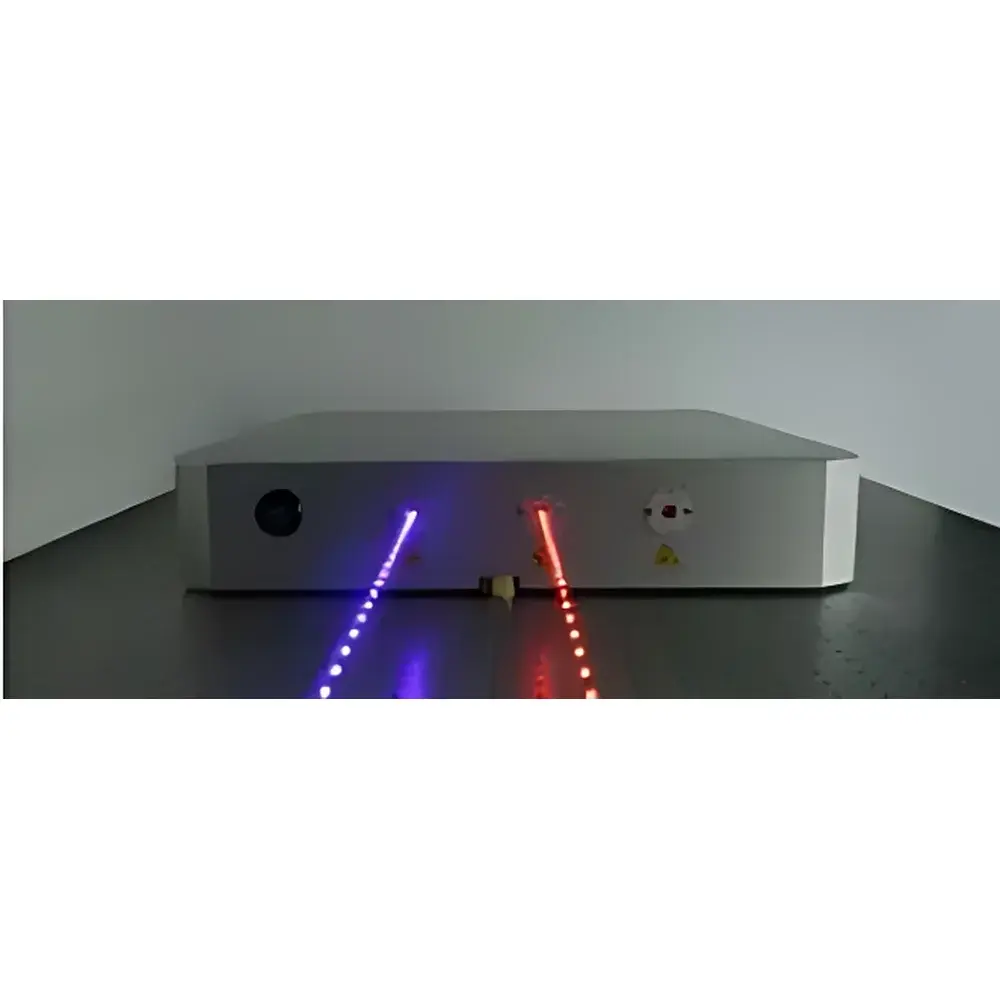
Mesa Photonics PIXIE Industrial-Grade Picosecond Mode-Locked Solid-State Laser
| Brand | Mesa Photonics |
|---|---|
| Origin | USA |
| Manufacturer Type | Authorized Distributor |
| Origin Category | Imported |
| Model | PIXIE |
| Pricing | Upon Request |
| Core Configuration | Diode-Pumped Solid-State (DPSS) Laser System with Integrated Passive Mode-Locking Module |
| Wavelength | 1342 nm (fundamental), optional harmonic generation to 671 nm (red) and 447 nm (blue) |
| Pulse Duration | <15 ps (typical) |
| Repetition Rate | 80 MHz (fixed, cavity-determined) |
| Average Power | >1.2 W @ 1342 nm |
| Beam Quality | M² < 1.1 |
| Cooling | Conductive + forced-air hybrid thermal management |
| Operating Environment | 15–30 °C, <70% RH non-condensing |
| Compliance | CE, RoHS, FDA 21 CFR Part 1040.10 (Laser Product Safety) |
Overview
The Mesa Photonics PIXIE is an industrial-grade, diode-pumped solid-state (DPSS) picosecond laser engineered for high-reliability, continuous-duty operation in demanding manufacturing and precision materials processing environments. It operates at a fundamental wavelength of 1342 nm and employs a passively mode-locked Nd:YVO4 oscillator architecture, delivering sub-15-picosecond pulses at a fixed repetition rate of 80 MHz. Unlike femtosecond systems requiring complex dispersion compensation or active stabilization, the PIXIE utilizes a patented monolithic cavity design with semiconductor saturable absorber mirror (SESAM)-based passive mode-locking—enabling exceptional long-term amplitude stability (<0.5% RMS over 24 h) and intrinsic resistance to environmental perturbations. Its ultrafast pulse duration enables non-thermal ablation mechanisms in transparent and thermally sensitive substrates, making it particularly suitable for applications where minimal heat-affected zone (HAZ), sub-micron feature fidelity, and high process repeatability are critical.
Key Features
- Industrial-hardened DPSS platform rated for 24/7 operation with MTBF >20,000 hours
- Passively mode-locked oscillator with SESAM integration—no active electronics or RF drivers required
- Integrated harmonic generation module supporting optional second-harmonic (671 nm) and third-harmonic (447 nm) output
- Beam delivery optimized for M² < 1.1 and pointing stability < 3 µrad/°C
- Conductive + forced-air hybrid thermal management system ensuring stable performance across ambient fluctuations
- Comprehensive interlock architecture compliant with IEC 60825-1:2014 Class 4 laser safety requirements
- RS-232 and USB-C digital interfaces for remote monitoring of temperature, power, and status flags
Sample Compatibility & Compliance
The PIXIE is routinely deployed in processes involving optically transparent yet thermally fragile materials—including fused silica, sapphire, borosilicate glass, and silicon wafers with embedded thin-film layers (e.g., ITO, SiNx, MoS2). Its 1342 nm emission exhibits low linear absorption in silicon while enabling efficient nonlinear interaction for selective film removal via multiphoton absorption. The system meets ISO 13850:2015 emergency stop requirements and incorporates dual-channel hardware interlocks compatible with factory-level safety PLCs. All optical outputs are certified per EN 60825-1:2014 and FDA 21 CFR Part 1040.10. Full traceable calibration documentation—including pulse width verification via autocorrelation and spectral characterization using calibrated wavemeters—is provided with each unit for GLP/GMP-aligned validation workflows.
Software & Data Management
Mesa Photonics provides the PIXIE Control Suite—a cross-platform (Windows/macOS/Linux) application supporting real-time power monitoring, interlock status logging, and thermal history archiving. All operational data is timestamped and stored in HDF5 format, enabling direct import into MATLAB, Python (via h5py), or LabVIEW for statistical process control (SPC) analysis. Audit trails comply with FDA 21 CFR Part 11 requirements when configured with user authentication and electronic signature modules. Optional OEM SDK (C/C++, Python bindings) supports integration into custom machine vision-guided ablation platforms or inline metrology feedback loops.
Applications
- Through-wafer laser machining of silicon-based MEMS and CMOS image sensors
- Selective thin-film ablation on TFT-LCD and OLED display substrates without substrate cracking
- Micro-structuring of polymer waveguides and bio-compatible hydrogels
- Pump source for optical parametric amplifiers (OPAs) in time-resolved spectroscopy setups
- Seed laser for high-energy picosecond amplifier systems requiring low timing jitter (<50 fs RMS)
- Calibration reference for ultrafast photodetector response characterization (per ISO 11554 Annex D)
FAQ
What is the typical pulse energy at the fundamental 1342 nm output?
At 80 MHz repetition rate and >1.2 W average power, the pulse energy is approximately 15 nJ.
Can the PIXIE be synchronized to external triggers?
Yes—via TTL-compatible sync output (5 V, NIM-compatible rise time <2 ns) and optional phase-locked loop (PLL) upgrade for sub-100 fs timing jitter relative to external RF sources.
Is vacuum-compatible mounting available?
Standard units use stainless-steel and Invar mechanical components; vacuum-rated variants (10−6 mbar) with bake-out compatible seals and feedthroughs are available under custom configuration.
Does the system support beam pointing stabilization?
Active beam stabilization is not integrated by default but can be implemented externally using Mesa Photonics’ BPS-1000 piezo-driven tip/tilt platform and closed-loop feedback from quadrant photodiodes.
What maintenance intervals are recommended for industrial deployment?
No routine optical alignment is required; preventive maintenance includes quarterly inspection of cooling airflow paths and annual verification of harmonic conversion efficiency using NIST-traceable power meters.





