
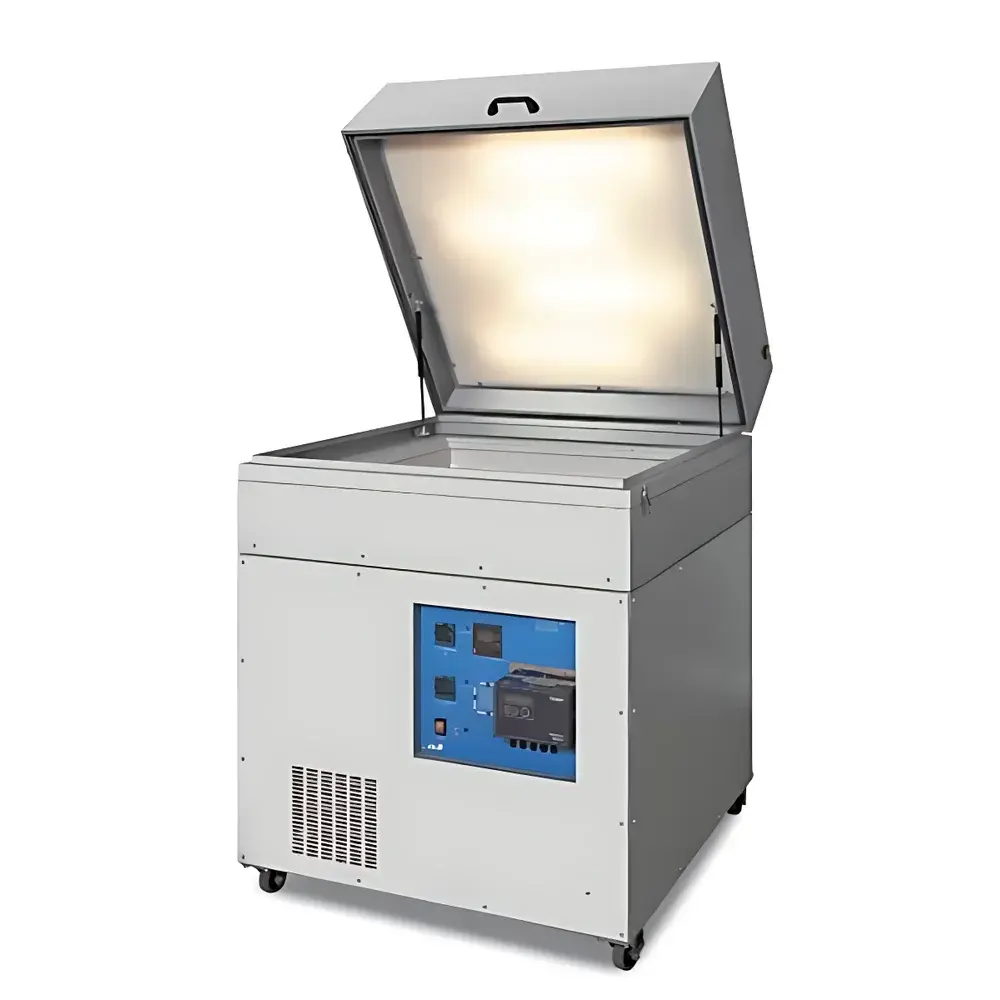
Grant Instruments GRD1 Temperature Gradient Incubator
| Brand | Grant Instruments |
|---|---|
| Origin | United Kingdom |
| Model | GRD1 |
| Temperature Range (Cooling Side) | 0–25 °C |
| Temperature Range (Heating Side) | Ambient +5 °C to 50 °C |
| Working Surface | 760 × 760 mm aluminum plate |
| Gradient Stability (per DIN 58966) | ±1 °C |
| Display | Digital LED |
| Power Supply | 220–240 V, 50/60 Hz, 2050 W |
| EMC Class | A |
| Sample Compartments | 196 discrete wells (14 × 14 grid) defined by removable acrylic divider plate |
| Data Logging | Multi-channel Squirrel data logger with 5 integrated Pt100 sensors (4 corners + center) |
| Timer Function | Programmable 24-h dual-phase cycle with automatic 90° orthogonal gradient rotation |
Overview
The Grant Instruments GRD1 Temperature Gradient Incubator is an engineered platform for high-resolution thermal phenotyping of biological samples under controlled, spatially resolved temperature conditions. Unlike conventional incubators maintaining uniform setpoints, the GRD1 employs a bidirectional thermoelectric (Peltier) system integrated into a precision-machined aluminum plate to generate stable, reproducible linear temperature gradients across its 760 × 760 mm working surface. One side of the plate is actively cooled while the opposite side is heated—establishing a continuous thermal profile from 0 °C to 50 °C (with cooling limited to 25 °C per DIN 58966 compliance). This architecture enables simultaneous exposure of up to 196 discrete samples—each occupying a defined well in a 14 × 14 acrylic grid—to unique, stable thermal microenvironments. The system supports both static gradient mapping and dynamic orthogonal cycling: over a 24-hour period, it maintains a primary gradient (e.g., north–south), then automatically rotates the thermal vector by 90° (e.g., west–east) for secondary profiling—yielding orthogonal thermal response matrices essential for robust physiological modeling.
Key Features
- Bidirectional Peltier-based gradient generation with independent cooling (0–25 °C) and heating (ambient +5 °C to 50 °C) zones
- High-stability aluminum thermal plate (760 × 760 mm) conforming to DIN 58966 thermal uniformity standards (±1 °C)
- Removable, autoclavable acrylic divider plate defining 196 individual sample wells (14 × 14 matrix), accommodating specimens up to 30 mm diameter
- Programmable 24-hour dual-phase timer enabling sequential gradient orientation control (e.g., 8 h N–S followed by 16 h W–E)
- Integrated multi-channel Squirrel data logger with five calibrated Pt100 sensors (four corners + center) for real-time, traceable temperature–time acquisition
- Full-enclosure design with locking castors, robust steel frame, and EMI-compliant Class A emissions profile
- Digital LED interface with intuitive parameter entry and status feedback; no proprietary software required for basic operation
Sample Compatibility & Compliance
The GRD1 accommodates a broad spectrum of life science specimens—including seeds (e.g., Striga hermonthica, Oryza sativa), microbial colonies (bacteria, yeasts, filamentous fungi), nematodes (Heterodera schachtii, Meloidogyne incognita), insect eggs/larvae, tissue explants, and small-scale biomaterials. Its open-well architecture permits direct optical monitoring, gas exchange, and non-invasive sampling without disrupting thermal integrity. The system meets DIN 58966 for incubator thermal stability and conforms to IEC 61000-6-3 (EMC emissions) and IEC 61000-6-2 (immunity). While not certified for GLP/GMP production environments, its data logging architecture supports audit-ready workflows when paired with validated Squirrel firmware (v5.2+), enabling time-stamped, sensor-identified records compliant with ALCOA+ principles. Full traceability is maintained via USB export of CSV-formatted logs compatible with Excel, MATLAB, or statistical platforms such as R or JMP.
Software & Data Management
Data acquisition is handled exclusively through the standalone Squirrel 2020 series logger, requiring no host PC during operation. Five Pt100 sensors—strategically positioned at the four corners and geometric center of the plate—record synchronized temperature readings at user-defined intervals (1 s to 24 h resolution). Logged data includes absolute timestamps, sensor IDs, and raw resistance-to-temperature conversions per ITS-90. Files export via USB mass storage mode as ASCII CSV, preserving metadata (e.g., calibration date, sensor serial numbers). Optional SquirrelView software (Windows/macOS) provides visualization tools: gradient contour mapping, temporal overlay plots, and orthogonal vector analysis. All logged datasets retain native precision (0.1 °C resolution) and support post-acquisition interpolation for estimating temperatures at uninstrumented well locations using bilinear spatial modeling.
Applications
The GRD1 serves as a foundational tool in thermal biology research where response surfaces—not single-point optima—are critical. Peer-reviewed applications include: seed dormancy release kinetics (Ellis & Barrett, 1994; Kebreab & Murdoch, 1999a,b,c), thermoperiodic germination modeling, thermal time (θT) quantification for phenological forecasting, and comparative thermal tolerance screening in entomology (e.g., Diabrotica virgifera diapause termination). It has been deployed in germplasm conservation programs (e.g., Australian Plant Bank, Chinese National Crop Germplasm Repository), biofuel feedstock optimization (UC Davis Cereal Bioenergy Initiative), and pest diagnostics (California Department of Food and Agriculture). Its orthogonal cycling capability uniquely supports experimental designs requiring factorial combinations of minimum/maximum daily temperatures—enabling validation of nonlinear thermal response models such as the Beta or Wang–Engel functions.
FAQ
What is the maximum sample diameter supported on the GRD1 working surface?
Samples up to 30 mm in diameter can be accommodated within individual wells of the 14 × 14 acrylic grid.
Does the GRD1 support remote monitoring or network connectivity?
No—data logging is local only via the embedded Squirrel unit; Ethernet or Wi-Fi interfaces are not available. Real-time streaming requires external DAQ hardware.
Can the gradient orientation be manually overridden or customized beyond the default 90° rotation?
No—the system implements only automated 90° orthogonal switching between two fixed axes (X/Y). Custom angular offsets are not programmable.
Is the acrylic divider plate supplied with pre-drilled wells, or must users fabricate custom inserts?
The unit ships with one standard 196-well (14 × 14) acrylic plate. Additional plates with alternate well geometries (e.g., 10 × 10, 20 × 20) are available as optional accessories.
How is temperature calibration performed, and is certificate-of-calibration included?
Each GRD1 undergoes factory calibration using NIST-traceable Pt100 references. A UKAS-accredited calibration certificate (optional add-on) documents as-delivered performance against DIN 58966 criteria.





