
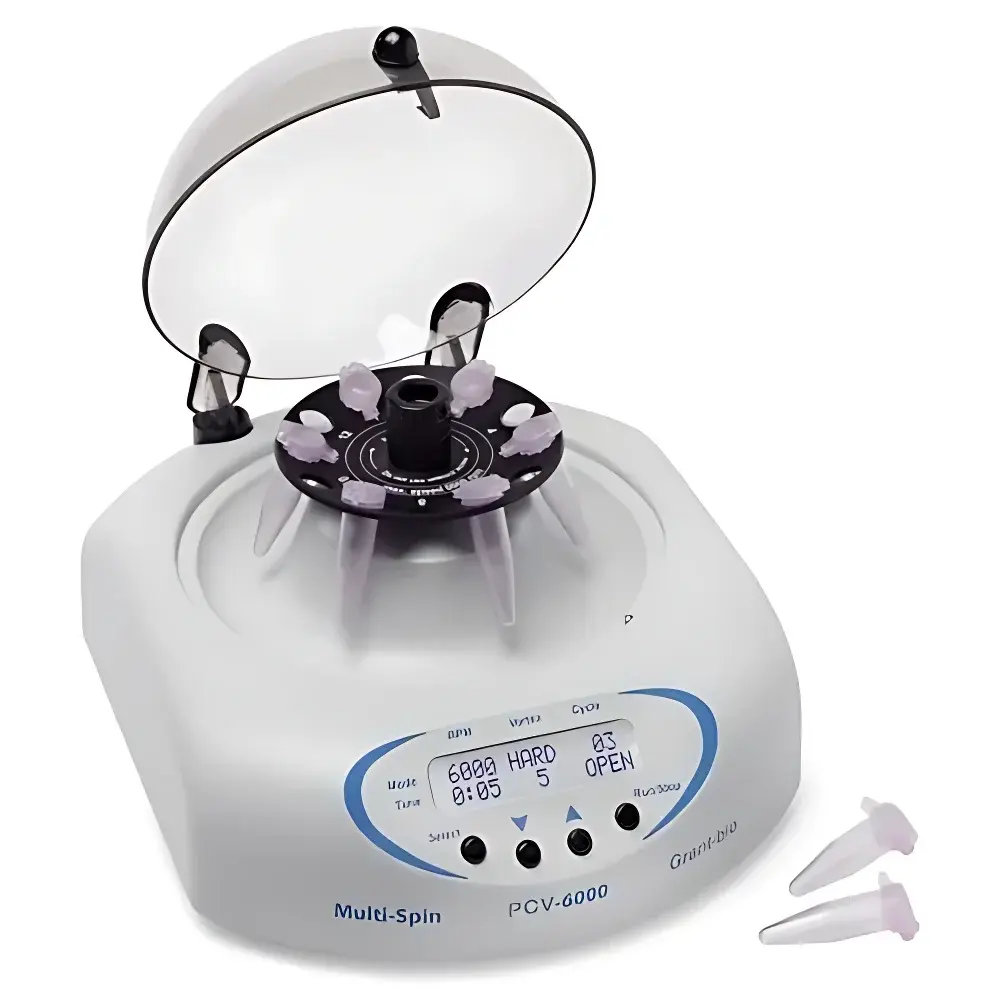
Grant PCV-6000 Multi-Spin™ Benchtop Centrifuge with Integrated Vortex Mixer
| Brand | Grant Instruments (Cambridge, UK) |
|---|---|
| Origin | United Kingdom |
| Type | Benchtop Centrifuge |
| Max Speed | 6000 rpm |
| Max RCF | 2350 × g |
| Max Capacity | 12 × 1.5 mL tubes |
| Dimensions (W×D×H) | 190 × 235 × 125 mm |
| Timer Range | 1 s – 99 min (centrifugation), 1–20 s (vortex) |
| Vortex Intensity | 3-level adjustable |
| Power Supply | 12 V DC (external adapter), compatible with incubator integration |
| Safety | Interlocked lid, automatic rotor detection, imbalance protection |
Overview
The Grant PCV-6000 is a CE-marked, UK-engineered benchtop centrifuge integrating high-precision centrifugation and programmable vortex mixing in a single compact platform. Unlike conventional centrifuges or standalone vortex mixers, the PCV-6000 implements Grant’s proprietary Multi-Spin™ technology, enabling synchronized or sequential execution of centrifugation and vortex agitation within a single instrument. This dual-function architecture operates on fundamental principles of rotational inertia and orbital oscillation—centrifugation separates components via radial acceleration (RCF), while vortex mixing induces controlled orbital motion to resuspend pellets or homogenize viscous suspensions. Designed for low-volume sample workflows typical in molecular biology, immunoprecipitation, and PCR setup, the PCV-6000 eliminates inter-instrument transfer, reducing contamination risk and operator handling time. Its 12 V DC power architecture allows safe operation inside CO2 incubators or cold rooms, supporting time-sensitive cell-based assays requiring temperature-controlled processing.
Key Features
- Multi-Spin™ Dual-Mode Operation: Three programmable modes—(i) centrifugation-only, (ii) vortex-only, and (iii) combined centrifugation + vortex—each configurable with independent timing, intensity, and cycle repetition (1–999 cycles).
- Precision Timing & Control: Centrifugation timer: 1 second to 99 minutes with auto-brake and lid lock release; vortex timer: 1–20 seconds with automatic stop; both support ramp-up/down profiles for sensitive samples.
- Three-Level Vortex Intensity: Adjustable mechanical oscillation amplitude optimized for diverse sample viscosities—from aqueous buffers to glycerol-dense lysates—without tube ejection or aerosol generation.
- Interlocked Safety System: Lid-mounted microswitch ensures motor disablement during opening; real-time imbalance detection halts operation if rotor load asymmetry exceeds tolerance thresholds.
- Modular Rotor Compatibility: Standard configuration includes 12-position rotors for 1.5 mL, 0.5 mL, and 0.2 mL tubes; optional rotors accommodate 16/18-tube arrays, 8-strip 0.2 mL PCR plates, and dual microplate carriers (96-well standard/deep-well).
- Low-Voltage Incubator Integration: External 12 V DC power supply enables seamless installation inside regulated environments; cable routing through incubator grommets maintains chamber integrity and thermal uniformity.
Sample Compatibility & Compliance
The PCV-6000 supports common laboratory consumables including polypropylene microcentrifuge tubes (0.2–2.0 mL), PCR strips, and standard microplates. Its rotor geometry ensures uniform radial distribution across all tube positions, minimizing edge effects during pelleting. The instrument complies with IEC 61010-1:2010 for electrical safety and EN 61326-1:2013 for electromagnetic compatibility. While not certified for GLP/GMP production environments, its repeatable timing logic, non-volatile parameter memory, and audit-ready operation logs align with ISO/IEC 17025 pre-analytical workflow requirements. For clinical diagnostics labs, the device meets essential performance criteria outlined in CLSI EP17-A2 for centrifugal separation validation under routine use conditions.
Software & Data Management
The PCV-6000 operates via an embedded firmware interface—no external software or drivers required. All parameters are stored in EEPROM with battery-backed retention, preserving user-defined protocols across power cycles. The two-line, 16-character LCD displays real-time RPM, elapsed time, remaining time, and vortex status simultaneously. Parameter entry uses tactile membrane buttons with haptic feedback to prevent accidental changes during active runs. Although it does not feature USB or Ethernet connectivity, its deterministic control loop ensures ±1% speed accuracy and ±0.5 s timing reproducibility—critical for method transfer between instruments in multi-site research consortia. Protocol export/import is not supported; however, standardized operating procedures (SOPs) can be documented using the fixed parameter set (e.g., “IP Wash Cycle: 3000 rpm × 30 s → vortex medium × 5 s × 3 cycles”).
Applications
- Molecular Biology: Rapid post-PCR cleanup, spin-column binding/wash steps, cDNA precipitation, and plasmid miniprep supernatant clarification.
- Immunology & Cell Signaling: Antibody–antigen complex pelleting in co-immunoprecipitation (Co-IP), nuclear extract preparation, and organelle fractionation washes.
- Clinical Diagnostics: Serum/plasma separation from capillary blood samples, viral RNA extraction prep, and rapid antigen assay buffer equilibration.
- Enzyme Kinetics & Assay Prep: Enzyme–substrate mixing immediately prior to reaction initiation, followed by immediate quenching via centrifugation.
- Quality Control Labs: Consistency testing of reagent homogeneity, particulate suspension stability, and lyophilized powder reconstitution verification.
FAQ
Can the PCV-6000 be used inside a CO2 incubator?
Yes—the 12 V DC input and compact footprint allow secure mounting inside incubators; the external power adapter remains outside, connected via a sealed feedthrough port.
Is rotor calibration required before first use?
No—factory-calibrated rotors are pre-matched to the drive shaft; users only need to verify physical seating and lid engagement prior to each run.
Does the instrument support continuous (non-timed) operation?
Yes—both centrifugation and vortex modes offer continuous operation until manually stopped or lid opened.
What is the maximum allowable imbalance for safe operation?
The system detects mass differentials exceeding ±0.1 g per tube position and halts rotation within 0.8 seconds to prevent bearing stress or rotor deformation.
Are rotor replacements traceable for audit purposes?
Each rotor carries a laser-etched serial number; Grant provides a Certificate of Conformance with batch-specific mechanical test data upon request for regulatory documentation.
Related Products



