
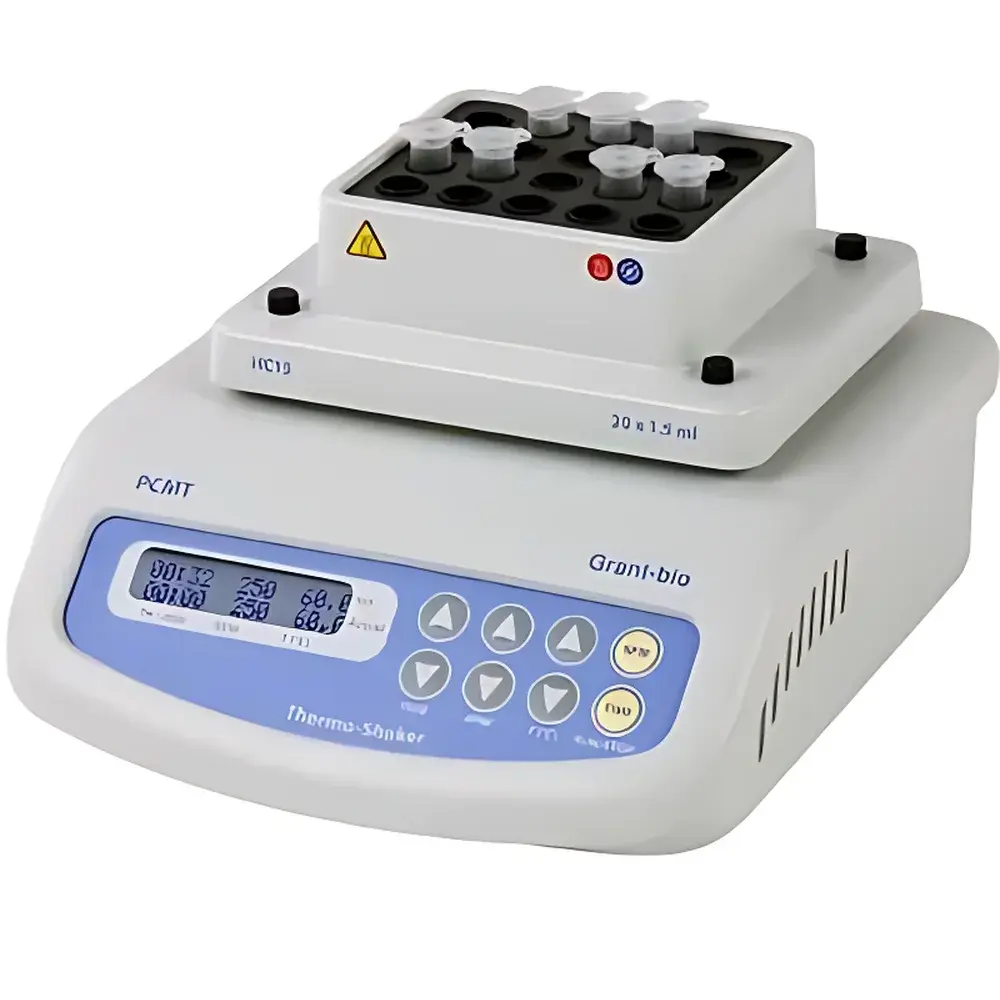
Grant PCMT Refrigerated Thermo-Mixer
| Brand | Grant Instruments |
|---|---|
| Origin | United Kingdom |
| Model | PCMT |
| Instrument Type | Benchtop Thermo-Mixer with Active Cooling |
| Temperature Range | +4 °C to +100 °C |
| Temperature Uniformity | ±0.1 °C |
| Heating Rate (HC15 module) | 5 °C/min (25 °C → 100 °C) |
| Cooling Rate (HC15 module) | 5 °C/min (100 °C → 25 °C) |
| Oscillation Speed | 250–1400 rpm |
| Speed Resolution | 1 rpm |
| Orbit Diameter | 2 mm |
| Timer Range | 1 min – 96 h (1-min increments, audible alarm, auto-shutdown) |
| Plate Capacity | 1 × standard microplate (96-well, 0.2 mL) or equivalent tube configurations |
| Dimensions (W×D×H) | 250 mm × 230 mm × 130 mm |
| Weight | 4 kg |
| Power Supply | 120 V or 230 V AC, 50/60 Hz |
| Input Current | 4.16 A |
Overview
The Grant PCMT Refrigerated Thermo-Mixer is a precision-engineered benchtop instrument designed for simultaneous temperature-controlled incubation and orbital mixing of biological samples in molecular biology, biochemistry, and cell culture workflows. It operates on the principle of controlled orbital shaking combined with Peltier-based thermoelectric heating and active cooling—enabling bidirectional thermal regulation from +4 °C up to +100 °C, including sub-ambient operation down to 15 °C below ambient. Unlike passive cooling units, the PCMT maintains tight thermal stability (±0.1 °C uniformity across the platform) and rapid thermal response—achieving 5 °C/min heating and comparable cooling rates under defined load conditions (e.g., HC15 module). Its compact footprint, low power consumption, and absence of refrigerant gases align with modern laboratory sustainability and safety standards. The device is intended for use in ISO 17025-accredited labs, GLP-compliant sample preparation environments, and research settings requiring reproducible thermal-mechanical conditioning of nucleic acids, proteins, and metabolites.
Key Features
- Peltier-driven dual-mode thermal control: precise setpoint accuracy from +4 °C to +100 °C, with active cooling capability extending operation below ambient temperature
- High-resolution digital speed control: adjustable orbital shaking from 250 to 1400 rpm in 1-rpm increments, with 2-mm orbit diameter ensuring efficient mixing without splashing or foaming
- Integrated 2-line × 16-character LCD display showing real-time setpoint and actual values for both temperature and speed
- Programmable digital timer (1 minute to 96 hours), featuring audible alert and automatic shutdown upon completion
- Modular platform design supporting five interchangeable heat-transfer blocks optimized for common labware formats
- Robust aluminum alloy housing with insulated chamber walls, minimizing external heat transfer and improving energy efficiency
- Compliance with IEC 61010-1:2010 for electrical safety and electromagnetic compatibility (EMC)
Sample Compatibility & Compliance
The PCMT accommodates a range of standard consumables via its swappable modules: HC15 (20 × 1.5 mL tubes), HC18 (12 × 1.5 mL + 20 × 0.5 mL), HC24 (24 × 2.0 mL), HC32 (12 × 1.5 mL + 20 × 0.2 mL), and HC96 (single 96-well PCR plate, 0.2 mL well volume). Each module is CNC-machined from anodized aluminum for optimal thermal conductivity and chemical resistance. The system supports protocols aligned with ASTM E2927-20 (standard practice for validation of thermal cyclers) and ISO 20387:2018 (biobanking requirements), particularly for pre-analytical steps such as RNA stabilization, enzymatic digestion, and metabolite extraction. Temperature uniformity data are traceable to NPL (National Physical Laboratory, UK) calibration standards. No internal moving parts require lubrication; maintenance is limited to periodic cleaning of the block interface and verification of thermal sensor drift per manufacturer-recommended intervals.
Software & Data Management
The PCMT operates as a standalone instrument without proprietary software dependency. All operational parameters—including temperature setpoint, speed, timer duration, and run status—are configured and monitored directly via the front-panel interface. For laboratories implementing electronic record-keeping under FDA 21 CFR Part 11 or EU Annex 11, optional third-party data loggers (e.g., compliant USB-temperature/rpm acquisition modules) may be integrated via analog output ports (0–5 V DC) for time-stamped parameter logging. Audit trails can be generated externally using validated LIMS or ELN platforms. Firmware updates are performed manually via USB port using signed binary files distributed through Grant Instruments’ secure customer portal.
Applications
- Nucleic acid purification: consistent lysis and binding buffer mixing during column-based DNA/RNA isolation
- Enzyme kinetics assays: temperature-resolved reaction monitoring at fixed agitation speeds to minimize diffusion-limited artifacts
- Cell lysate preparation: uniform resuspension of pelleted cells prior to centrifugation or filtration
- Antibody conjugation and labeling reactions: gentle yet effective mixing during pH-sensitive coupling steps
- Metabolomics sample prep: stabilization of labile intermediates during quenching and extraction workflows
- PCR master mix equilibration: pre-incubation at 4 °C or 37 °C with agitation to ensure homogeneous reagent distribution
FAQ
Does the PCMT support GMP/GLP documentation requirements?
Yes—when used with external validated data loggers and appropriate procedural controls, the PCMT meets core instrumentation qualification criteria for IQ/OQ under GLP and GMP frameworks.
Can multiple modules be heated/cooled simultaneously?
No—the PCMT features a single thermal block interface; only one module is mounted and conditioned at a time.
What is the maximum ambient temperature for reliable sub-ambient operation?
For stable operation at temperatures ≥15 °C below ambient, ambient conditions should not exceed 30 °C and relative humidity should remain below 70% non-condensing.
Is the HC96 module compatible with skirted or semi-skirted PCR plates?
Yes—the HC96 block accepts standard ANSI/SLAS-format 96-well plates, including full-skirted, semi-skirted, and unskirted variants with 0.2 mL well geometry.
How often does the unit require recalibration?
Grant recommends annual verification of temperature and speed accuracy using NIST-traceable reference standards; no field recalibration is user-serviceable.



