
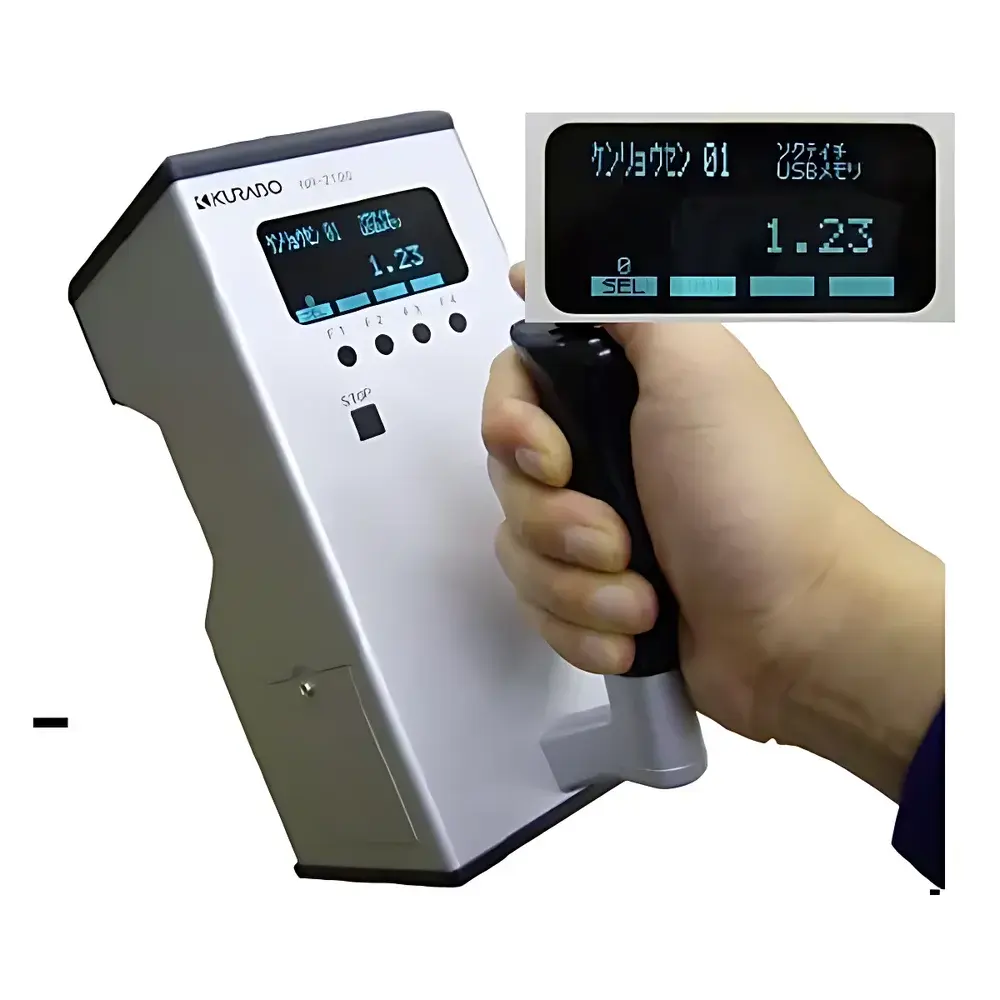
Kurabo NR-2100IB/210 Infrared Organic Coating Thickness Analyzer
| Brand | Kurabo |
|---|---|
| Origin | Japan |
| Model | NR-2100IB/210 |
| Measurement Principle | Infrared Reflectance Absorption (Rotating Filter Method) |
| Measurement Range | 0.1–10 µm |
| Repeatability | < 0.01 µm |
| Measurement Area | 518 × 36 mm (elliptical) |
| Dimensions | 100(W) × 210(D) × 145(H) mm |
| Weight | ~1.5 kg |
| Light Source Configuration | P-polarized Incident Beam |
| Integrated Thermal Printer | Yes |
Overview
The Kurabo NR-2100IB/210 Infrared Organic Coating Thickness Analyzer is a precision benchtop and field-deployable instrument engineered for non-destructive, real-time quantification of ultra-thin organic films on conductive metallic substrates. It operates on the fundamental principle of infrared reflectance absorption spectroscopy—specifically leveraging characteristic vibrational absorption bands of organic functional groups (e.g., C–H, C=O, O–H) in the mid-infrared region (~2.5–25 µm). Unlike contact or eddy-current methods, this system employs a rotating optical filter to isolate wavelength-specific reflectance signals from the sample surface. By comparing the intensity of reflected IR radiation at analytically relevant absorption peaks against reference baselines, the instrument calculates film thickness using pre-established calibration curves derived from NIST-traceable standards. Its P-polarized incident beam architecture minimizes interference from specular reflection and substrate-induced multiple reflections—critical for high-fidelity measurement on rolled steel, aluminum coils, and coated tinplate. Designed for integration into continuous production lines and QC laboratories, the NR-2100IB/210 delivers metrological traceability compliant with ISO 9001 quality management frameworks and supports audit-ready documentation per GLP and internal QA protocols.
Key Features
- P-polarized infrared illumination system optimized for metallic substrates, suppressing Fresnel reflection artifacts and enabling stable signal acquisition on glossy or textured surfaces
- Rotating interference filter mechanism ensuring precise spectral band selection without moving grating components—enhancing long-term optical alignment stability
- Ergonomic, portable form factor (100 × 210 × 145 mm; ~1.5 kg) with three-point mechanical positioning for repeatable placement on flat or slightly curved metal sheets
- Elliptical measurement footprint (518 × 36 mm) accommodating wide-strip industrial samples such as cold-rolled steel coils and beverage can stock
- Onboard thermal printer providing immediate hard-copy output of measurement values, timestamps, and operator ID—reducing transcription errors and supporting paper-based QA workflows
- No consumables or sample preparation required; measurements completed in under 3 seconds per location with no surface contact or solvent exposure
Sample Compatibility & Compliance
The NR-2100IB/210 is validated for quantitative analysis of hydrocarbon-based lubricants (e.g., rolling oils), rust preventive oils, fingerprint-resistant polymer coatings, epoxy primers, and PVDF topcoats applied to ferrous and non-ferrous metals—including cold-rolled steel, galvanized steel, aluminum alloys (e.g., 3004, 5182), and electrolytic tinplate. It is not suitable for transparent inorganic layers (e.g., SiO₂, Al₂O₃), thick polymer laminates (>15 µm), or non-reflective substrates (e.g., painted or anodized surfaces without metallic underlayer). The instrument conforms to IEC 61000-6-3 (EMC emissions) and IEC 61010-1 (safety requirements for electrical equipment). While not certified to ASTM E1712 or ISO 3270, its methodology aligns with the physical principles referenced in ASTM D7091 (Standard Practice for Nondestructive Measurement of Dry Film Thickness of Nonmagnetic Coatings Applied to Ferrous Metals) for organic layer verification. Calibration verification is performed using certified reference foils traceable to JIS Z 2241 and NMIJ (National Metrology Institute of Japan) standards.
Software & Data Management
The NR-2100IB/210 operates as a standalone analyzer with embedded firmware; no external PC is required for routine operation. All measurement data—including thickness value, date/time stamp, measurement location identifier (user-assigned), and instrument serial number—are stored internally and printed in real time. For enterprise-level integration, optional RS-232 or USB-to-serial interface enables export of CSV-formatted logs to LIMS or MES platforms. Data records support basic traceability requirements under FDA 21 CFR Part 11 when paired with organizational procedural controls (e.g., operator login via physical key switch, manual logbook cross-referencing). Audit trails are maintained via printed reports, which include instrument status flags (e.g., “Calibration Valid”, “Filter Position OK”) and environmental condition notes (operator-entered ambient temperature/humidity).
Applications
- Quantitative control of mill oil application on automotive-grade cold-rolled steel prior to stamping—ensuring optimal drawability while minimizing post-forming residue
- In-line verification of organic passivation layers on aluminum beverage can body stock (e.g., 3004 alloy), directly impacting lacquer adhesion and corrosion resistance
- Thickness validation of epoxy-phenolic primers on color-coated steel roofing panels—critical for weathering performance and warranty compliance
- Process monitoring of lubricant replenishment on continuous hot-dip galvanizing lines, where excess oil leads to furnace carbon buildup
- QC screening of backside coating uniformity on prepainted metal coils used in HVAC ductwork and appliance housings
FAQ
Can the NR-2100IB/210 measure thickness on painted or powder-coated surfaces?
No—it requires a highly reflective metallic substrate beneath the organic layer to generate a measurable IR reflectance signal. Non-conductive topcoats without exposed metal will yield unreliable or invalid readings.
Is calibration required before each use?
A daily verification using a supplied reference foil is recommended; full recalibration is typically performed quarterly or after instrument service, following Kurabo’s documented procedure.
Does the instrument comply with FDA 21 CFR Part 11 for electronic records?
The device itself does not provide electronic signature capability or automated audit trails; however, its printed outputs—when managed within a documented SOP—may serve as compliant records under Part 11 Subpart B.
What is the minimum substrate thickness required for accurate measurement?
Steel substrates ≥ 0.3 mm and aluminum ≥ 0.2 mm are recommended to ensure sufficient IR reflectivity and thermal mass stability during measurement.
Can it distinguish between multiple stacked organic layers?
No—the system reports total organic mass per unit area (converted to equivalent single-layer thickness); compositional deconvolution requires FTIR or ellipsometry.
Related Products



