
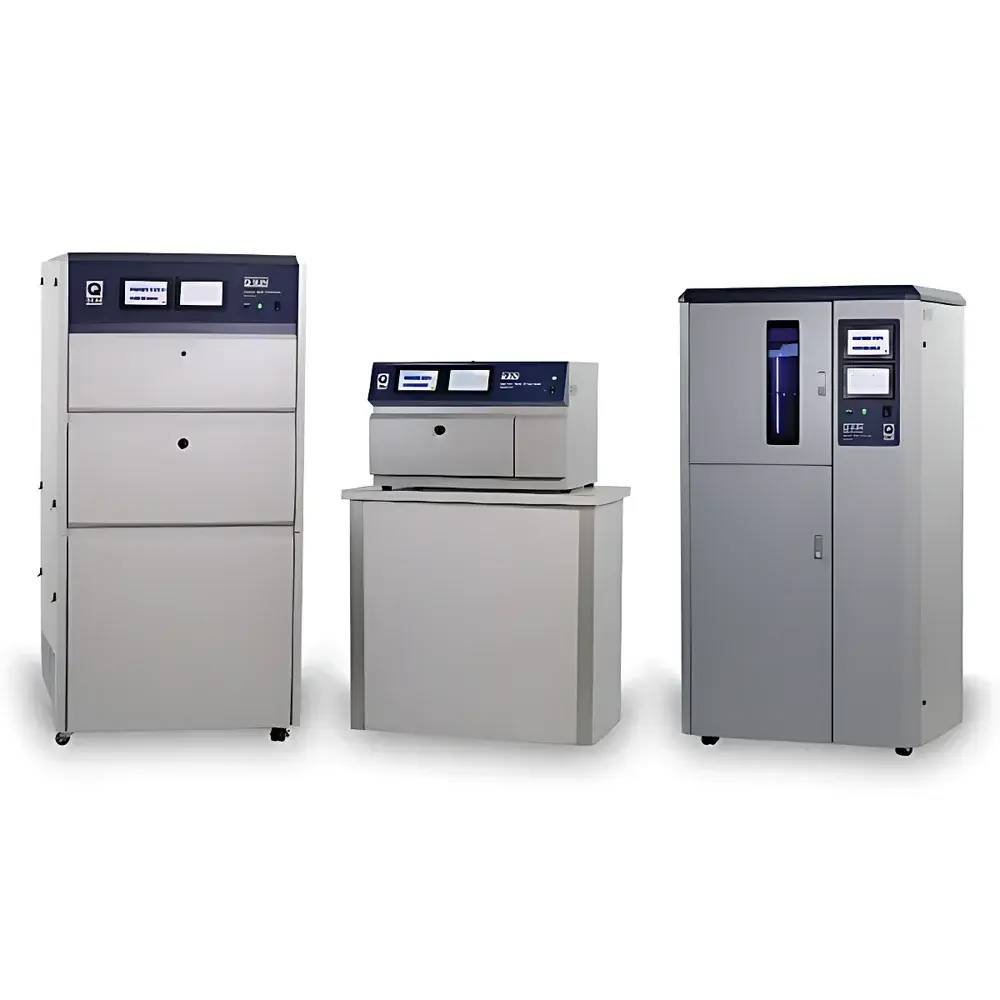
Q-Lab Q-Sun Xe-3 Xenon Arc Weathering Test Chamber
| Brand | Q-Lab |
|---|---|
| Origin | USA |
| Model | Q-Sun Xe-3 |
| Xenon Lamp Power | 3 × 1800 W |
| Irradiance Range | 0.55–1.3 W/m²/nm @ 340 nm |
| Light Exposure Cycle | 1–999 h |
| Humidity Range | 20–95% RH |
| Cooling Method | Air-cooled |
| Sample Tray Dimensions | 451 mm × 718 mm |
| Filter Options | Daylight, Window Glass, Extended UV |
| Optional Features | Front/Rear Spray, Dual Spray (Secondary Liquid), Refrigerated Cooling (Xe-3-HSCE), SOLAR EYE Irradiance Control, NIST-Traceable Calibration |
Overview
The Q-Lab Q-Sun Xe-3 Xenon Arc Weathering Test Chamber is an air-cooled, full-spectrum accelerated weathering instrument engineered for precision simulation of solar radiation, temperature, and humidity effects on materials. It employs three independent 1800 W xenon arc lamps to replicate the ultraviolet (UV), visible, and near-infrared (NIR) components of natural sunlight—enabling reproducible, quantitative assessment of photodegradation, color fading, gloss loss, cracking, and chalking under controlled laboratory conditions. Unlike water-cooled systems, the Xe-3’s air-cooled architecture reduces operational complexity, maintenance frequency, and total cost of ownership while maintaining compliance with international weathering standards including ISO 4892-2, ASTM G155, SAE J2527, and AATCC TM16. Its flat-bed sample configuration supports heterogeneous geometries—from flat panels and textiles to 3D automotive components—without requiring custom fixtures. The chamber operates across a broad environmental envelope: black panel temperature from 42 °C to 120 °C, relative humidity from 20% to 95% RH, and irradiance controllable at 340 nm, 420 nm, or TUV (total UV) bands via the SOLAR EYE feedback system.
Key Features
- Air-cooled triple-xenon lamp array (3 × 1800 W) with >1500 h nominal lamp life and tool-free replacement
- Standard humidity control with real-time monitoring of chamber air RH, black panel temperature, and ambient air temperature
- Modular optical filtration system: interchangeable Daylight (e.g., Daylight-F/Q/B), Window Glass (e.g., Window-Q/B/SL/SF-5), and Extended UV (e.g., UV-Q/B) filters for spectral tailoring
- Front spray, rear spray, and dual-spray options—enabling sequential or simultaneous application of deionized water and secondary test liquids (e.g., acid rain simulants, detergent solutions)
- SOLAR EYE irradiance control system with NIST-traceable sensors for closed-loop regulation at user-selected wavelengths (340 nm, 420 nm, or TUV)
- Refrigerated cooling option (Xe-3-HSCE) extends low-temperature capability down to 31 °C at 50% RH—critical for thermally sensitive pharmaceuticals, cosmetics, and polymers
- Large horizontal sample tray (451 mm × 718 mm) accommodating up to 55 standard 51 mm × 102 mm specimens or irregular 3D parts with adjustable-height mounting
- Integrated Ethernet interface supporting remote data logging, firmware updates, and diagnostic telemetry via Q-Lab’s Virtual Strip software
Sample Compatibility & Compliance
The Q-Sun Xe-3 accommodates diverse sample types—including coated metals, architectural coatings, automotive trim, textiles, plastics, packaging films, and medical device polymers—without size or orientation constraints. Its horizontal exposure plane ensures uniform wetting during spray cycles and minimizes runoff artifacts common in tilted or vertical configurations. All operational parameters are programmable to satisfy regulatory requirements under ISO 17025-accredited calibration protocols. Q-Lab’s A2LA-accredited calibration laboratory (certificates #2382-01, #2383-02, #2383-03) provides NIST-traceable recalibration services for both black panel temperature sensors and SOLAR EYE irradiance detectors—ensuring long-term measurement integrity required for GLP, GMP, and FDA 21 CFR Part 11–compliant environments. The system supports audit-ready data capture with timestamped event logs, operator authentication, and electronic signature capability when paired with validated software configurations.
Software & Data Management
The embedded controller features multilingual UI (English, French, Spanish, German, Italian), self-diagnostic routines, and scheduled service alerts. Standard Ethernet connectivity enables seamless integration into enterprise LIMS or quality management systems. Optional Virtual Strip PC software provides automated acquisition of irradiance, temperature, humidity, and cycle phase data—with configurable sampling intervals and CSV/Excel export. All logged parameters include metadata (sensor ID, calibration date, operator ID, firmware version) to satisfy ALCOA+ principles (Attributable, Legible, Contemporaneous, Original, Accurate, Complete, Consistent, Enduring, Available). Remote diagnostics allow Q-Lab technical support to initiate secure, read-only session-based troubleshooting—reducing mean time to resolution without compromising network security.
Applications
The Q-Sun Xe-3 is deployed globally in R&D labs, QC departments, and third-party testing facilities for accelerated durability validation across sectors. In automotive engineering, it validates exterior trim stability per SAE J2527 and interior material resistance to filtered daylight per ISO 105-B02. In coatings development, it correlates laboratory exposure to field performance of roof membranes, façade paints, and marine finishes using Daylight-F filtration and cyclic UV/water exposure. For consumer goods, it assesses textile colorfastness (AATCC TM16), plastic yellowing (ISO 4892-2), and cosmetic packaging integrity under window-glass-filtered spectra. Pharmaceutical manufacturers use the refrigerated Xe-3-HSCE variant to evaluate light-induced degradation of photosensitive actives under ICH Q1B conditions—while maintaining strict thermal control below 35 °C.
FAQ
What spectral ranges does the Q-Sun Xe-3 simulate?
The Xe-3 reproduces the full solar spectrum (295–800 nm) using interchangeable filters: Daylight filters match unfiltered terrestrial noon sun; Window Glass filters emulate transmission through standard float glass (cutting off <320 nm); Extended UV filters enhance sub-320 nm output for aggressive stress testing.
Is purified water mandatory for all spray functions?
Yes—front spray, rear spray, and dual-spray operations require deionized or distilled water (conductivity <5 µS/cm) to prevent nozzle clogging and mineral deposition on samples and optics.
How often must irradiance and temperature sensors be recalibrated?
Q-Lab recommends annual return-to-factory recalibration for both SOLAR EYE irradiance sensors and black panel temperature probes—performed in accordance with ISO/IEC 17025 and traceable to NIST reference standards.
Can the Xe-3 operate without active humidity control?
No—humidity control is standard and integral to the chamber’s environmental regulation architecture; RH is continuously monitored and adjusted via integrated steam generator and dry-air purge.
What safety certifications does the Q-Sun Xe-3 hold?
The instrument complies with UL 61010-1, CE (EMC Directive 2014/30/EU and Low Voltage Directive 2014/35/EU), and meets RoHS 2011/65/EU restrictions on hazardous substances.



