
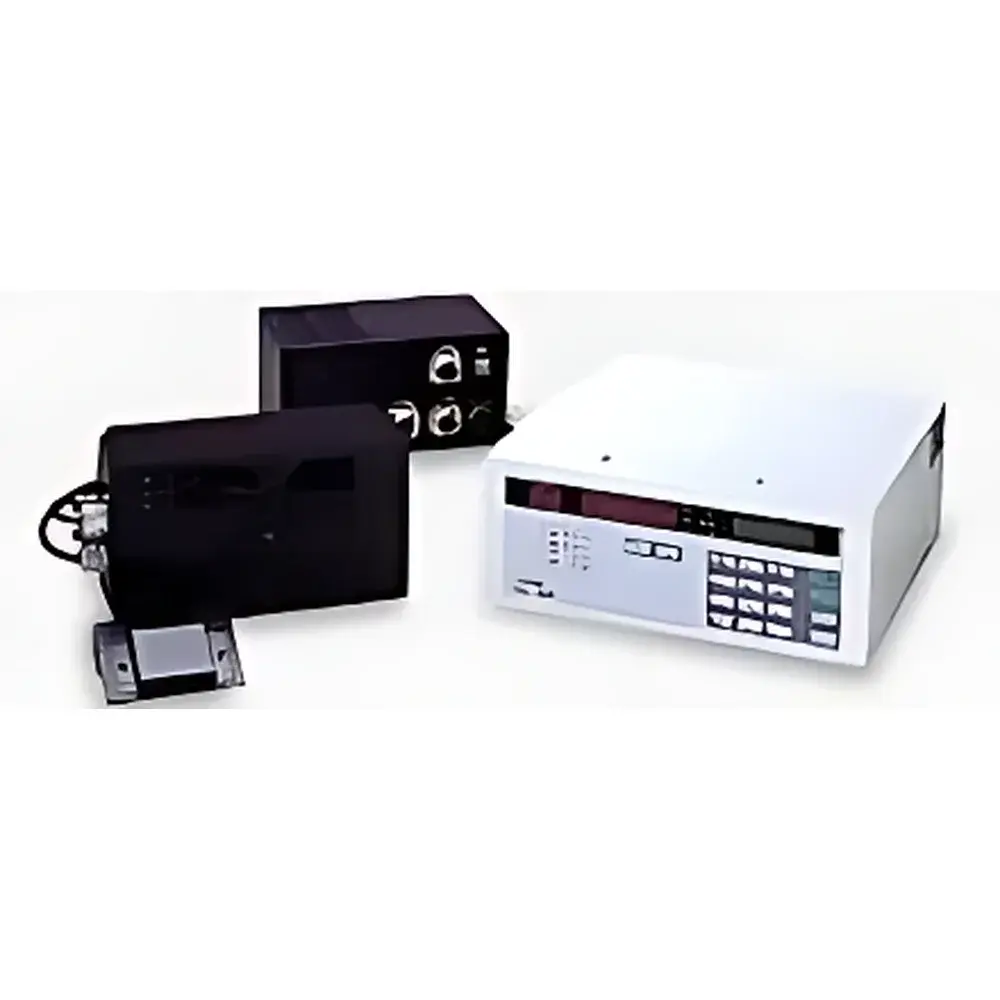
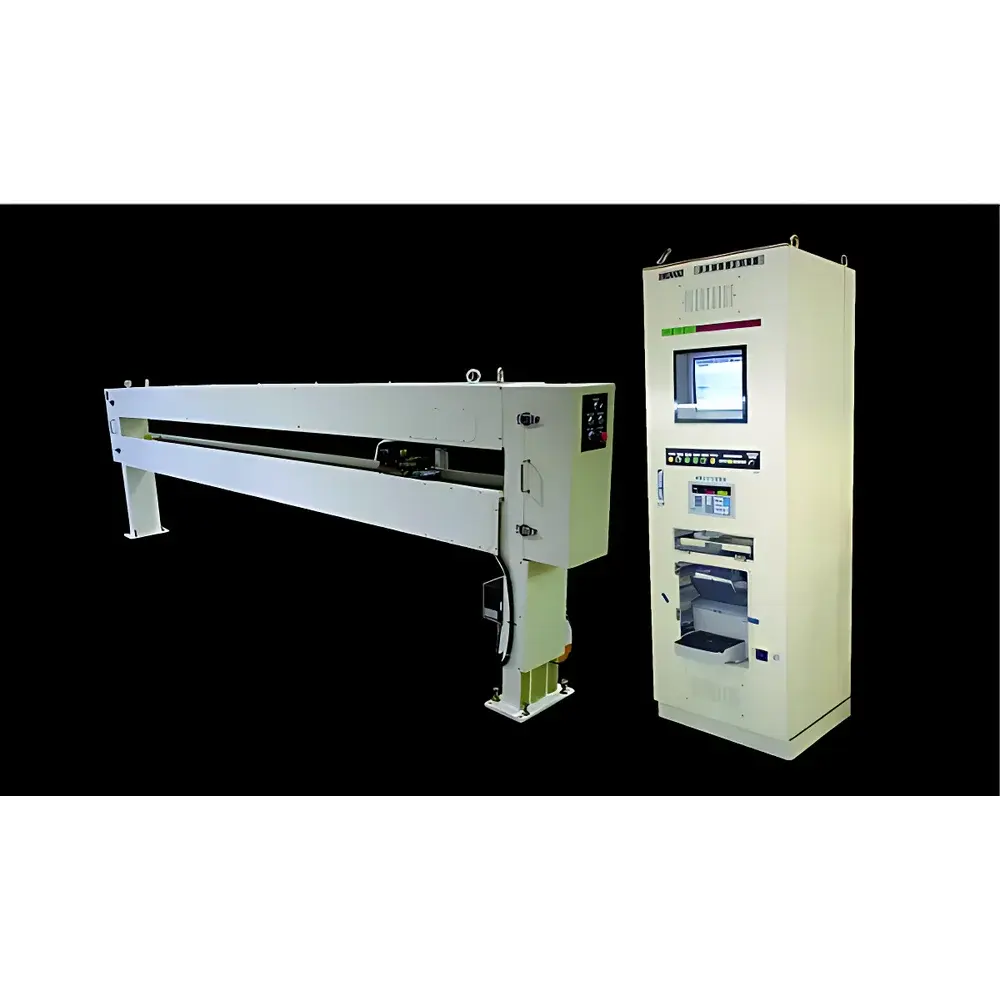
Kurabo RX400 Online Infrared Oil Film Thickness Gauge
| Brand | Kurabo |
|---|---|
| Origin | Japan |
| Model | RX400 |
| Measurement Principle | Infrared Reflectance Absorption |
| Spectral Method | Rotating Filter Wheel (6-band) |
| Measurement Distance | 40 mm (from bottom surface of main unit) |
| Spot Size | 20 × 30 mm (elliptical) |
| Operating Temperature | 5–40 °C (non-condensing) |
| Power Supply | AC 100 V ±10%, 50/60 Hz, 200 VA (main unit & data processor) |
| Output Signals | 0–10 V DC and 4–20 mA analog (factory-configured) |
| Main Unit Dimensions | 410 × 207 × 160 mm (W×D×H, excluding protrusions) |
| Main Unit Weight | 8.5 kg |
| Relay Connector Dimensions | 322 × 113 × 140 mm |
| Relay Connector Weight | 4 kg |
| Data Processor Dimensions | 300 × 275 × 165 mm |
| Data Processor Weight | 6 kg |
Overview
The Kurabo RX400 Online Infrared Oil Film Thickness Gauge is an industrial-grade, non-contact thickness measurement system engineered for real-time, in-line monitoring of ultra-thin inorganic and organic coatings on metallic substrates—primarily cold-rolled steel, silicon steel, and pre-coated automotive sheet. It operates on the principle of infrared reflectance absorption spectroscopy, leveraging wavelength-dependent absorption characteristics of thin films in the near- to mid-infrared range (typically 1.0–5.0 µm). Unlike X-ray fluorescence or beta-backscatter methods, the RX400 avoids ionizing radiation and regulatory licensing requirements while delivering high repeatability for sub-micron to several-micron thick layers—including SiO₂ native oxides, phosphate conversion coatings, silicone-based lubricants, and multi-layer functional polymer films. Its fixed 40 mm working distance and elliptical 20 × 30 mm measurement footprint enable stable integration into rolling mill lines, coating lines, and continuous annealing furnaces without mechanical interference or process interruption.
Key Features
- Non-destructive, real-time infrared reflectance absorption measurement optimized for inorganic oxides (e.g., SiO₂), phosphates, and silicone-based lubricants on steel surfaces
- Rotating six-filter wheel architecture enabling discrete spectral band selection—each filter tuned to a specific absorption peak of target film chemistries
- Stable 40 mm standoff distance accommodates typical roll gap clearances and conveyor-mounted installation without recalibration
- High signal-to-noise ratio detector design ensures robust performance under ambient lighting, thermal drift, and vibration conditions common in hot-dip galvanizing and temper mill environments
- Modular architecture comprising main sensor head, relay connector, and standalone data processor—facilitating maintenance, calibration traceability, and redundancy planning
- Analog output interface (0–10 V DC and 4–20 mA) preconfigured for direct integration with PLCs, DCS systems, and SCADA platforms used in steel manufacturing automation
Sample Compatibility & Compliance
The RX400 is validated for quantitative thickness determination of uniform, optically homogeneous films ≤ 5 µm on electrically conductive, thermally stable substrates such as low-carbon steel, silicon electrical steel, and zinc-coated (GI/GA) sheet. It supports ASTM E2796-21 (Standard Practice for In-Line Thickness Measurement of Thin Films Using Infrared Absorption) and aligns with ISO 2178 (non-magnetic coatings on magnetic substrates) where applicable. While not FDA-regulated, its analog I/O architecture and stable thermal operating envelope (5–40 °C) meet baseline requirements for GLP-compliant process validation in metallurgical QA/QC laboratories. No radioactive sources or hazardous materials are employed—ensuring compliance with IEC 61000-6-2 (EMC immunity) and CE machinery directive 2006/42/EC when installed per Kurabo’s mounting guidelines.
Software & Data Management
The RX400 operates without embedded PC or proprietary software; instead, it delivers calibrated analog signals synchronized to line speed via optional encoder input. All calibration coefficients—including film refractive index assumptions, substrate emissivity compensation, and filter-specific absorption cross-sections—are stored in non-volatile memory within the data processor. Raw voltage outputs can be logged via third-party DAQ systems supporting IEEE 1451.2 or OPC UA protocols. For traceable metrology, Kurabo provides NIST-traceable calibration certificates upon request, documenting measurement uncertainty budgets per GUM (JCGM 100:2008) for each configured film-substrate pair. Audit trails for calibration events and zero/span adjustments are maintained locally in the data processor’s event log—supporting internal quality audits aligned with ISO 9001:2015 clause 7.1.5.
Applications
- In-line monitoring of native SiO₂ oxide layer thickness on grain-oriented silicon steel during final annealing—critical for magnetic domain control and core loss optimization
- Quantification of phosphate conversion coating mass (g/m²) on cold-rolled steel prior to electrogalvanizing or painting—enabling closed-loop rinsing and chemical dosing control
- Real-time verification of silicone oil application uniformity on automotive exposed panels—ensuring consistent drawability and corrosion resistance
- Layer-resolved thickness assessment of co-extruded polymer-metal laminates used in battery foil packaging—where interfacial adhesion depends on precise sub-µm coating control
- Process window validation during development of nanostructured anti-fingerprint coatings on stainless steel appliances
FAQ
Does the RX400 require periodic recalibration with physical standards?
Yes—Kurabo recommends quarterly verification using certified reference samples with known film thicknesses deposited on representative substrates. Full recalibration is required after sensor head replacement or exposure to mechanical shock exceeding 50 g.
Can the RX400 measure multilayer stacks independently?
It resolves total optical path difference but does not inherently deconvolve individual layer thicknesses without prior knowledge of refractive indices and layer sequence. Layer-by-layer analysis requires complementary modeling (e.g., transfer matrix method) and at least two independent spectral bands per interface.
Is the system compatible with 24 V DC industrial power supplies?
No—the RX400 requires AC 100 V ±10% at 50/60 Hz. A dedicated isolation transformer and line conditioner are advised when integrating into facilities with variable-frequency drive–induced harmonics.
What is the minimum detectable thickness for SiO₂ on steel?
Under controlled lab conditions, the practical lower limit is approximately 0.3 nm (RMS noise floor), though industrial repeatability is typically specified at ±0.8 nm for 1σ over 1 hour at constant temperature.
Does Kurabo provide OEM integration support for custom PLC communication protocols?
Yes—Kurabo’s technical service team offers hardware-level interface documentation (pinout schematics, timing diagrams) and assists in developing Modbus RTU or Profibus DP gateways for legacy automation systems.



