
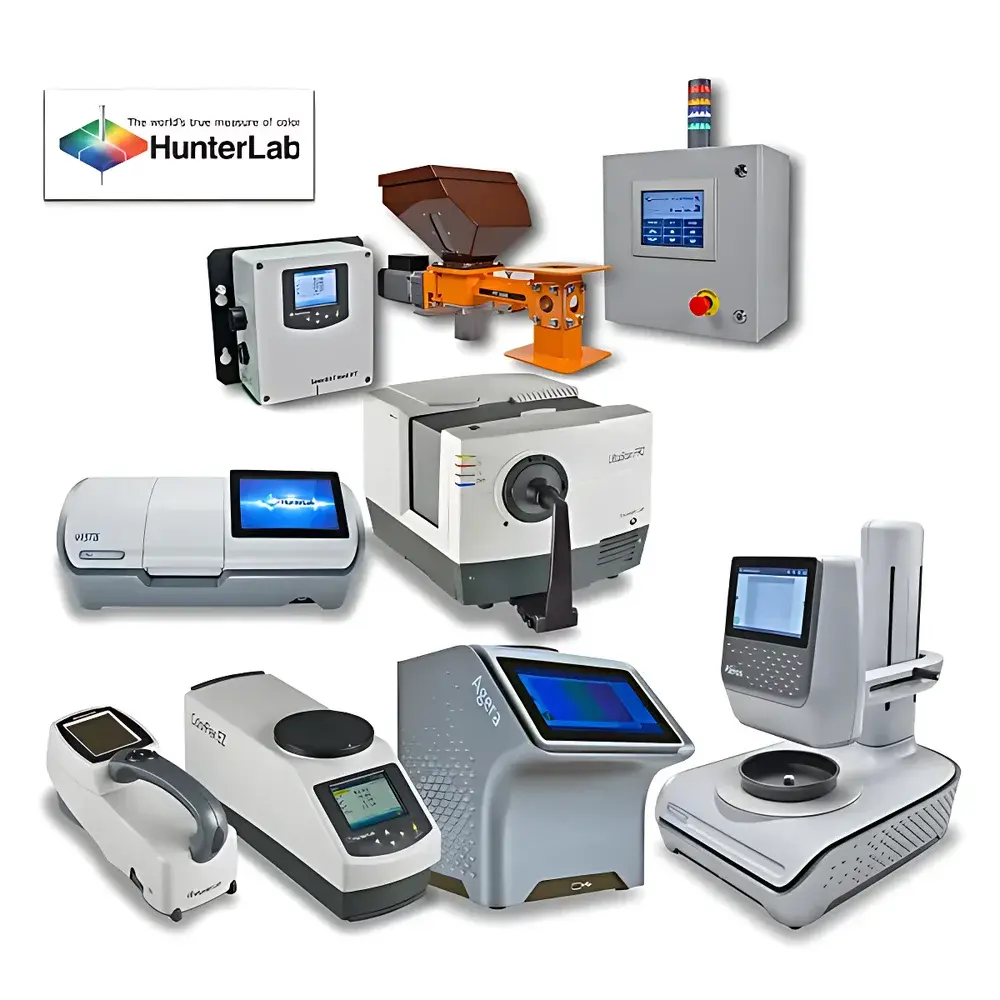
HunterLab Vista Series Benchtop Spectrophotometer
| Brand | HunterLab |
|---|---|
| Origin | USA |
| Manufacturer Type | Authorized Distributor |
| Product Category | Imported |
| Model | Vista |
| Product Type | Spectrophotometric Colorimeter |
| Instrument Type | Benchtop |
| Optical Geometry | d/8° Integrating Sphere |
| Light Source | LED |
| Spectral Range | 400–700 nm, 360–780 nm, or 350–1050 nm |
| Repeatability | ΔE*₀₀ ≤ 0.03 (mean) |
Overview
The HunterLab Vista Series is a high-precision benchtop spectrophotometer engineered for absolute color measurement consistency across global R&D, QC, and manufacturing environments. Built upon the foundational CIE L*a*b* color space pioneered by Richard S. Hunter—a physicist and perceptual psychologist—the Vista implements advanced d/8° integrating sphere optics with pulsed LED illumination to deliver stable, drift-free spectral data from 350 nm to 1050 nm. Its optical architecture conforms to CIE No. 15:2018, ISO/CIE 11664, and ASTM E308–22 standards, ensuring traceable compliance with international colorimetric practice. Unlike legacy tristimulus meters, the Vista captures full reflectance/transmittance spectra at 10 nm intervals (or finer, depending on configuration), enabling calculation of all major color spaces (CIELAB, CMC, CIEDE2000, Hunter L,a,b), whiteness (CIE, Ganz, ASTM E313), yellowness (ASTM D1925, E313), haze, transmittance, and specialized indices (e.g., APHA/Pt-Co, Gardner, Saybolt, HCCI, Citrus CN/CR/CY). Its design prioritizes long-term photometric stability, thermal independence, and minimal maintenance—critical for regulated industries operating under GLP, GMP, or FDA 21 CFR Part 11 requirements.
Key Features
- Triple selectable spectral range options: 400–700 nm (visible), 360–780 nm (extended visible + near-UV), or 350–1050 nm (full UV-VIS-NIR) — configurable per application need
- LED-based illumination system with >100,000-hour lifetime, zero warm-up time, and no spectral shift over instrument lifetime
- d/8° geometry with dual-beam compensation and large-diameter integrating sphere (≥150 mm) for robust handling of textured, glossy, and matte surfaces
- Repeatability of ΔE*₀₀ ≤ 0.03 (mean, 10 measurements on white tile) — validated per ASTM E2539 and ISO 13655
- Integrated calibration validation via onboard ceramic standards; automated verification before each measurement sequence
- Modular sample compartment accommodating solid, liquid, powder, paste, and translucent film geometries — compatible with optional accessories including liquid cells, powder cups, transmission holders, and 0°/45° gloss ports
- Embedded touchscreen interface with multilingual OS support and offline operation capability
Sample Compatibility & Compliance
The Vista supports universal sample presentation across industrial sectors without requiring hardware reconfiguration. It accommodates flat solids (plastic sheets, painted panels, textiles), irregular geometries (capsules, granules, pellets), liquids (oils, solvents, beverages), semi-solids (gels, pastes), and thin films (PET, PVC, optical coatings). All optical paths meet ISO 9001-certified manufacturing protocols, and firmware complies with FDA 21 CFR Part 11 for electronic records and signatures—including full audit trail logging, user access controls, and secure data export. The instrument satisfies ASTM D2244 (color difference), ASTM E308 (computing color coordinates), ISO 11475 (paper and board), ISO 11664 (colorimetry fundamentals), and USP (transparency/haze for pharmaceutical packaging). Optional IQ/OQ/PQ documentation packages are available for regulated labs requiring 3Q validation per ICH Q7 and EU Annex 15.
Software & Data Management
Vista instruments operate natively with EasyMatch QC software—fully compliant with 21 CFR Part 11, featuring role-based permissions, electronic signatures, and immutable audit trails. Data structures support hierarchical sample naming, batch tracking, tolerance mapping (box, ellipse, or custom polygonal limits), and statistical process control (SPC) charting (X-bar/R, Cp/Cpk). Raw spectral data exports in ASTM E2912-compliant .qtx format; CSV and XML outputs enable seamless integration into LIMS, MES, and ERP systems (SAP, Oracle). Cloud-enabled remote monitoring and firmware updates are supported via secure TLS 1.2 connections. For advanced research, optional Color iQC Developer Toolkit provides API access for custom algorithm development, machine learning model training (e.g., pigment dispersion prediction), and real-time spectral clustering.
Applications
The Vista serves as a primary color reference platform across more than 40 verticals. In plastics, it quantifies YI E313 for thermal degradation assessment in PP, PET, and engineering resins per ASTM D6290. In food & beverage, it validates SCAA roast scales for coffee, CN/CR/CY indices for citrus juices, and Lovibond® equivalents for edible oils—all traceable to NIST SRM 2035. In pharmaceuticals, it verifies capsule shell color uniformity per USP , performs tablet coating thickness correlation via NIR absorption bands, and supports extract standardization in herbal formulations. In automotive, it measures metamerism under multiple illuminants (D65, A, F2, F11) for interior trim and exterior paint matching. In textiles, it enables spectral goniometry for angle-dependent color evaluation of metallic yarns and fluorescent safety fabrics. In paper & packaging, it computes ISO brightness, GE brightness, and TAPPI T485 opacity under both specular-included and specular-excluded modes.
FAQ
What distinguishes the Vista’s d/8° geometry from 0°/45° instruments?
The d/8° configuration measures diffuse reflectance independent of surface texture and viewing angle, making it ideal for comparative analysis across diverse substrates (e.g., brushed metal vs. matte plastic). It also enables simultaneous measurement of color and appearance attributes (haze, gloss, fluorescence) using standardized sphere coatings and auxiliary ports.
Can the Vista validate compliance with FDA or EU pharmacopeial color specifications?
Yes. Its spectral engine directly computes USP transmittance/haze, EP 2.2.39 color acceptability ranges, and Chinese Pharmacopoeia ChP 0901 visual comparison metrics. Full 3Q validation kits—including certified reference materials and protocol templates—are available.
How does HunterLab ensure inter-instrument agreement across global facilities?
All Vista units ship with factory-applied spectral characterization matrices traceable to NIST. The “Data Consistency” protocol uses proprietary cross-calibration algorithms that normalize spectral response deviations below ±0.1% across instruments—even when operated in different ambient conditions or after years of service.
Is NIR capability required for routine color measurement?
Not for standard colorimetry—but essential for applications involving optical brighteners (e.g., detergents, paper), near-infrared pigments (automotive IR-reflective coatings), or functional film characterization (PV encapsulants, OLED barriers). The 350–1050 nm option enables quantitative fluorescence correction and spectral deconvolution of multi-layer systems.




