
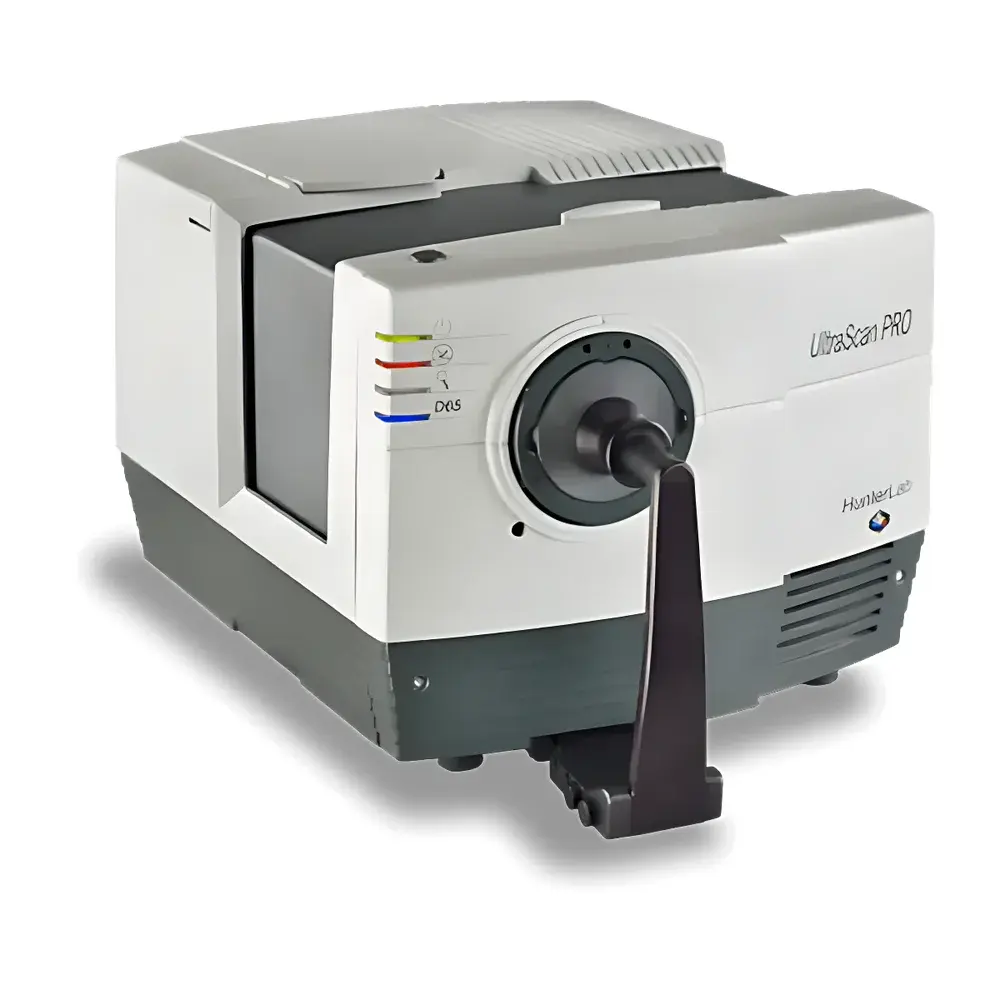
HunterLab UltraScan Pro Spectrophotometer
| Brand | HunterLab |
|---|---|
| Origin | USA |
| Manufacturer Status | Authorized Distributor |
| Product Type | Spectrophotometric Colorimeter |
| Instrument Type | Benchtop |
| Optical Geometry | d/8° Integrating Sphere |
| Light Source | Xenon Flash Lamp |
| Spectral Range | 350–1050 nm |
| Wavelength Interval | 5 nm (reporting), 2 nm (acquisition) |
| Repeatability | ≤0.03 ΔE*ab (CIE Lab, 20 measurements on certified white tile) |
| Detector | Dual 512-element silicon photodiode arrays |
| Integrating Sphere Diameter | 152 mm (6″) |
| Sphere Coating | Spectraflect™ |
| Mirror Finish Components | Duraflect™ |
| Measurement Apertures | 19 mm (1.00″), 9 mm (0.50″), 4 mm (0.25″) |
| Transmission Path Length | 80 mm |
| UV Control | Motorized, programmable UV filter with full insertion/removal capability |
| Compliance | ASTM E308, ASTM D2244, ISO 7724, ISO 11664, CIE No. 15, AATCC Evaluation Procedure 1, USP <1061>, FDA 21 CFR Part 11 (software-enabled) |
Overview
The HunterLab UltraScan Pro is a high-precision benchtop spectrophotometer engineered for absolute color measurement fidelity across the ultraviolet, visible, and near-infrared (UV-VIS-NIR) spectrum (350–1050 nm). Unlike conventional colorimeters limited to visible wavelengths, the UltraScan Pro employs dual high-resolution concave holographic grating monochromators coupled with two synchronized 512-element silicon photodiode array detectors—delivering 1024 independent spectral data points per scan. Its optical architecture follows the CIE-recommended d/8° integrating sphere geometry with automated specular component inclusion/exclusion (SCI/SCE), enabling rigorous compliance with ASTM, ISO, and CIE standards for reflectance and transmittance quantification. The instrument is calibrated against NPL-traceable opal glass standards—not magnesium oxide—and incorporates motorized UV-filter control to ensure metrologically sound evaluation of fluorescent materials, UV-absorbing coatings, and optically modified substrates such as ophthalmic lenses and solar control films.
Key Features
- Dual-monochromator optical path with 2 nm acquisition resolution and 5 nm reporting interval—optimized for high-fidelity capture of narrow-band spectral features in vivid pigments, deep blacks, and fluorescent systems.
- Spectraflect™-coated 152 mm integrating sphere with Duraflect™ baffle and port components, maintaining >97% diffuse reflectance stability over 10+ years without degradation or yellowing.
- Triple xenon flash lamp system simulating D65 illumination with enhanced UV output and spectral continuity—critical for accurate measurement of carbon black, metallized films, and fluorescent whitening agents (FWAs).
- Three user-selectable measurement apertures (19 mm, 9 mm, 4 mm) with motorized lens switching and integrated sample illumination optics for precise small-area analysis of textiles, printed electronics, and micro-patterned surfaces.
- Programmable UV filter mechanism enabling real-time calibration of UV energy output—supports ASTM E308 Annex A2 fluorescence correction and quantitative UV absorbance profiling down to 350 nm.
- Comprehensive metrological validation suite: NPL-certified opal white standard (short-term verification), long-term stability green tile, neodymium-praseodymium wavelength verification filter, and dedicated FWA calibration tile—ensuring traceability and audit readiness per GLP/GMP and ISO/IEC 17025 requirements.
Sample Compatibility & Compliance
The UltraScan Pro accommodates opaque, translucent, and transparent solids and liquids—including powders, gels, emulsions, films, and solutions—via configurable reflectance and transmission modes. Its large 80 mm transmission cell path and tri-directional open chamber facilitate measurement of irregular, thick, or multi-layered samples without repositioning. The system meets regulatory and industry-specific requirements for color measurement in regulated environments: ASTM D6290 (plastics), ASTM D313 (paper brightness), ISO 27677 (pharmaceutical film coating), AATCC TM19 (textile whiteness), and USP (ophthalmic device tint uniformity). Full 21 CFR Part 11 compliance is supported through optional software modules providing electronic signatures, audit trails, and role-based access control—validated for use in FDA-audited pharmaceutical, food, and medical device manufacturing QC laboratories.
Software & Data Management
Universal Software v8.x provides instrument control, spectral analysis, and statistical process monitoring with native support for CIE L*a*b*, L*C*h*, Yellowness Index (YI), Whiteness Index (WI), APHA/Pt-Co, Gardner, Hazen, Haze, and Transmittance % calculations. All spectral data are stored in vendor-neutral .jdx format compliant with ASTM E1447 and ISO 12647-2. The software includes embedded calibration verification workflows, automated pass/fail reporting against user-defined tolerances (ΔE*, ΔL*, Δa*, etc.), and export to LIMS via ODBC or CSV. Audit trail logging records every parameter change, calibration event, and result modification—including operator ID, timestamp, and reason for change—satisfying ALCOA+ data integrity principles.
Applications
- Quality assurance of automotive interior trims, where NIR reflectance correlates with thermal management performance.
- Quantification of UV-blocking efficacy in sunscreen formulations and protective eyewear using spectral transmittance at 350–400 nm.
- Color consistency monitoring of OLED display substrates and anti-reflective coated optics requiring sub-0.05 ΔE*ab repeatability.
- Fluorescence-corrected color matching of detergent formulations containing optical brighteners under daylight simulation.
- Batch-to-batch verification of pigment dispersion quality in architectural coatings via spectral curve shape analysis.
- Regulatory submission support for FDA 510(k) dossiers involving colored medical device housings and drug packaging.
FAQ
Does the UltraScan Pro support measurement of fluorescent samples?
Yes—the instrument includes motorized UV filter control and a dedicated NIST-traceable fluorescent calibration tile to enable accurate D65-simulated fluorescence correction per ASTM E308 Annex A2.
What is the smallest measurable sample area?
The 4 mm (0.25″) aperture enables reliable measurement of features as small as 7 mm in diameter, with integrated coaxial illumination and auto-focus optics ensuring consistent geometry.
How is long-term instrument stability verified?
HunterLab supplies a certified green reference tile optimized for drift detection over extended periods (>5 years), complementing the NPL white standard used for daily verification.
Can spectral data be exported for third-party analysis?
All raw and processed spectra are exportable in JCAMP-DX (.jdx) format, fully compatible with MATLAB, Python (SciPy), and commercial chemometrics platforms.
Is the UltraScan Pro suitable for GMP-regulated environments?
When configured with Universal Software’s Part 11 module, it delivers full electronic record/electronic signature functionality, including immutable audit trails, user authentication, and calibration lockout—validated per IQ/OQ protocols.




