
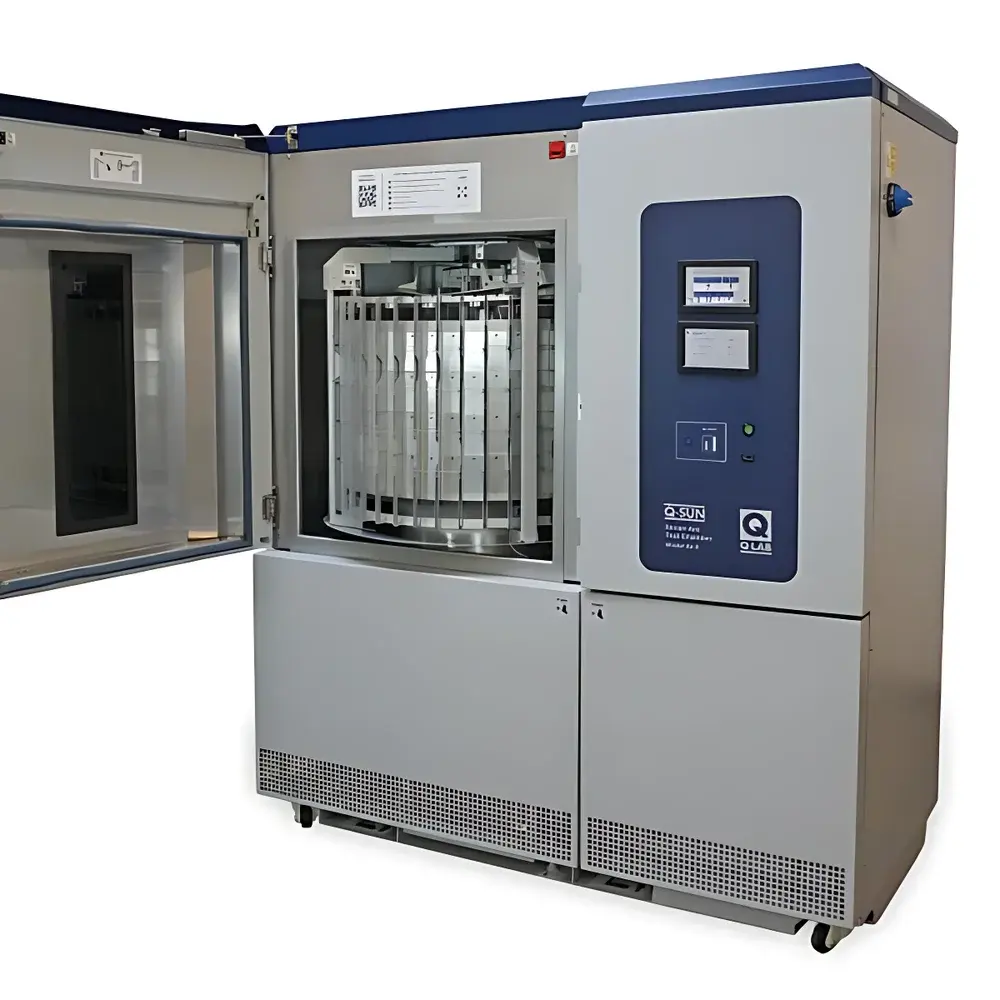
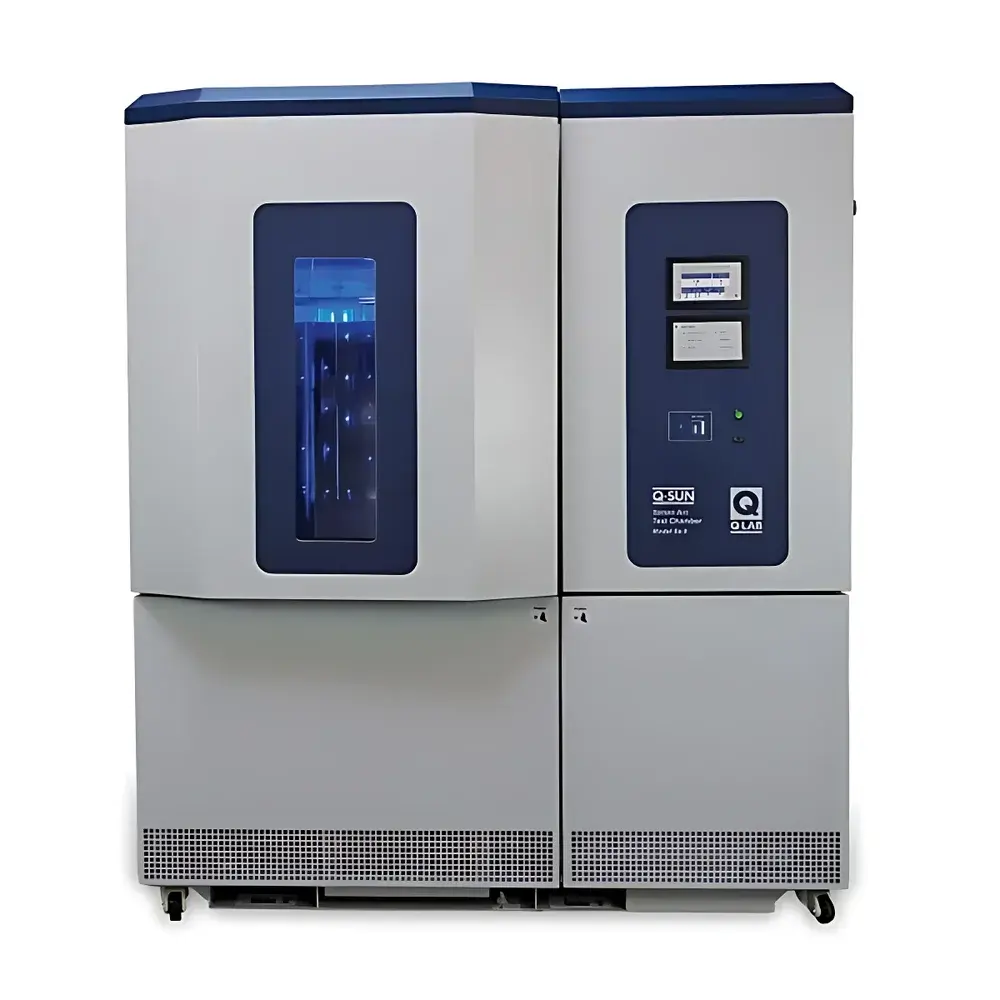
Q-Lab Q-SUN® Xe-8 Large-Capacity Rotating Rack Xenon Arc Weathering Test Chamber
| Brand | Q-Lab |
|---|---|
| Origin | USA |
| Manufacturer Type | Authorized Distributor |
| Product Origin | Imported |
| Model | Q-SUN® Xe-8 |
| Price | Upon Request |
Overview
The Q-Lab Q-SUN® Xe-8 is a high-throughput, rotating-rack xenon arc weathering test chamber engineered for accelerated simulation of full-spectrum solar radiation—including UV, visible, and near-infrared wavelengths—under precisely controlled environmental conditions. Based on the fundamental principle of xenon arc irradiation, the system replicates natural sunlight using four 4200 W air-cooled xenon lamps, delivering photometrically accurate spectral power distribution (SPD) across 290–2500 nm. Unlike water-cooled alternatives, the LIGHT/YEAR™ lamp architecture eliminates external chillers, reducing energy consumption, footprint, and long-term maintenance overhead. The chamber integrates real-time irradiance control via SOLAR EYE™ multi-band sensors (340 nm, 420 nm, and TUV: 300–400 nm), blackboard/black standard temperature monitoring, programmable relative humidity (RH), and dual-face water spray—enabling compliance with globally harmonized weathering standards including ASTM G155, ISO 4892-2, SAE J2527, AATCC TM16, and IEC 60068-2-9. Designed for unattended 24/7 operation in GLP- and GMP-aligned laboratories, the Xe-8 delivers reproducible, traceable exposure data essential for material durability qualification, regulatory submissions, and comparative aging studies.
Key Features
- Four high-output, air-cooled xenon lamps (4200 W each) with ≥8000 h service life at nominal irradiance; lamp replacement accessible from front panel only
- Rotating sample rack accommodating up to 164 specimens (51 × 102 mm) or 96 specimens (67 × 145 mm), optimized for maximum throughput without compromising exposure uniformity
- Triple-wavelength irradiance control (340 nm, 420 nm, TUV) using factory-calibrated SOLAR EYE™ sensor array; supports automatic feedback-driven lamp power adjustment
- Independent control of blackboard temperature (45–105 °C), non-insulated black standard temperature, and chamber air temperature
- Integrated RH control (10–95% RH, ±3% accuracy) requiring purified water supply; real-time display and logging of RH setpoint and actual value
- Dual-position spray system (front and back) with programmable timing during light/dark cycles; compatible with SAE-defined rear-spray protocols
- Dual full-color touchscreen interface supporting 17 languages; built-in Ethernet port for remote monitoring, data export, and firmware updates
- AUTOCAL™ assisted calibration workflow; UC80 universal calibrator compatible for field verification of irradiance and temperature sensors
- Comprehensive self-diagnostic suite with multicolor status LEDs, error logging, and scheduled service reminders
Sample Compatibility & Compliance
The Q-SUN Xe-8 accommodates rigid and flexible flat-panel specimens across two standardized mounting configurations: high-density racks (164 × 51 × 102 mm) and legacy-format racks (96 × 67 × 145 mm). Its rotating geometry ensures uniform angular exposure—critical for minimizing edge effects and improving inter-laboratory reproducibility per ISO 4892-2 Annex B. Optical filtering options include Daylight-F/Q/B/B (ASTM G155 Type A/B), Window-Q/B/SL/SF-5/IR (for indoor applications), and Extended UV-Q/B (for aggressive automotive testing). All filters are quartz-based, thermally stable, and require no routine replacement except Window-IR. The system meets traceability requirements under ISO/IEC 17025 when paired with UC80 calibrators certified by A2LA-accredited labs (US, DE, GB, CN), with measurement uncertainty traceable to NIST standards. It supports audit-ready data integrity per FDA 21 CFR Part 11 when used with Q-Lab’s optional Virtual StripChart software and encrypted USB data export.
Software & Data Management
Control firmware features embedded Ethernet connectivity, enabling secure HTTP(S)-based access for real-time parameter monitoring, alarm notification, and historical trend review. All exposure parameters—including irradiance setpoints, temperature profiles, RH curves, and spray cycle logs—are timestamped and stored internally with >30-day buffer capacity. USB export supports CSV-formatted datasets compatible with LIMS integration and statistical process control (SPC) platforms. Optional Virtual StripChart application provides configurable graphical overlays for multi-parameter correlation analysis (e.g., irradiance vs. ΔE* color shift). Firmware updates are performed via authenticated USB drive; version history and checksum validation ensure code integrity. System diagnostics generate event-triggered log files containing sensor health metrics, lamp hour counters, and thermal gradient maps—facilitating predictive maintenance planning and root-cause analysis during failure investigations.
Applications
The Q-SUN Xe-8 serves as a primary tool for accelerated weathering validation across automotive OEMs (paint, plastics, interior trim), architectural coatings (roofing membranes, façade systems), textile manufacturers (outdoor fabrics, awnings), packaging suppliers (UV-sensitive polymers), and electronics enclosures (UV-stabilized housings). Its ability to replicate window-filtered spectra makes it equally suitable for indoor lightfastness testing of printed media, museum-grade pigments, and medical device labeling. In R&D settings, the chamber supports comparative screening of UV stabilizers, HALS additives, and pigment formulations under identical irradiance and thermal stress profiles. Regulatory submissions to EPA, EU REACH, and UL rely on Xe-8-generated data due to its documented adherence to ASTM D4329, ISO 11341, and IEC 61215-2 MQT10 protocols.
FAQ
What lamp lifetime can be expected under standard operating conditions?
At nominal irradiance (e.g., 0.35 W/m² @ 340 nm), Q-Lab LIGHT/YEAR™ lamps deliver ≥8000 hours of stable output. At elevated irradiance levels (e.g., 0.65 W/m² @ 340 nm), rated life decreases to ~1000 hours.
Is filter replacement required during normal operation?
All optical filters except Window-IR maintain spectral fidelity indefinitely under standard use; Window-IR requires periodic replacement based on cumulative UV dose (typically every 12–18 months at 0.55 W/m² @ 340 nm).
How is temperature uniformity validated across the sample plane?
Blackboard sensors are positioned at top/bottom locations on both sides of the rotating rack; temperature gradients are maintained within ±2 °C across the entire exposure area per ISO 4892-2 Section 6.3.
Does the system support automated reporting for quality audits?
Yes—USB-exported CSV files include operator ID, test method reference, calibration timestamps, and digital signatures; optional Virtual StripChart enables PDF report generation with embedded pass/fail thresholds.
Can the Xe-8 operate without purified water?
No—both RH control and spray functionality require Type II purified water (ASTM D1193) to prevent mineral deposition on optics and sensors.



