
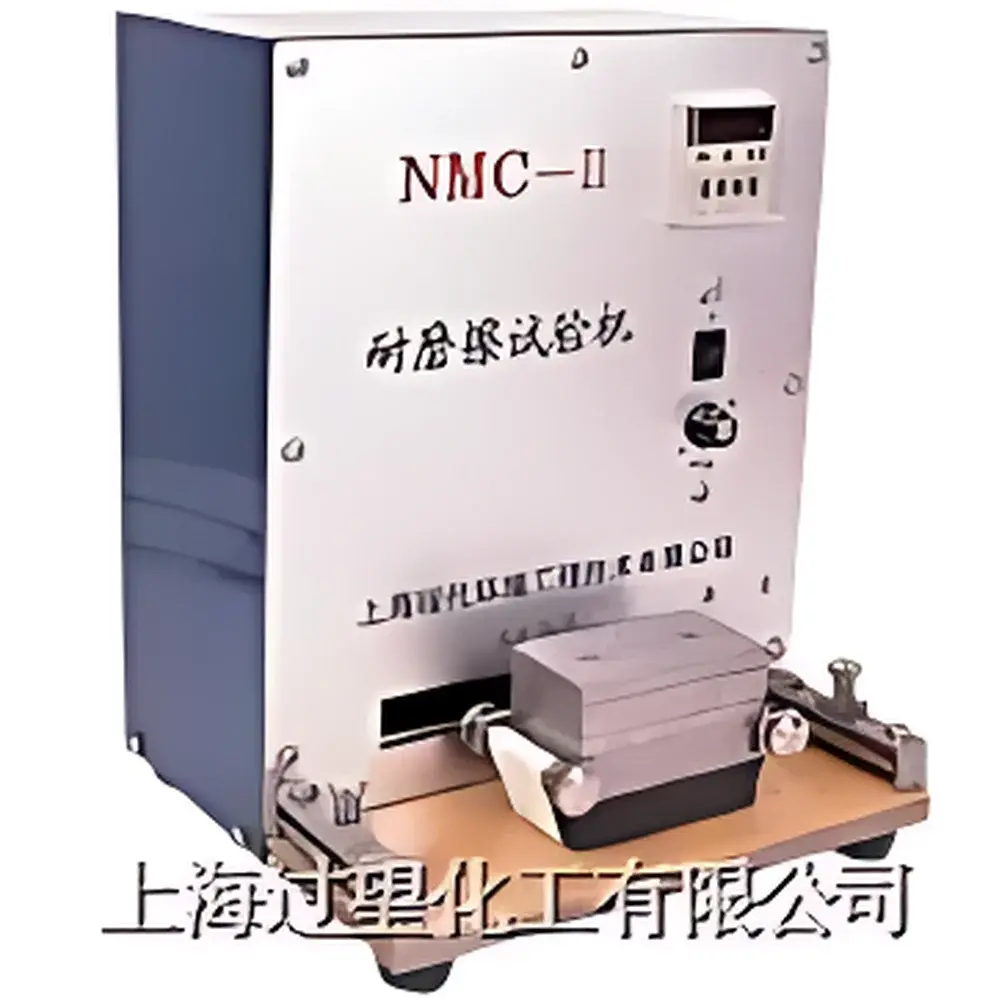
NMC-II Ink Abrasion Tester
| Origin | Shanghai, China |
|---|---|
| Manufacturer Type | Distributor |
| Origin Category | Domestic (China) |
| Model | NMC-II |
| Pricing | Available Upon Request |
| Motor | 60 W, 220 V, 50 Hz |
| Rotational Speed Range | 0–54 rpm |
| Abrading Head Load | 1000 g (standard) |
| Optional Weights | 250 g, 500 g |
| Dimensions (L×W×H) | 260 × 240 × 340 mm |
| Net Weight | 20 kg |
Overview
The NMC-II Ink Abrasion Tester is a precision-engineered tribological testing instrument designed specifically for evaluating the mechanical durability of ink layers on printed paper substrates. It operates on the principle of controlled reciprocating abrasion—applying calibrated normal force and consistent oscillatory motion to simulate real-world handling, rubbing, and surface contact encountered during packaging, storage, and end-user interaction. Unlike general-purpose wear testers, the NMC-II incorporates a fixed-axis oscillating abrading head that traverses linearly across the inked specimen at adjustable frequency and defined load conditions, enabling standardized quantification of ink rub resistance in accordance with established print quality assessment protocols. Its design prioritizes repeatability, operator safety, and compatibility with routine QC workflows in ink formulation labs, printing R&D centers, and packaging material certification facilities.
Key Features
- Adjustable rotational speed range from 0 to 54 rpm, allowing precise control over abrasion intensity and test duration per cycle.
- Dual-load configuration: standard 1000 g abrading head mass supplemented by optional calibrated weights (250 g and 500 g) to enable graded load testing per ISO 11664 or TAPPI T 476 specifications.
- Robust aluminum-alloy frame with vibration-dampened base, ensuring stable operation and minimal mechanical drift during extended test sequences.
- Manually indexed specimen holder accommodating standard A4-sized (210 × 297 mm) printed sheets, with clamping mechanism designed to prevent lateral slippage under dynamic loading.
- Integrated motor drive system rated at 60 W, 220 V, 50 Hz—engineered for continuous-duty operation with thermal overload protection and low-noise commutation.
- Compact footprint (260 × 240 × 340 mm) and lightweight construction (20 kg) facilitate benchtop deployment in regulated laboratory environments without dedicated floor anchoring.
Sample Compatibility & Compliance
The NMC-II accommodates flat, rigid, or semi-rigid substrates including coated and uncoated offset papers, cardboard laminates, flexographic label stocks, and metallized film composites—provided surface roughness remains within Ra ≤ 3.2 µm and thickness does not exceed 2.5 mm. Test specimens must be free of curl, creases, or dimensional instability that could compromise contact uniformity. While the instrument itself is not certified to ISO/IEC 17025, its operational methodology aligns with key industry reference standards including ASTM D5264 (Standard Practice for Determining Print Rub Resistance), ISO 11664:2015 (Graphic technology — Measurement of ink rub resistance), and TAPPI T 476 om-18 (Rub Resistance of Printing Inks). Data generated using the NMC-II may serve as objective evidence in GLP-compliant internal validation studies or supplier qualification dossiers.
Software & Data Management
The NMC-II operates as a manual, non-digitally controlled instrument; no embedded firmware, touchscreen interface, or proprietary software is included. All test parameters—including cycle count, applied load, rotational speed, and elapsed time—are recorded manually by the operator using standardized lab notebooks or LIMS-integrated electronic forms. This analog architecture ensures full auditability, eliminates firmware version dependencies, and supports straightforward 21 CFR Part 11 compliance when paired with validated electronic record systems. Users are advised to implement documented SOPs governing test initiation, interruption protocols, pass/fail criteria (e.g., visual grading per ISO 12219-2 or grayscale comparison charts), and raw data retention periods per organizational quality policy.
Applications
- Comparative evaluation of pigment dispersion stability and binder adhesion strength across solvent-based, UV-curable, and water-based ink formulations.
- Pre-press validation of ink-substrate affinity prior to high-speed press trials, reducing waste and press downtime.
- Quality conformance testing for contract printing services, especially for premium packaging where tactile finish and graphic integrity are critical.
- Accelerated aging correlation studies—linking rub resistance metrics to shelf-life predictions under simulated distribution conditions.
- Root-cause analysis of ink transfer (marring) observed in folding carton assembly lines or retail display handling.
FAQ
Is the NMC-II compliant with FDA or EU regulatory requirements for packaging used in food contact applications?
No—the instrument itself is not subject to FDA or EU food-contact regulation. However, test data generated using the NMC-II may support due diligence documentation required under EU Framework Regulation (EC) No 1935/2004 or FDA 21 CFR §170–189, provided testing is performed within a validated, documented quality system.
Can the NMC-II be used for testing ink on plastic films or metallic foils?
Yes, provided substrate flatness, rigidity, and surface energy permit consistent abrading head contact; users should verify coefficient of friction compatibility and conduct preliminary method suitability testing.
Does the device include calibration certification or traceable reference standards?
No—calibration of applied load is verified using NIST-traceable weights (250 g, 500 g, 1000 g); speed calibration requires external tachometric verification per ISO/IEC 17025-accredited procedures.
What maintenance intervals are recommended for long-term reliability?
Biannual inspection of motor coupling alignment, abrading head bearing lubrication, and electrical insulation resistance testing are advised; replacement of drive belt every 12 months under continuous use.
Is technical support available outside mainland China?
Yes—authorized distributors provide localized application guidance, spare parts logistics, and remote troubleshooting assistance in APAC, EMEA, and LATAM regions.



