
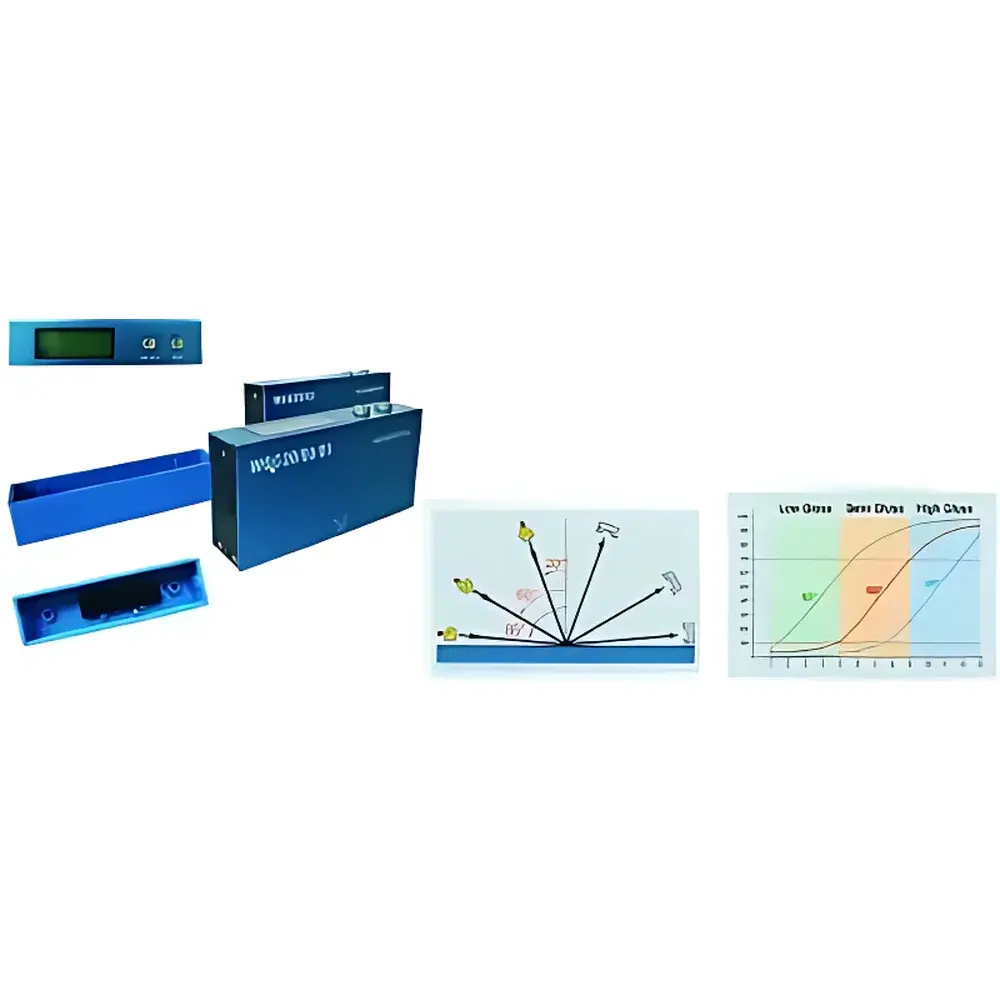
WGG-60 Digital Gloss Meter
| Origin | Shanghai, China |
|---|---|
| Manufacturer Type | Authorized Distributor |
| Origin Category | Domestic (PRC) |
| Model | WGG-60 |
| Pricing | Available Upon Request |
Overview
The WGG-60 Digital Gloss Meter is a compact, microprocessor-controlled optical instrument engineered for precise measurement of specular gloss on smooth, non-metallic and metallic planar surfaces. It operates on the principle of specular reflectance—quantifying the ratio of reflected luminous flux at the specular angle to that of a reference black glass standard (defined per ISO 2813 and ASTM D523) under controlled illumination geometry. The device employs a 60° incident/reflectance angle configuration, optimized for general-purpose gloss assessment across mid-gloss ranges (typically 10–100 GU), making it suitable for routine quality control in industrial manufacturing environments where surface finish consistency is critical to functional performance and aesthetic acceptance.
Key Features
- Integrated digital display with high-contrast LCD for real-time gloss readings in Gloss Units (GU), ensuring legibility under varied ambient lighting conditions.
- Microprocessor-based signal processing enables automatic zero calibration, temperature compensation, and stable output repeatability within ±0.5 GU under standardized test conditions.
- Compact handheld form factor (approx. 120 × 60 × 30 mm) with ergonomic design facilitates single-handed operation and field deployment without external power supply—powered by standard AAA batteries.
- Durable anodized aluminum housing provides mechanical robustness and resistance to incidental impact, solvent exposure, and environmental dust ingress (IP54-rated enclosure).
- Non-contact optical measurement eliminates surface wear or contamination risk, preserving sample integrity during repeated testing cycles.
Sample Compatibility & Compliance
The WGG-60 is validated for use on homogenous, optically flat substrates including but not limited to solvent-based and waterborne coatings, thermoplastic and thermoset polymers, coated and uncoated paperboard, anodized and mill-finish aluminum sheets, and laminated composites. It complies with core international standards governing gloss measurement methodology: ISO 2813 (Paints and varnishes — Determination of specular gloss at 20°, 60° and 85°), ASTM D523 (Standard Test Method for Specular Gloss), and GB/T 9754 (Chinese national standard equivalent). While not certified for regulated pharmaceutical or medical device QC workflows, its measurement traceability aligns with GLP-aligned laboratory practices when used with documented calibration protocols and annual verification against NIST-traceable reference standards.
Software & Data Management
The WGG-60 operates as a standalone instrument without embedded Bluetooth or USB connectivity; however, it supports manual data logging via integrated hold-and-memory function (up to 99 readings stored internally). For integration into structured QA/QC documentation systems, users may export recorded values via optional RS-232 interface modules (sold separately), enabling direct import into Excel, LIMS, or statistical process control (SPC) platforms. Firmware supports configurable averaging (2–9 readings per test point) and pass/fail threshold alerts, facilitating compliance with internal specification limits defined per customer material specifications or industry benchmarks (e.g., automotive OEM paint gloss tolerances per GMW14872 or Ford CETP).
Applications
- Coatings & Paints: Monitoring batch-to-batch consistency of automotive refinishes, architectural paints, and coil coating lines.
- Plastics & Polymers: Verifying surface finish uniformity after extrusion, injection molding, or vacuum metallization processes.
- Packaging & Paper: Assessing gloss retention of printed cartons, laminated labels, and premium-grade offset papers.
- Automotive & Aerospace Interiors: Validating gloss match between trim components (e.g., ABS dash panels vs. PU-coated door inserts).
- Quality Audits & Supplier Certification: Supporting third-party inspection reports required under IATF 16949 or ISO 9001 clause 8.6 (Release of products and services).
FAQ
What is the measurement geometry of the WGG-60?
It uses a fixed 60° angle of incidence and detection, conforming to ISO 2813 Category B for general-purpose gloss evaluation.
Does the instrument require periodic recalibration?
Yes—annual calibration against certified ceramic or black glass standards is recommended; daily zero-check using the supplied calibration tile is mandatory prior to use.
Can the WGG-60 measure curved or textured surfaces?
No—it is designed exclusively for flat, smooth surfaces; curvature or macro-texture introduces angular deviation and invalidates specular reflectance assumptions.
Is the device compliant with FDA 21 CFR Part 11?
No—this model lacks electronic audit trail, user authentication, or secure electronic signature capabilities required for regulated life science applications.
What is the typical measurement repeatability under controlled lab conditions?
±0.5 GU for homogeneous samples measured at ambient temperature (23 ± 2°C) and relative humidity ≤ 65% RH, per manufacturer’s technical validation report.





