
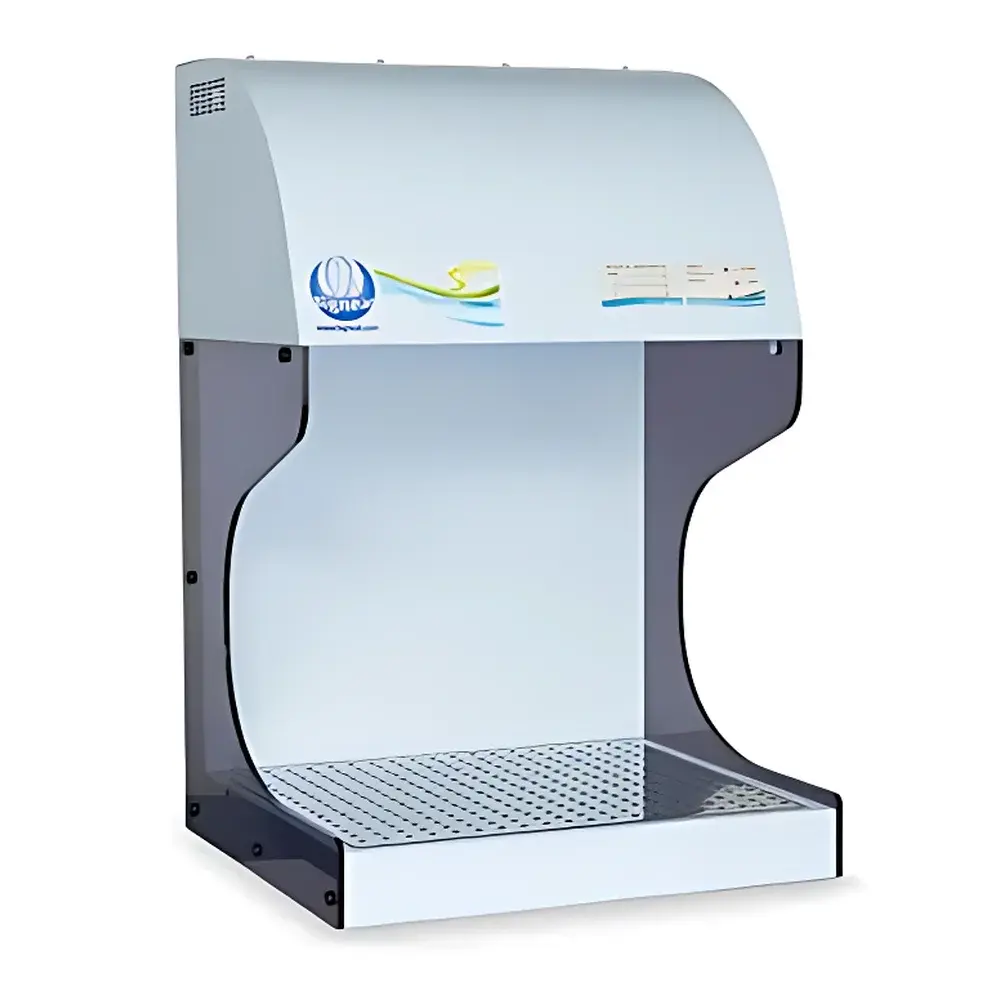
Bigneat Optiflow Unducted Benchtop Fume Hood
| Brand | Bigneat |
|---|---|
| Origin | United Kingdom |
| Manufacturer Type | Authorized Distributor |
| Product Origin | Imported |
| Model | Optiflow |
| Construction | All-Steel Laboratory Workbench |
| Configuration | Single-Sided Benchtop Unit |
| Dimensions (W×D×H) | 655 × 600 × 1000 mm (External) / 634 × 520 × 565 mm (Internal) |
| Face Velocity | 0.5 m/s (Stabilized via Centrifugal Blower) |
| Filtration System | Activated Carbon Filter (for organic vapors & fumes) + HEPA Filter (≥99.995% @ 0.3 µm) |
| Pre-filter | Removable Perforated Stainless Steel Work Surface |
| Safety Alarms | Dual Visual-Audible Low-Airflow Alert (<0.4 m/s) |
| Mobility | Optional 130 mm Casters or Adjustable Leveling Feet |
| Optional Accessory | 14 W LED Task Lighting |
Overview
The Bigneat Optiflow Unducted Benchtop Fume Hood is an engineered solution for localized containment of airborne chemical vapors, fumes, and particulates in laboratories where ducted ventilation infrastructure is unavailable, impractical, or cost-prohibitive. Unlike conventional ducted fume hoods that rely on building exhaust systems, the Optiflow operates as a self-contained, recirculating unit—drawing ambient air through a dual-stage filtration system and returning cleaned air into the laboratory environment. Its core principle is unidirectional downward airflow: air is drawn vertically through perforations in the stainless steel work surface, passes sequentially through a pre-filter, activated carbon filter, and HEPA filter, and is then recirculated or optionally exhausted externally. This design ensures continuous operator protection without compromising workspace ergonomics—offering an open, unrestricted front access profile that eliminates the physical barrier and restricted arm movement typical of traditional sash-based enclosures. The system is validated for use with low-to-moderate volatility chemicals, including alcohols, acetone, formaldehyde (at controlled concentrations), and non-toxic particulates, and complies with EN 14175-3:2018 for performance testing of unducted fume cupboards.
Key Features
- Self-contained, ductless operation—no external venting or structural modification required
- Precisely regulated face velocity of 0.5 m/s, maintained by a variable-speed centrifugal blower with real-time feedback control
- Dual-filtration architecture: high-capacity granular activated carbon bed (for adsorption of organic vapors and acidic fumes) paired with a certified HEPA H14 filter (EN 1822-1:2019, ≥99.995% efficiency at 0.3 µm)
- Removable, perforated 304 stainless steel work surface enabling rapid access to the pre-filter for cleaning and inspection—extending main filter service life and preventing premature clogging
- Integrated dual-mode safety alarm: red LED indicator + audible tone triggered automatically when airflow drops below 0.4 m/s (±0.02 m/s tolerance), meeting EN 14175-3 alarm response requirements
- Modular filter retention system with gasketed clamping mechanism ensuring zero-bypass sealing during installation, replacement, or operational vibration
- Ergonomic single-sided configuration with 634 mm internal width—optimized for standard benchtop integration and routine analytical workflows
- Two mounting options: industrial-grade 130 mm swivel casters with brakes (for repositionable deployment) or adjustable leveling feet (for permanent, vibration-dampened installation)
Sample Compatibility & Compliance
The Optiflow is intended for applications involving low-hazard, low-volatility substances where full ducted containment is not mandated by institutional EHS policy or regulatory jurisdiction. It is routinely deployed in teaching labs, QC/QA environments handling solvents in weighing, dilution, or sample preparation steps, and R&D settings performing non-carcinogenic organic synthesis. While not rated for perchloric acid, hydrogen sulfide, or radioactive aerosols, its filtration system is validated per ISO 10121-1:2013 for carbon filter service life estimation and conforms to IEST-RP-CC001.4 for HEPA integrity. Documentation includes CE marking under the Machinery Directive 2006/42/EC and compliance with UKCA requirements. Full traceability of filter batch certifications, airflow calibration records, and alarm verification logs supports GLP-compliant audit readiness.
Software & Data Management
The Optiflow operates via a dedicated microcontroller-based interface with capacitive touch buttons—requiring no PC connectivity or proprietary software. All operational parameters (blower speed, cumulative runtime, alarm events) are stored locally in non-volatile memory with timestamping. A built-in diagnostics mode enables manual airflow verification using calibrated anemometry. For laboratories operating under FDA 21 CFR Part 11 or ISO/IEC 17025 frameworks, optional data export via USB-C (firmware v2.1+) provides CSV-formatted logs of alarm triggers, filter usage hours, and daily airflow stability checks—enabling integration into LIMS or electronic lab notebooks with user-defined audit trails.
Applications
- Weighing and dispensing of powdered reagents and standards in analytical chemistry labs
- Solvent-based sample preparation for HPLC, GC, or ICP-MS analysis
- Handling of pH-adjusted buffers, enzyme solutions, and non-pathogenic cell culture media
- Electronics component cleaning with isopropyl alcohol or ethanol
- Small-scale coating, resin mixing, and adhesive application in materials science prototyping
- Education-focused demonstrations of volatile organic compound (VOC) handling under instructor supervision
FAQ
Does the Optiflow require external ductwork or building exhaust connections?
No. It is a fully self-contained, unducted system designed for plug-and-play operation on standard laboratory benches.
How often must the filters be replaced?
Carbon filter replacement frequency depends on chemical load and exposure duration; typical service life ranges from 6–12 months under moderate use. HEPA filters generally last 2–3 years unless exposed to excessive particulate loading. Filter status is tracked via runtime counters and visual saturation indicators.
Can the Optiflow be used for handling nanomaterials?
Yes—when equipped with the HEPA H14 filter, it provides effective containment of nanoparticles ≥30 nm under controlled, low-energy manipulation conditions (e.g., sonication-free dispersion, static weighing). For high-aerosol-generation processes, supplementary local exhaust may be advised.
Is the stainless steel work surface resistant to common laboratory acids and bases?
The 304 stainless steel surface offers robust resistance to diluted acetic acid, sodium hydroxide up to 10%, and most organic solvents. Prolonged exposure to concentrated mineral acids (e.g., HCl, HNO₃) or halogenated solvents is not recommended.
Does the unit support remote monitoring or IoT integration?
Not natively. However, firmware-upgraded units (v2.1+) enable periodic log export via USB-C for ingestion into centralized facility monitoring platforms. No Wi-Fi or Ethernet interfaces are included.



