
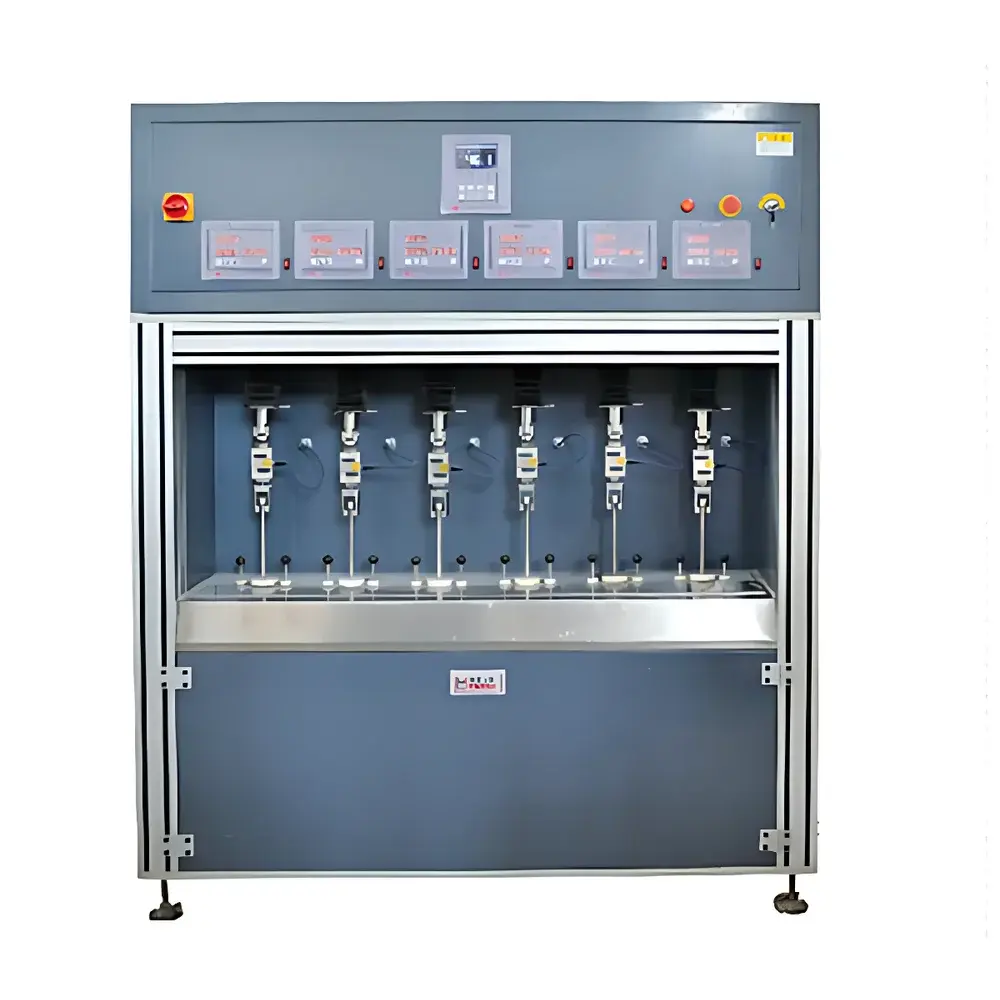
Hengyi HY(FNCT)0220QWE Full-Notch Creep Testing Machine
| Brand | Hengyi |
|---|---|
| Origin | Shanghai, China |
| Manufacturer Type | Direct Manufacturer |
| Country of Origin | China |
| Model | HY(FNCT)0220QWE |
| Price | Upon Request |
| Test Stations | 6 or 12 independent stations |
| Load Range | 20 N – 5000 N |
| Force Accuracy | ±0.5% FS |
| Creep Displacement Range | 0–200 mm |
| Temperature Control Accuracy | ±0.5 °C |
| Power Supply | 380 V AC |
| Compliance Standards | GB/T 32682-2016, GB/T 15820, GB/T 11546, ISO 16770, ISO 3501 |
Overview
The Hengyi HY(FNCT)0220QWE Full-Notch Creep Testing Machine is an engineered solution for standardized evaluation of environmental stress cracking (ESC) resistance in polyethylene (PE) and other thermoplastic polymers under sustained static loading. It operates on the principle of full-notch creep testing (FNCT), a method defined in ISO 16770 and GB/T 32682-2016, where pre-notched specimens are subjected to constant tensile force in a controlled thermal environment—typically a heated water bath—to quantify time-to-failure under combined mechanical and chemical stress. This test provides critical data for material qualification, quality assurance in pipe and film manufacturing, and regulatory compliance in infrastructure-grade PE applications such as gas distribution and potable water systems.
Key Features
- Six or twelve fully independent test stations, each equipped with precision electromechanical loading actuators enabling simultaneous yet isolated experiments without cross-interference;
- Modular elastic support architecture ensures mechanical decoupling between stations, eliminating load redistribution and preserving measurement integrity across multi-sample runs;
- Integrated real-time diagnostics and hardware-level safety protocols—including over-force cutoff, thermal runaway detection, and displacement limit enforcement—support unattended operation over extended durations (up to 10,000 hours);
- High-stability temperature-controlled water bath system with ±0.5 °C uniformity across all stations, compatible with ASTM D1693 and ISO 16770 immersion requirements;
- Dual-language (English/Chinese) PC-based control software compliant with GLP data governance principles, featuring audit-trail-enabled user authentication, timestamped raw data logging, and automated derivation of key metrics including time-to-failure (TTF), creep strain rate, and stress rupture curves.
Sample Compatibility & Compliance
The HY(FNCT)0220QWE accommodates standard FNCT specimens per ISO 16770 (10 mm × 10 mm × 4 mm) and GB/T 32682-2016, including notched PE pipe wall sections and extruded sheet materials. It supports testing in aqueous surfactant solutions (e.g., Igepal CO-630), glycol-water mixtures, or distilled water at temperatures ranging from 40 °C to 80 °C. The system meets essential regulatory alignment requirements for polymer certification: it satisfies mechanical accuracy criteria per ISO 7500-1 (Class 0.5), thermal stability requirements of ISO 291 (conditioning environment), and data traceability expectations under FDA 21 CFR Part 11 when configured with electronic signature and role-based access controls. Validation documentation—including IQ/OQ protocols and uncertainty budgets for force and displacement transducers—is available upon request for GMP-aligned laboratories.
Software & Data Management
The embedded Windows-based control suite enables synchronized acquisition of force, displacement, and bath temperature at configurable sampling intervals (1 Hz to 10 Hz). All raw data are stored in vendor-neutral CSV and HDF5 formats, supporting third-party statistical analysis (e.g., Weibull modeling of failure distributions). Software modules include automatic curve fitting for logarithmic time-to-failure vs. applied stress, batch reporting with customizable templates (PDF/Excel), and export-ready compliance summaries aligned with ISO/IEC 17025 reporting clauses. Audit logs record operator actions, parameter changes, and calibration events with immutable timestamps—ensuring readiness for external audits under ISO 9001 or EN 10204 3.1 certification frameworks.
Applications
- Environmental stress cracking resistance (ESCR) qualification of HDPE resins used in pressure pipe systems;
- Comparative ranking of antioxidant formulations in PE compounds;
- Long-term performance prediction of geosynthetic liners exposed to landfill leachate;
- Validation of fusion joint integrity in butt-welded PE pipelines via accelerated FNCT on extracted coupons;
- Regulatory submission support for ASTM F2620-compliant pipe material certifications in North America and CE-marked products under EN 1555.
FAQ
What standards does the HY(FNCT)0220QWE explicitly support?
It is validated for GB/T 32682-2016, GB/T 15820, GB/T 11546, ISO 16770, and ISO 3501, with optional configuration for ASTM D1693 Annex A3.
Can the system operate unattended for multi-week tests?
Yes—its redundant thermal monitoring, force feedback loop stabilization, and automatic shutdown on anomaly detection enable continuous operation up to 10,000 hours with minimal intervention.
Is third-party calibration certification available?
Certified calibration reports traceable to NIM (China) or UKAS-accredited labs can be provided; force transducers are calibrated per ISO 376 Class 0.5, displacement sensors per ISO 9513 Class 1.
Does the software support 21 CFR Part 11 compliance?
When deployed with Windows Active Directory integration, digital signature modules, and electronic audit trail archiving, the system meets core technical requirements for Part 11 compliance in regulated environments.
What specimen geometries are supported beyond standard FNCT bars?
Custom fixtures accommodate pipe ring segments (per ISO 13479), compression-molded plaques, and ASTM D638 Type I dumbbells with notch modification kits—subject to mechanical clearance verification.



