
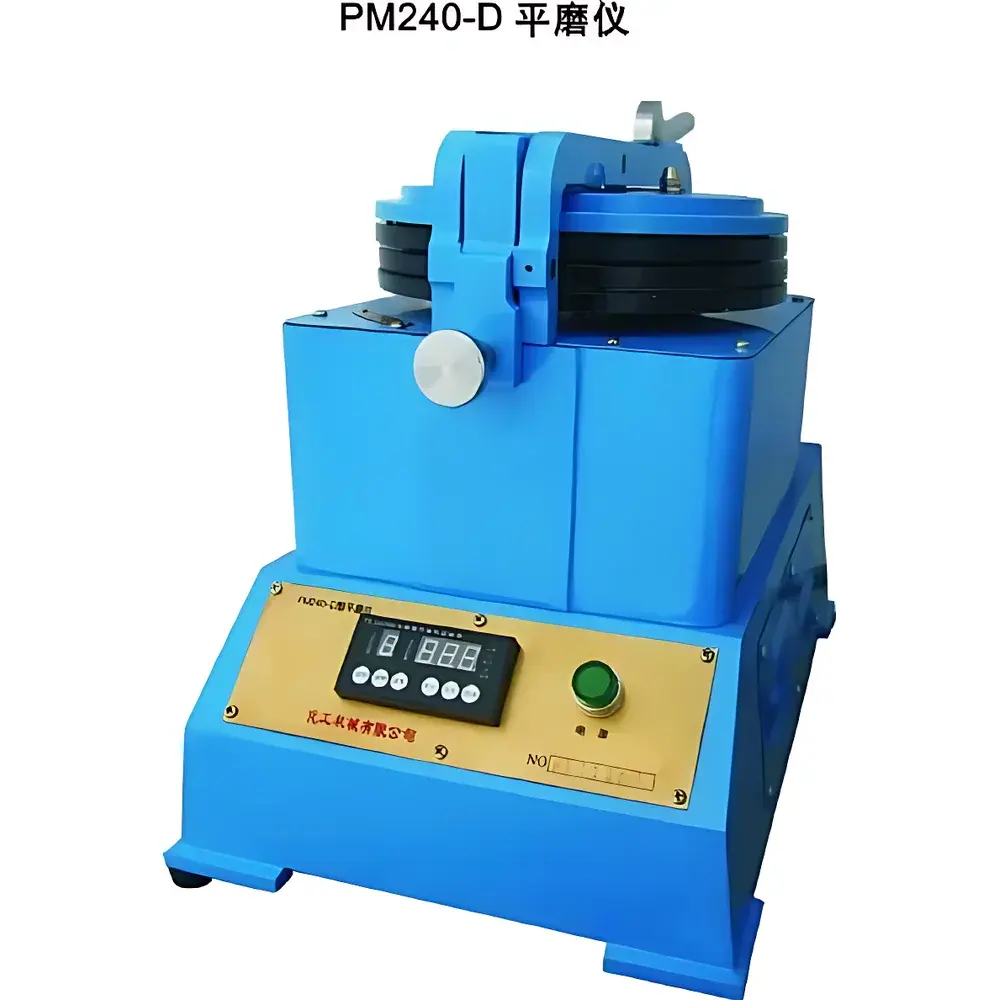
PM-240 Planetary Abrasion Tester
| Origin | Shanghai, China |
|---|---|
| Manufacturer Type | Authorized Distributor |
| Origin Category | Domestic (China-made) |
| Model | PM-240 |
| Dimensions (L×W×H) | 580 × 368 × 472 mm |
| Net Weight | 93 kg |
| Grinding Plate Diameter | 240 mm |
| Load Options | 27 kg, 47 kg, 69 kg, 102 kg |
| Calibration Weights | 0.9 kg, 1.75 kg, 1.75 kg, 2.92 kg |
| Power Supply | Single-phase, 220 V ±5%, 50 Hz |
| Motor Power | 0.55 kW |
| Motor Speed | 1440 rpm |
| Grinding Plate Speed | 855 rpm |
| Cycle Counter Display Range | 0–9 |
| Preset Cycles Range | 000–999 |
| Actual Cycles Display Range | 000–999 |
| Total Power Consumption | 0.555 kW |
Overview
The PM-240 Planetary Abrasion Tester is a precision-engineered instrument designed for standardized abrasion resistance evaluation of pigments, coatings, inks, and related film-forming materials. It operates on the principle of controlled planetary motion—where a rotating glass grinding plate subjects a coated or pigment-dispersed substrate to reproducible mechanical shear under defined normal load and rotational speed. This method simulates real-world wear conditions encountered during industrial processing, storage, and application. The tester complies with core physical testing methodologies referenced in ASTM D968 (falling abrasive), ISO 7784-2 (rotating abrasive), and GB/T 23988–2009 (Chinese standard for coating abrasion resistance), serving as a critical auxiliary device in QC/QA laboratories supporting R&D, formulation validation, and batch release protocols.
Key Features
- Planetary motion architecture with precisely regulated 855 rpm grinding plate rotation, ensuring uniform surface contact and minimal edge-effect deviation.
- Four selectable static loads (27 kg, 47 kg, 69 kg, 102 kg) achieved via calibrated counterweights—enabling graded stress profiling across material hardness classes.
- Modular glass grinding disc (240 mm diameter) with quick-release mounting mechanism, facilitating rapid cleaning, calibration verification, and substrate changeover.
- Embedded microcontroller system with LED digital display for real-time cycle monitoring, preset count entry (000–999), and automatic termination upon completion.
- Compact footprint (580 × 368 × 472 mm) and rigid cast-iron base structure (93 kg net weight) minimize operational vibration and enhance measurement repeatability.
- Compliant power interface: 220 V ±5%, 50 Hz single-phase supply; motor rated at 0.55 kW with thermal overload protection and stable 1440 rpm no-load speed.
Sample Compatibility & Compliance
The PM-240 accommodates flat, rigid substrates up to 240 mm in diameter—including metal panels, glass slides, ceramic tiles, and polymer films—coated with liquid or paste formulations. It supports both dry-film abrasion assessment (e.g., cured paint layers) and wet-film dispersion stability testing (e.g., pigment grind consistency). All mechanical parameters adhere to traceable metrological practices. While not certified to ISO/IEC 17025 out-of-box, the instrument is fully compatible with GLP-compliant laboratory workflows when integrated into documented SOPs—including audit-ready cycle logging, operator ID tagging (via external LIMS linkage), and periodic verification using NIST-traceable reference weights and tachometer calibration.
Software & Data Management
The PM-240 operates via embedded firmware without proprietary software dependency. Cycle data (preset value, elapsed count, final count) are retained in non-volatile memory and displayed on a high-contrast 7-segment LED panel. For integration into modern QA systems, the unit provides TTL-level pulse output (optional accessory) synchronized with each full revolution—enabling connection to PLCs, data loggers, or LIMS platforms for automated record generation. When deployed in FDA-regulated environments, users may configure external electronic notebooks to capture timestamps, operator IDs, and environmental conditions (e.g., lab temperature/humidity) alongside abrasion cycle reports—supporting 21 CFR Part 11 compliance through third-party validated data acquisition modules.
Applications
- Quantitative comparison of pigment dispersion quality in solvent-based and waterborne paints.
- Evaluation of scratch resistance and film integrity in automotive clearcoats and architectural finishes.
- Grind gauge correlation studies for ink manufacturing process control.
- Accelerated wear screening of functional coatings (e.g., anti-graffiti, antimicrobial, or UV-stabilized layers).
- Raw material qualification—verifying binder-pigment interaction stability under mechanical stress.
- Internal benchmarking against industry reference standards (e.g., ISO 1518–1 for paint fineness).
FAQ
What standards does the PM-240 directly support?
It aligns with methodology requirements in ASTM D968, ISO 7784-2, and GB/T 23988–2009. Full conformance requires user-defined SOPs, calibrated weights, and environmental controls.
Can the grinding plate speed be adjusted beyond 855 rpm?
No—the drive train is fixed-ratio geared for 855 rpm under nominal load to ensure torque consistency and test reproducibility per standard protocols.
Is the glass grinding disc supplied with certification of flatness or surface roughness?
Standard discs meet optical-grade float glass specifications (Ra < 0.1 µm); optional metrology-certified discs with surface profile report are available upon request.
How is maintenance performed on the motor and gear assembly?
The sealed induction motor requires no routine lubrication; annual inspection of belt tension and bearing play is recommended using manufacturer-provided service guidelines.
Does the unit include data export capability?
Native USB or Ethernet ports are not integrated; however, the TTL pulse output enables seamless integration with third-party DAQ systems for CSV or database logging.



