
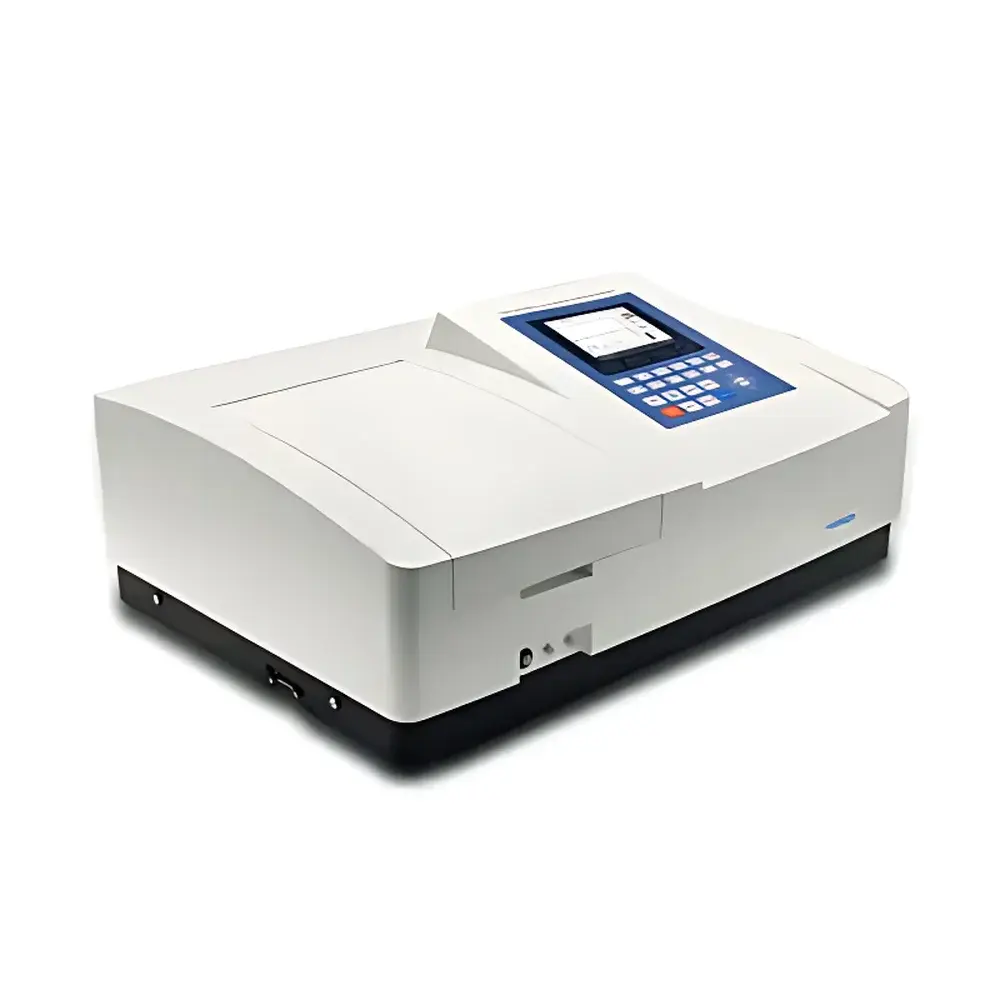
Mapada UV-3200 Scanning Ultraviolet-Visible Spectrophotometer
| Brand | Mapada |
|---|---|
| Origin | Shanghai, China |
| Manufacturer Type | Original Equipment Manufacturer (OEM) |
| Instrument Architecture | Pseudo-Double-Beam |
| Detector Type | Silicon Photodiode |
| Wavelength Range | 190–1100 nm |
| Wavelength Accuracy | ±0.3 nm |
| Spectral Bandwidth | 1.8 nm |
| Wavelength Scanning Speed | Up to 3800 nm/min (High/Medium/Low Selectable) |
| Display | 320×240 LCD with Graphical Interface |
| Photometric Range | 0–200% T, –4.0 to +4.0 A |
| Light Sources | Imported Long-Life Deuterium Lamp & Tungsten-Halogen Lamp |
| Sample Compartment | Accommodates Cuvettes from 5 mm to 100 mm Pathlength |
| Data Interface | USB Port |
| Print Interface | Parallel Port |
| Power Supply | AC 220 V / 50 Hz or AC 110 V / 60 Hz |
| Dimensions | 590 × 420 × 260 mm |
| Net Weight | 20 kg |
Overview
The Mapada UV-3200 is a high-performance scanning ultraviolet-visible (UV-Vis) spectrophotometer engineered for routine and research-grade quantitative and qualitative analysis in pharmaceutical, environmental, biochemical, and materials laboratories. Based on the principle of absorption spectroscopy, the instrument measures the attenuation of monochromatic light as it passes through a sample solution—enabling determination of analyte concentration via the Beer–Lambert law, identification of chromophores through spectral fingerprinting, and kinetic monitoring of reaction progress. Its pseudo-double-beam optical architecture compensates for source intensity drift and detector sensitivity variation in real time, significantly enhancing photometric stability and measurement reproducibility over extended acquisition periods. The system integrates a 1200 lines/mm holographic grating, precision stepper-motor-driven wavelength drive, and imported deuterium and tungsten-halogen lamps—ensuring consistent spectral output across the full 190–1100 nm range. Designed for compliance-ready operation, the UV-3200 supports GLP (Good Laboratory Practice) workflows through built-in self-diagnostic routines and traceable calibration verification.
Key Features
- Pseudo-double-beam optical design with real-time reference beam correction for improved baseline stability and reduced photometric noise
- High-resolution 1200 lines/mm holographic grating paired with 1.8 nm spectral bandwidth for enhanced peak resolution and accurate spectral shape reproduction
- Imported long-life deuterium lamp with ozone-reduced emission profile and tungsten-halogen lamp optimized for visible/NIR performance
- 320×240 graphical LCD display supporting direct visualization of absorbance/transmittance spectra, kinetic curves, and calibration plots without external software
- Plug-and-play lamp module design—no optical realignment required after replacement of deuterium or tungsten lamps
- Automated wavelength scanning at three selectable speeds (up to 3800 nm/min), enabling rapid spectral acquisition for high-throughput screening
- Integrated lamp usage timer for predictive maintenance and regulatory documentation of source lifetime
- Large sample compartment accommodating standard cuvettes from 5 mm to 100 mm pathlength—including microvolume and flow-cell configurations
- Onboard data storage for spectra, calibration curves, and kinetic datasets; export via USB to PC or direct printing via parallel port
Sample Compatibility & Compliance
The UV-3200 accommodates liquid, colloidal, and dissolved solid samples in quartz, fused silica, or high-quality optical glass cuvettes. Its wide 190–1100 nm spectral coverage supports applications ranging from nucleic acid quantification (260 nm) and protein assay (280 nm) to colorimetric metal ion detection (e.g., Fe²⁺/Fe³⁺ at 510 nm) and semiconductor bandgap analysis (>800 nm). The instrument meets core requirements of ISO 9001 quality management systems and aligns with ASTM E275 and ISO 6059 for UV-Vis spectrophotometer performance verification. Built-in GLP self-validation allows users to execute wavelength accuracy (±0.3 nm) and photometric linearity checks per internal reference standards—generating timestamped reports suitable for audit trails. While not inherently 21 CFR Part 11 compliant, the system supports secure data handling when used with validated Mapada SpectraPro software and controlled network environments.
Software & Data Management
The UV-3200 operates natively via its embedded firmware interface but achieves full analytical capability when connected to the optional Mapada SpectraPro scanning software (Windows-based). SpectraPro provides advanced functions including multi-wavelength kinetics, derivative spectroscopy, spectral subtraction, peak integration, and customizable report generation with metadata embedding (operator ID, date/time, instrument serial number). All spectral acquisitions are stored with full parameter metadata—including slit width, scan speed, response time, and baseline correction mode. Data files follow standardized .spc or .csv formats compatible with third-party analysis platforms such as OriginLab, MATLAB, or Python-based spectral processing pipelines. USB connectivity enables seamless transfer of raw spectra, method templates, and calibration databases between instruments and central lab servers.
Applications
- Quantitative analysis of pharmaceutical actives and excipients per USP and EP 2.2.25 guidelines
- DNA/RNA purity assessment (A260/A280, A260/A230 ratios) in molecular biology workflows
- Enzyme kinetics (e.g., NADH oxidation at 340 nm) and ligand-binding studies
- Water quality testing: nitrate (220 nm), phosphate (880 nm), and COD (via dichromate reduction)
- Thin-film thickness estimation and optical density profiling in material science labs
- Educational use in undergraduate chemistry and physics laboratories for Beer’s law validation and spectral interpretation
FAQ
What is the optical architecture of the UV-3200, and how does it differ from true double-beam systems?
The UV-3200 employs a pseudo-double-beam design: a single light beam is split temporally (not spatially) using a rotating sector mirror, alternating illumination between sample and reference positions at high frequency. This architecture delivers comparable baseline stability to dual-optical-path systems while minimizing alignment complexity and cost.
Can the UV-3200 perform quantitative analysis without external software?
Yes—the instrument supports direct concentration calculation using preloaded standard curves (up to 20 points), single-point calibration, and fixed-factor methods directly on the LCD interface. Full curve-fitting (linear, quadratic, cubic) requires SpectraPro software.
Is the deuterium lamp ozone-free?
The lamp features an ozone-suppressed envelope design that reduces ambient ozone generation by >90% compared to conventional UV sources—improving laboratory air quality without requiring external ventilation.
How is wavelength accuracy verified during routine operation?
The built-in GLP self-test uses certified holmium oxide and didymium oxide filters to validate wavelength accuracy at multiple reference peaks (e.g., 241.1 nm, 279.4 nm, 360.9 nm, 536.2 nm). Results are logged with operator ID and timestamp.
What cuvette pathlengths are supported, and is there an auto-detection feature?
The sample chamber accepts 5 mm, 10 mm, 20 mm, 50 mm, and 100 mm rectangular cuvettes. Pathlength must be manually entered into the method setup—no optical pathlength sensing is implemented.






