
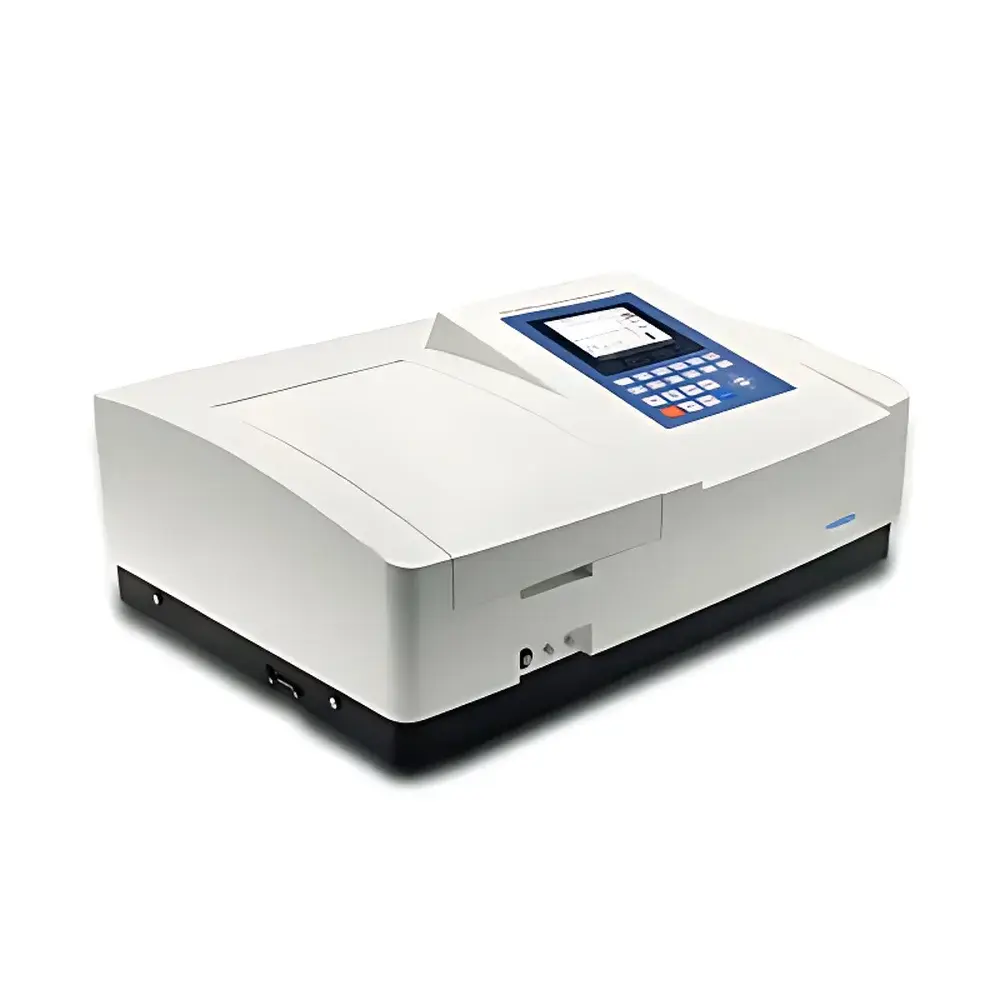
Mapada UV-6100 Scanning Double-Beam Ultraviolet-Visible Spectrophotometer
| Brand | Mapada |
|---|---|
| Origin | Shanghai, China |
| Manufacturer Type | Original Equipment Manufacturer (OEM) |
| Instrument Architecture | Double-Beam |
| Detector | Silicon Photodiode |
| Wavelength Range | 190–1100 nm |
| Wavelength Accuracy | ±0.3 nm |
| Spectral Bandwidth | 1.8 nm |
| Wavelength Setting | Motorized Auto-Scanning |
| Display | 320 × 240 LCD |
| Data Interface | USB Port |
| Power Supply | AC 220 V/50 Hz or AC 110 V/60 Hz |
| Dimensions (L×W×H) | 590 × 420 × 260 mm |
| Net Weight | 26 kg |
Overview
The Mapada UV-6100 is a scanning double-beam ultraviolet-visible (UV-Vis) spectrophotometer engineered for precision absorbance, transmittance, concentration, and kinetic measurements across the full spectral range of 190–1100 nm. Its optical architecture employs a high-efficiency double-beam design with a 1200 lines/mm holographic grating, ensuring stable baseline performance and minimized photometric drift during extended acquisitions. The instrument utilizes a dual-lamp source system—comprising a long-life deuterium lamp for the UV region (190–350 nm) and a tungsten-halogen lamp for the visible–NIR region (350–1100 nm)—with automatic lamp switching synchronized to wavelength scanning. This configuration supports high-fidelity spectral acquisition in compliance with international method standards including ASTM E275, ISO 6425, and USP . The UV-6100 is designed for routine QC/QA laboratories, academic research facilities, and regulatory-compliant environments requiring traceable photometric performance and operational repeatability.
Key Features
- Double-beam optical path with real-time reference beam compensation, delivering high photometric stability (<0.001 A/h drift at 500 nm) and enhanced signal-to-noise ratio
- High-resolution 1200 lines/mm holographic grating with optimized blaze angle for uniform spectral response across UV, visible, and near-infrared regions
- Motorized auto-scanning mechanism supporting three selectable scan speeds (high: up to 3800 nm/min; medium: 1200 nm/min; low: 300 nm/min), enabling optimization for resolution vs. acquisition time trade-offs
- Integrated GLP self-validation protocol compliant with laboratory quality management systems—automatically verifies wavelength accuracy (via holmium oxide or didymium filters) and photometric accuracy (using neutral density filters) with timestamped report generation
- Plug-and-play lamp module design: pre-aligned deuterium and tungsten lamps with socket-based installation eliminate post-replacement optical alignment procedures
- Ozone-reduced deuterium lamp housing with active ventilation, minimizing operator exposure per OSHA and IARC occupational safety guidelines
- Large sample compartment accommodating cuvettes from 5 mm to 100 mm pathlength, compatible with standard quartz, glass, and plastic cells
- Real-time lamp usage monitoring with cumulative hour logging for both deuterium and tungsten sources—supports predictive maintenance scheduling per ISO/IEC 17025 Clause 6.4.10
Sample Compatibility & Compliance
The UV-6100 accommodates liquid, suspension, and transparent solid samples using standard 10 mm, 20 mm, 50 mm, and 100 mm optical path cuvettes. It supports measurement modes including single-point absorbance, fixed-wavelength kinetics, multi-wavelength quantitation, and full-spectrum scanning. All photometric calibrations adhere to NIST-traceable reference standards. The instrument meets essential regulatory requirements for analytical instrumentation under ISO/IEC 17025, GLP (OECD Principles), and GMP Annex 11 (data integrity). Its firmware implements audit-trail functionality for critical parameters—including wavelength calibration events, lamp replacement logs, and user-initiated validation reports—ensuring compliance with FDA 21 CFR Part 11 when used with validated Mapada SpectraPro software.
Software & Data Management
The UV-6100 operates seamlessly with Mapada SpectraPro v3.x—a Windows-based PC application supporting instrument control, spectral acquisition, quantitative analysis (including multi-component regression and DNA/protein A280/A260 calculations), and method storage. Data export formats include CSV, TXT, and XML for integration into LIMS or statistical platforms such as JMP or MATLAB. USB connectivity enables direct firmware updates and secure data transfer without network dependency. Internal memory retains ≥1000 spectra and ≥500 quantitative methods with metadata tagging (operator ID, timestamp, sample ID, instrument serial number). All stored data are write-protected until explicitly exported, satisfying ALCOA+ principles for raw data integrity.
Applications
- Pharmaceutical assay development and release testing per USP , EP 2.2.25, and JP 2.03
- Environmental water quality analysis (e.g., nitrate, phosphate, COD, TOC derivatization)
- Food & beverage QA: color index determination (e.g., AOAC 971.21), antioxidant capacity (DPPH assay), and preservative quantification
- Materials science: thin-film transmittance/absorbance profiling, nanoparticle plasmon resonance characterization
- Academic teaching labs: Beer–Lambert law verification, enzyme kinetics (e.g., LDH, ALP), and equilibrium constant determination
- Biotechnology: nucleic acid and protein concentration/purity assessment (A260/A280, A260/A230 ratios)
FAQ
What wavelength calibration standards are recommended for routine verification?
Holmium oxide solution (NIST SRM 2034) for 241.1, 279.4, 287.5, 333.7, 360.9, 418.5, 460.0, 484.5, 536.2, and 637.5 nm peaks; or didymium filter for 528.7, 573.0, 586.1, 640.8, and 740.8 nm.
Does the UV-6100 support method transfer between instruments?
Yes—SpectraPro software allows full method export/import (including wavelength ranges, slit widths, scan speeds, and calibration curves) in encrypted .spm format, ensuring consistent analytical conditions across multiple UV-6100 units.
Is the instrument compliant with 21 CFR Part 11 when connected to a networked PC?
Compliance requires implementation of validated SpectraPro software with enabled electronic signature, audit trail, and role-based access control—configurations documented in the vendor’s Part 11 Validation Package (available upon request).
Can the UV-6100 perform simultaneous multi-wavelength kinetic assays?
Yes—up to 10 user-defined wavelengths can be monitored concurrently with time resolution down to 0.1 s per point, suitable for stopped-flow or enzymatic reaction monitoring.
What is the typical warm-up time required before photometric measurements?
Deuterium lamp stabilization: ≤15 min; tungsten lamp stabilization: ≤5 min; full system thermal equilibrium (recommended prior to high-accuracy work): 30 min.




