
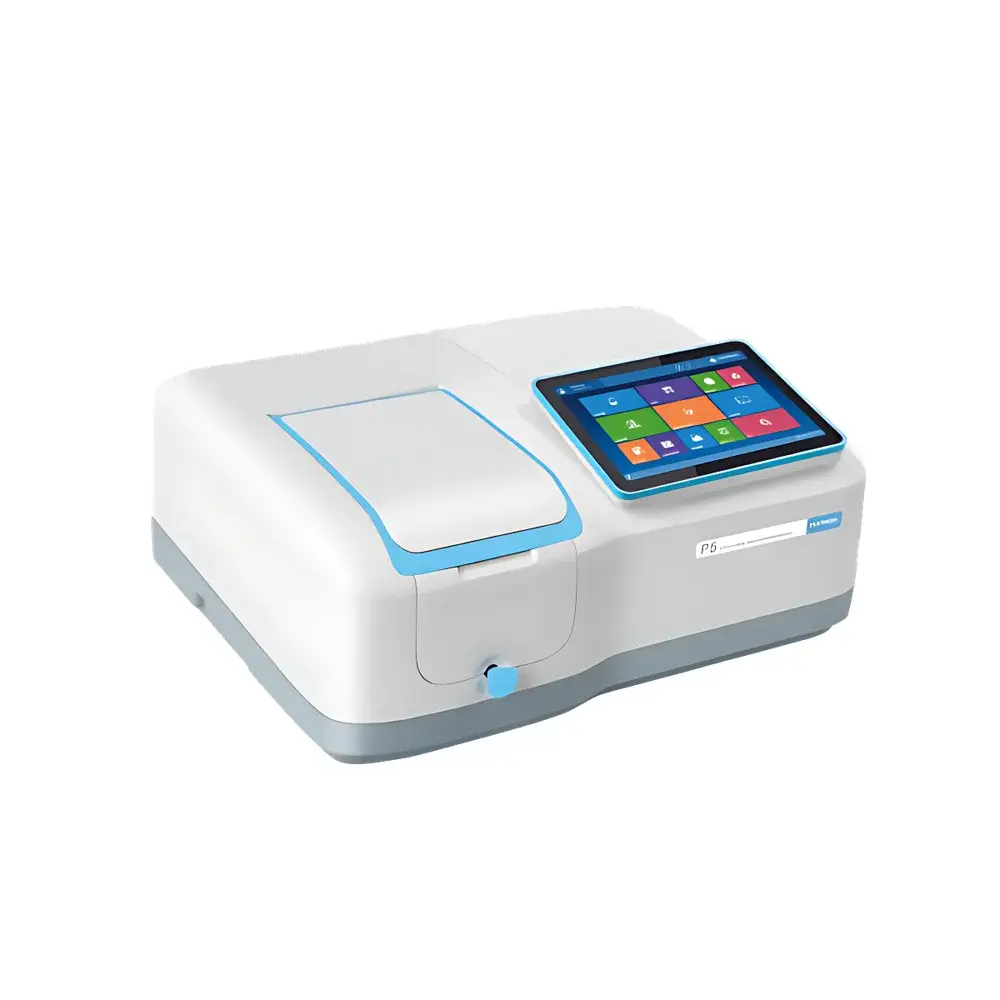
Mapada P5 Proportional Double-Beam Ultraviolet-Visible Spectrophotometer
| Brand | Mapada |
|---|---|
| Origin | Shanghai, China |
| Manufacturer Type | Direct Manufacturer |
| Instrument Architecture | Double-Beam |
| Detector Type | Photocell |
| Wavelength Range | 190–1100 nm |
| Wavelength Scanning Mode | Automatic |
| Spectral Bandwidth | 2 nm |
| Wavelength Accuracy | ±0.5 nm |
| Wavelength Repeatability | ≤0.3 nm |
| Stray Light | ≤0.05 %T at 220 nm and 360 nm |
Overview
The Mapada P5 Proportional Double-Beam Ultraviolet-Visible Spectrophotometer is an engineered solution for routine and research-grade quantitative and qualitative analysis in the 190–1100 nm spectral region. Based on the proportional double-beam optical architecture, the instrument simultaneously splits the light path into sample and reference channels using a rotating mirror or beam splitter, enabling real-time compensation for source intensity drift, lamp aging, and electronic fluctuations. This design ensures high photometric stability and measurement reproducibility—critical for long-duration kinetic studies, multi-sample batch analysis, and compliance-driven QC workflows. The system employs a low-noise silicon photocell detector optimized for broad spectral response and linearity across UV, visible, and near-infrared regions. Its fixed 2 nm spectral bandwidth balances resolution and signal-to-noise ratio for general-purpose applications including concentration determination, purity assessment, and spectral scanning of organic and inorganic compounds.
Key Features
- Proportional double-beam optics with real-time reference correction, minimizing baseline drift and improving measurement robustness over time
- Automated wavelength scanning with stepper motor-driven monochromator and precision grating, supporting full-spectrum acquisition from 190 to 1100 nm
- High-fidelity optical train incorporating quartz-coated optics for enhanced UV throughput and reduced photodegradation effects
- Wavelength accuracy of ±0.5 nm and repeatability ≤0.3 nm—validated per ISO 8579-1 and ASTM E275 guidelines for spectrophotometer performance verification
- Stray light performance ≤0.05 %T at 220 nm and 360 nm, ensuring reliable absorbance measurements up to 3.0 AU without significant deviation from Beer-Lambert linearity
- Integrated self-diagnostic routines including lamp energy check, wavelength calibration verification, and detector response validation
Sample Compatibility & Compliance
The P5 accommodates standard 10 mm rectangular cuvettes (glass, quartz, or plastic), as well as optional micro-volume adapters and flow cells for specialized configurations. It supports both transmission and absorbance modes, with transmittance range of 0–200 %T and absorbance range of –0.3 to 3.0 AU. The instrument meets essential requirements for GLP-compliant laboratories: audit-trail-capable operation logs (when paired with compliant software), user-access-level controls, and calibration traceability to NIST-traceable standards. While not pre-certified for FDA 21 CFR Part 11, its operational architecture—including password-protected method storage, timestamped data export, and immutable result files—supports implementation of Part 11–aligned SOPs when deployed within validated environments.
Software & Data Management
The P5 operates with Mapada’s proprietary UV-Solution software (Windows-based), providing intuitive control of scan parameters, kinetic acquisition, multi-wavelength quantitation, and spectral overlay functions. Data export is supported in CSV, TXT, and JCAMP-DX formats for interoperability with LIMS, statistical packages (e.g., JMP, Minitab), and regulatory documentation systems. Software features include automatic peak detection, baseline correction algorithms (linear, polynomial, rolling ball), and customizable report templates aligned with ISO/IEC 17025 reporting conventions. All raw spectra and processed results are stored with embedded metadata (date/time, operator ID, instrument serial number, method name), facilitating traceability during internal audits or external accreditation reviews.
Applications
- Quantitative analysis of pharmaceutical actives and excipients per USP and EP 2.2.25 methodologies
- Water quality monitoring—including nitrate, phosphate, and COD determination via colorimetric assays
- Enzyme kinetics and protein quantification (e.g., Bradford, Lowry, BCA) in life science laboratories
- Thin-film and nanomaterial characterization through absorbance edge analysis and bandgap estimation
- Educational use in undergraduate chemistry and biochemistry curricula for teaching Beer-Lambert law fundamentals and spectral interpretation
- Quality control of dyes, pigments, and food colorants in manufacturing QA/QC labs
FAQ
What type of detector is used in the P5, and how does it affect sensitivity?
The P5 employs a high-stability silicon photocell detector, optimized for linear response and low dark current across the 190–1100 nm range. While not a PMT or CCD, this detector delivers sufficient sensitivity for routine absorbance measurements up to 3.0 AU with excellent inter-day reproducibility.
Is the P5 suitable for GMP-regulated environments?
Yes—when configured with controlled access, electronic signatures, and documented calibration procedures, the P5 supports GMP-aligned operations. Full 21 CFR Part 11 compliance requires supplementary IT infrastructure and procedural controls beyond the base hardware.
Can the instrument be connected to a laboratory network for centralized data management?
The P5 communicates via USB 2.0 interface; network integration is achievable through host PC bridging or third-party middleware compatible with HL7 or ASTM E1384 standards.
Does the P5 support variable slit widths or adjustable spectral bandwidth?
No—the P5 maintains a fixed 2 nm spectral bandwidth, which is factory-optimized for balance between resolution and photometric precision in general analytical use.
How often should wavelength calibration be performed?
Initial calibration is verified at factory shipment using holmium oxide and didymium filters. Users should perform verification quarterly or after instrument relocation; recalibration is recommended annually or following mechanical impact or extended lamp replacement cycles.
Related Products





