
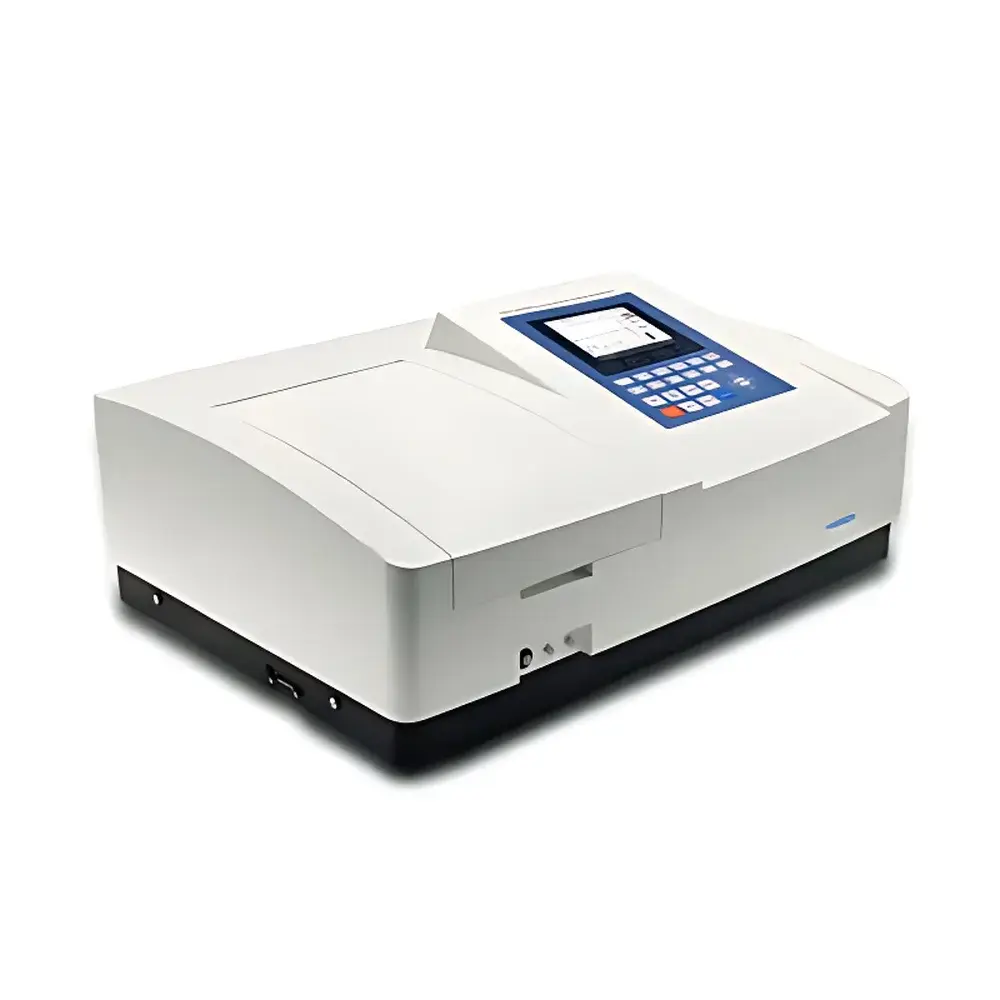
Metrohm UV-6100S Dual-Beam Ultraviolet-Visible Spectrophotometer
| Brand | Mapada |
|---|---|
| Origin | Shanghai, China |
| Manufacturer Type | Direct Manufacturer |
| Regional Origin | Domestic (China) |
| Model | UV-6100S |
| Price Range | USD 7,000–10,000 |
| Optical System | Dual-beam |
| Detector | Photodiode Array (PDA) |
| Wavelength Range | 190–1100 nm |
| Wavelength Accuracy | ±0.3 nm |
| Spectral Bandwidth | 1.8 nm (fixed) |
| Wavelength Setting | Automatic |
| Display | 320 × 240 LCD |
| Measurement Modes | Transmittance (T), Absorbance (A), Concentration (C), Energy (E) |
| Scan Speed Options | High/Medium/Low (up to 3800 nm/min) |
| Light Sources | Long-life imported tungsten lamp and deuterium lamp |
| Detector Type | Imported silicon photodiode |
| Interface | USB port for data export |
| Power Supply | AC 220 V / 50 Hz or AC 110 V / 60 Hz |
| Dimensions | 590 × 420 × 260 mm |
| Net Weight | 26 kg |
Overview
The Metrohm UV-6100S Dual-Beam Ultraviolet-Visible Spectrophotometer is engineered for high-stability quantitative and qualitative analysis across research laboratories, quality control environments, and educational institutions. Based on the dual-beam optical architecture, it continuously compensates for source intensity drift and detector response variation by splitting the light path into reference and sample beams—enabling real-time background correction and significantly improving measurement reproducibility over time. The instrument operates across a broad spectral range of 190–1100 nm, covering both deep-UV absorption transitions (e.g., peptide bonds, nucleic acids) and near-infrared vibrational overtones (e.g., C–H, O–H stretching). Its fixed 1.8 nm spectral bandwidth ensures optimal resolution for routine applications such as pharmaceutical assay validation, water quality monitoring (e.g., nitrate, phosphate), and dye concentration profiling—without compromising signal-to-noise ratio or scan speed.
Key Features
- Dual-beam optical design with real-time reference beam compensation for enhanced baseline stability and long-term photometric accuracy
- High-intensity, low-noise photodiode array (PDA) detector enabling rapid full-spectrum acquisition without mechanical scanning delays
- Imported long-life deuterium and tungsten-halogen lamps providing stable output across UV and visible regions with >2000-hour operational lifetime
- Automated wavelength calibration with ±0.3 nm accuracy traceable to NIST-certified holmium oxide and didymium filters
- Three selectable scan speeds (high/medium/low), supporting up to 3800 nm/min for rapid kinetic or multi-sample screening workflows
- Integrated 320 × 240 graphical LCD display with intuitive menu navigation—no external PC required for basic operation
- Comprehensive photometric modes: transmittance (%T), absorbance (A), concentration (C), and energy (E) with built-in calibration curve generation
Sample Compatibility & Compliance
The UV-6100S accommodates standard 10 mm pathlength quartz, glass, or plastic cuvettes (including matched pairs for dual-beam referencing) and supports microvolume adapters (down to 50 µL) via optional accessories. It complies with core international standards governing spectrophotometric performance verification, including ISO 9001:2015 (quality management systems), ASTM E275–22 (standard practices for describing and measuring performance of UV-Vis spectrophotometers), and USP (Ultraviolet-Visible Spectrophotometry). While not preconfigured for 21 CFR Part 11 compliance out-of-the-box, its USB data export functionality enables integration into validated LIMS or ELN platforms where audit trails, electronic signatures, and user access controls are externally managed per GLP/GMP requirements.
Software & Data Management
Data acquisition and processing are supported via optional Windows-compatible PC software (v3.2+), which provides advanced features including multi-wavelength kinetics, spectral subtraction, derivative spectroscopy, and peak identification algorithms. All spectra and measurement logs are exported in CSV or ASCII format for interoperability with third-party statistical tools (e.g., OriginLab, JMP, Python pandas). Raw absorbance data retains timestamping and instrument metadata (lamp hours, wavelength calibration date, operator ID if entered), facilitating traceability during internal audits. The USB interface supports plug-and-play connectivity with no proprietary drivers required—ensuring compatibility with modern Windows 10/11 and macOS systems via standard CDC ACM protocols.
Applications
- Pharmaceutical QC: Quantitative assay of active pharmaceutical ingredients (APIs) per USP monographs, excipient purity screening, and dissolution profile analysis
- Environmental testing: Determination of heavy metals (via complexometric colorimetry), nutrient ions (NO₃⁻, PO₄³⁻), and organic pollutants (phenols, surfactants)
- Food & beverage: Color index evaluation (e.g., AOAC methods), antioxidant capacity (DPPH assay), and preservative concentration (sorbic acid, benzoic acid)
- Academic research: Enzyme kinetics (NADH/NADPH monitoring at 340 nm), protein quantification (Bradford/Lowry), and polymer degradation studies
- Materials science: Bandgap estimation of semiconducting nanoparticles and thin-film transmittance characterization
FAQ
What is the typical warm-up time required before achieving photometric stability?
The UV-6100S achieves thermal and lamp stabilization within 20 minutes under ambient conditions (20–25°C, <60% RH), as verified by absorbance drift ≤0.002 A/h at 500 nm using a neutral density filter.
Can the instrument perform kinetic measurements over extended durations (e.g., >1 hour)?
Yes—its dual-beam architecture and temperature-compensated PDA detector support continuous kinetic acquisition for up to 4 hours without recalibration, provided ambient temperature fluctuations remain within ±1°C.
Is wavelength calibration performed manually or automatically?
Wavelength calibration is fully automated using internal holmium oxide and didymium reference filters; users may initiate calibration at any time via the instrument menu or prior to critical measurements.
Does the UV-6100S support method transfer between instruments?
Method parameters—including slit function, scan speed, and smoothing algorithms—are stored in instrument memory and can be exported/imported via USB, enabling consistent cross-platform execution when paired with identical optical configurations.
What maintenance intervals are recommended for optimal performance?
Lamp replacement is advised every 2000 hours; optical alignment verification should occur annually or after physical relocation; quartz cuvette holder cleaning with lint-free ethanol wipes is recommended after each use involving viscous or particulate-laden samples.





