
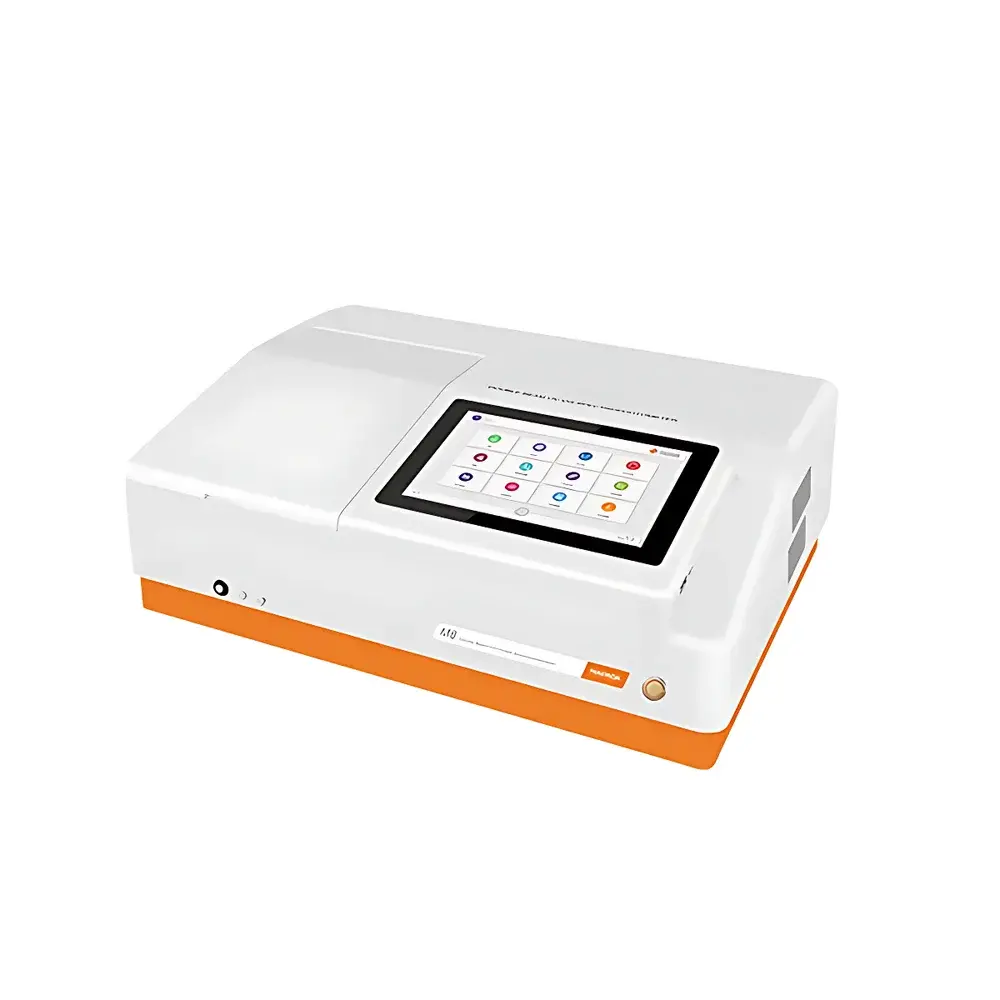
MPB M8 Dual-Beam Pulsed Xenon Lamp UV-Vis Spectrophotometer
| [Brand | MPB |
|---|---|
| Origin | Shanghai, China |
| Manufacturer Type | Original Equipment Manufacturer (OEM) |
| Instrument Architecture | Dual-Beam |
| Detector Type | Photocell |
| Wavelength Range | 190–1100 nm |
| Wavelength Accuracy | ±0.5 nm |
| Spectral Bandwidth | 2 nm |
| Wavelength Scanning | Motorized & Auto-Calibrated |
| Light Source | Pulsed Xenon Lamp (No Preheating Required)] |
Overview
The MPB M8 Dual-Beam Pulsed Xenon Lamp UV-Vis Spectrophotometer is engineered for high-reproducibility absorbance, transmittance, and reflectance measurements across the ultraviolet, visible, and near-infrared spectral regions (190–1100 nm). Unlike conventional single-beam or continuous-source instruments, the M8 employs a dual-beam optical architecture with real-time reference compensation—ensuring stability against lamp drift, environmental fluctuations, and electronic noise. Its core innovation lies in the solid-state pulsed xenon lamp: a cold light source that emits intense, broadband radiation only during measurement events. This eliminates warm-up delays, suppresses thermal degradation of photosensitive samples (e.g., proteins, nucleic acids, dyes), and avoids ozone generation associated with sustained UV emission from deuterium/tungsten lamps.
Key Features
- Dual-beam optical design with simultaneous sample/reference beam monitoring for baseline stability and long-term photometric accuracy
- Pulsed xenon lamp with >10⁹ operational pulses lifetime—equivalent to ~10 years under typical lab use (1,000 samples/day × 50 pulses/sample × 250 operating days/year)
- No preheating required: achieves full spectral output within milliseconds; enables true “instant-on” operation
- 2 nm spectral bandwidth optimized for resolution/sensitivity balance per ISO 9001 and ASTM E275 validation protocols
- Wavelength accuracy of ±0.5 nm traceable to NIST-certified holmium oxide and didymium filters
- Compact footprint (< 300 mm × 350 mm × 200 mm) with integrated Bluetooth 5.0 interface for wireless control via Microsoft Surface tablets
- Energy consumption reduced by ≥70% versus legacy tungsten/deuterium lamp systems—aligned with IEC 62474 and EU EcoDesign Directive requirements
Sample Compatibility & Compliance
The M8 accommodates standard 10 mm pathlength cuvettes (quartz, glass, plastic), microvolume adapters (0.5–2 µL), and optional fiber-optic probes for non-contact or flow-cell applications. All optical components—including mirrors, gratings, and detector housing—are sealed against ambient humidity and particulate ingress (IP52 rated). The instrument complies with electromagnetic compatibility (EMC) standards IEC 61326-1 and safety standard IEC 61010-1. Software functionality supports GLP/GMP audit trails per FDA 21 CFR Part 11 requirements, including user-defined roles, electronic signatures, and immutable data logging with time-stamped metadata.
Software & Data Management
Pre-installed MPB SpectraPro v4.2 software delivers comprehensive analytical workflows: photometric mode (A/T/%T), quantitative analysis (single/multi-point calibration, equation-based concentration calculation), multi-wavelength kinetics, time-scan kinetics, full spectral scanning (190–1100 nm in < 3 s), and bio-specific modules (protein A280/A260, DNA quantification, enzyme kinetics). Raw data export is supported in CSV, ASCII, and JCAMP-DX formats. Data integrity safeguards include automatic backup to network drives, version-controlled method storage, and encrypted local database archiving. Audit trail records capture all parameter changes, measurement initiations, calibration events, and user logins with tamper-proof timestamps.
Applications
The M8 serves diverse analytical needs across pharmaceutical QC (USP , ), academic research (nanoparticle characterization, ligand-binding studies), environmental testing (COD, nitrate/nitrite, phosphate), food & beverage QA (colorimetric assays, antioxidant capacity), and clinical diagnostics (serum bilirubin, hemoglobin derivatives). Its cold-light operation makes it particularly suitable for photolabile biomolecules, live-cell extracts, and thermally unstable formulations where conventional lamp heating induces artifactual degradation.
FAQ
Does the M8 require wavelength calibration using external standards?
Yes—initial setup and periodic verification (recommended every 6 months or after transport) require calibration with NIST-traceable holmium oxide (241, 279, 287, 333, 360, 418, 480, 536 nm) and didymium (528.7, 573, 585, 643, 749, 807 nm) filters.
Can the M8 operate without a tablet or external computer?
No—the embedded controller lacks a local display or physical keypad; full operation requires Bluetooth-paired Windows 10/11 tablet running SpectraPro v4.2.
Is the pulsed xenon lamp replaceable by the end user?
Yes—lamp replacement is tool-free and takes < 5 minutes; no optical realignment is needed due to factory-aligned lamp module mounting.
What is the maximum scan speed for full 190–1100 nm spectra?
At 1 nm data interval and 2 nm slit width, full-spectrum acquisition completes in ≤2.8 seconds with signal averaging disabled.
Does the software support automated method transfer between M8 units?
Yes—SpectraPro v4.2 allows export/import of validated methods (.spm files) with embedded calibration coefficients, ensuring inter-instrument comparability per ISO/IEC 17025 clause 7.7.






