
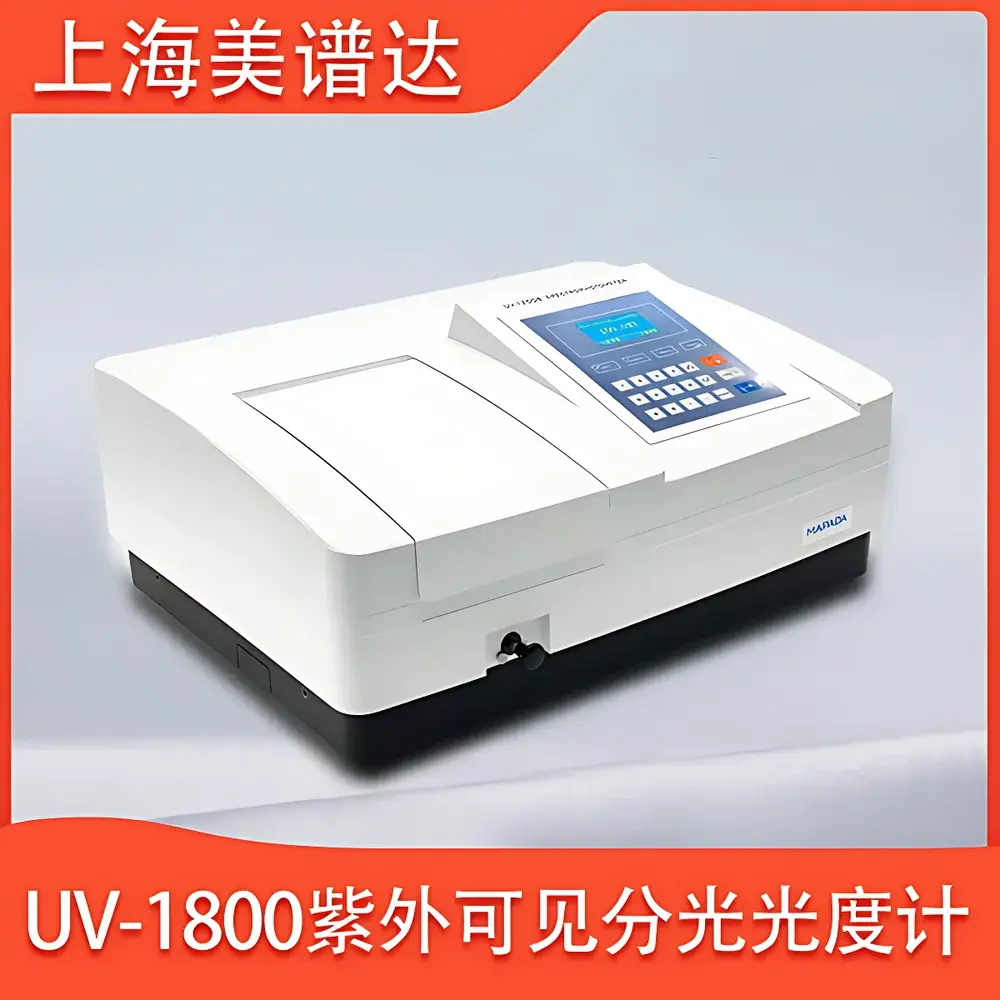
Mapada UV-1800PC Ultraviolet-Visible Spectrophotometer
| Brand | Mapada |
|---|---|
| Origin | Shanghai, China |
| Manufacturer Type | Original Equipment Manufacturer (OEM) |
| Instrument Architecture | Single-Beam |
| Detector | Silicon Photodiode Array |
| Wavelength Range | 190–1100 nm |
| Spectral Bandwidth | 2 nm |
| Wavelength Accuracy | ±0.5 nm |
| Wavelength Repeatability | ±0.2 nm |
| Light Sources | Imported Deuterium Lamp & Tungsten-Halogen Lamp |
| Display | 128×64 Dot-Matrix LCD |
| Data Interface | USB 2.0 Standard Port |
| Power Supply | AC 220 V/50 Hz or 110 V/60 Hz |
| Dimensions (W×D×H) | 490 × 360 × 240 mm |
| Net Weight | 14 kg |
Overview
The Mapada UV-1800PC is a single-beam ultraviolet-visible (UV-Vis) spectrophotometer engineered for routine quantitative and qualitative analysis in academic laboratories, quality control environments, and industrial R&D settings. It operates on the fundamental principle of Beer-Lambert law-based absorbance measurement, utilizing a fixed-grating monochromator with 1200 lines/mm holographic grating to resolve spectral features across a broad optical range from 190 nm to 1100 nm. The instrument integrates dual light sources — a deuterium lamp for deep-UV performance (190–350 nm) and a tungsten-halogen lamp for visible-to-NIR coverage (350–1100 nm) — automatically switched based on wavelength selection. Its 2 nm spectral bandwidth ensures sufficient resolution for most standard applications including concentration determination, purity assessment, and spectral profiling of organic compounds, nucleic acids, and proteins.
Key Features
- Single-beam optical architecture optimized for stability, ease of maintenance, and cost-effective operation in high-throughput labs.
- High-fidelity silicon photodiode array detector with low dark current and excellent linearity over four decades of absorbance (0–3.5 A).
- Automated wavelength calibration and source switching logic eliminates manual intervention and reduces operator-induced error.
- Real-time lamp usage monitoring system tracks cumulative ignition time for both deuterium and tungsten lamps, supporting predictive maintenance and compliance with laboratory equipment lifecycle protocols.
- Spacious sample compartment accommodating cuvettes from 5 mm to 100 mm pathlength — compatible with standard quartz, glass, and plastic cells.
- Plug-and-play lamp design: socket-mounted deuterium and tungsten lamps require no optical realignment after replacement, minimizing downtime.
- Integrated 128×64 dot-matrix LCD display supports on-device visualization of full-spectrum scans, kinetic time-course plots, and up to 200 stored data sets without external software.
Sample Compatibility & Compliance
The UV-1800PC accommodates a wide variety of liquid-phase samples in standard cuvette formats, including those used in pharmaceutical dissolution testing, environmental water analysis, food additive quantification, and biochemical assays. Its wavelength accuracy (±0.5 nm) and repeatability (±0.2 nm) meet the performance criteria outlined in ASTM E275 and ISO 6223 for routine UV-Vis instrumentation verification. While not inherently 21 CFR Part 11 compliant in standalone mode, the instrument’s USB interface enables integration with validated third-party data acquisition platforms that support electronic signatures, audit trails, and user access controls required under GLP and GMP frameworks.
Software & Data Management
The UV-1800PC is fully compatible with Mapada’s proprietary scanning software — a Windows-based application supporting spectral acquisition, multi-point calibration, kinetic modeling, DNA/protein A260/A280 ratio calculation, and customizable report generation. Data export is supported in CSV, TXT, and XML formats for downstream statistical analysis in tools such as Microsoft Excel, OriginLab, or MATLAB. The USB 2.0 interface ensures plug-and-play connectivity with modern PCs; no additional drivers are required for Windows 10/11 or macOS (via virtual machine or compatibility layer). All spectral and quantitative results can be timestamped and assigned to user-defined sample IDs, facilitating traceability in regulated environments.
Applications
- Quantitative analysis of pharmaceutical actives using validated standard curve methods per USP and EP 2.2.25.
- Determination of nucleic acid concentration and purity (A260/A280, A260/A230) in molecular biology workflows.
- Monitoring enzymatic reaction kinetics via time-resolved absorbance at specific wavelengths.
- Colorimetric assays including Bradford, Lowry, and BCA protein quantitation.
- Quality assurance of dyes, pigments, and UV-absorbing additives in polymer and cosmetic formulations.
- Environmental monitoring of nitrate, phosphate, and heavy metal complexes using established colorimetric protocols.
FAQ
Is the UV-1800PC suitable for regulatory submissions under FDA or EMA guidelines?
It serves as a qualified analytical tool when operated within an established validation framework — including periodic wavelength and photometric accuracy verification per NIST-traceable standards.
Can the instrument perform spectral scanning faster than 1 nm/s?
Scanning speed is fixed at 120 nm/min (2 nm/s), optimized for signal-to-noise ratio and baseline stability in routine applications.
Does the software support multi-user login with role-based permissions?
The native Mapada software does not include built-in user authentication; however, it can be deployed within enterprise-controlled environments where OS-level access policies apply.
What is the recommended calibration frequency for routine QC use?
Wavelength calibration should be verified daily using holmium oxide or didymium filters; photometric calibration with neutral density filters is advised before each analytical batch.
Is there an option for thermal stabilization of the sample compartment?
No — the UV-1800PC lacks Peltier-based temperature control. For temperature-dependent studies, external thermostatted cuvette holders are recommended.



