
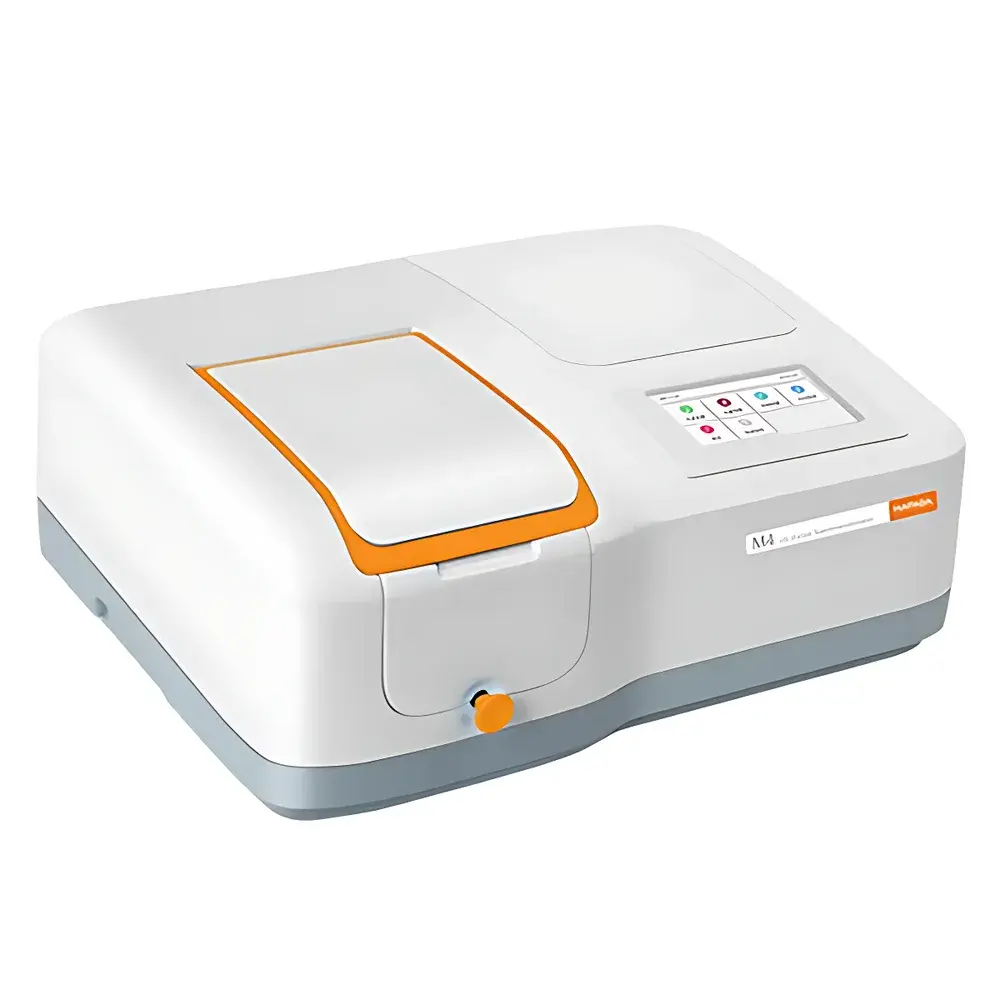
MPD M4 Proportional Double-Beam Pulsed Xenon UV-Vis Spectrophotometer
| Brand | MPD |
|---|---|
| Origin | Shanghai, China |
| Manufacturer Type | Direct Manufacturer |
| Instrument Architecture | Quasi-Double-Beam |
| Detector Type | Photocell |
| Wavelength Range | 190–1100 nm |
| Wavelength Scanning Mode | Motorized Auto-Scanning |
| Spectral Bandwidth | 2 nm |
| Wavelength Accuracy | ±0.5 nm |
| Display | 5-inch Capacitive Color Touchscreen |
| Sample Compartment Design | Removable Front Panel, Damped Hinged Lid (0–120° Position Hold), Integrated Spill Drain Port |
Overview
The MPD M4 Proportional Double-Beam Pulsed Xenon UV-Vis Spectrophotometer is engineered for high-stability quantitative and qualitative analysis across research laboratories, quality control environments, and educational institutions. Utilizing a pulsed xenon lamp as its broadband light source, the M4 eliminates thermal drift and lamp aging effects common in traditional deuterium/tungsten systems—ensuring consistent spectral output over extended operational lifetimes. Its quasi-double-beam optical architecture employs time-shared beam routing via a high-precision rotating mirror, enabling real-time compensation for source intensity fluctuations and detector response variations. This design delivers improved photometric accuracy and baseline stability without requiring matched lamps or complex mechanical beam splitters. The instrument operates across a full 190–1100 nm spectral range with 2 nm spectral bandwidth, supporting both absorbance and transmittance measurements with wavelength accuracy of ±0.5 nm (NIST-traceable calibration verified).
Key Features
- Pulsed Xenon Light Source: Delivers stable, flash-based illumination across UV, visible, and near-IR regions—eliminating warm-up time, reducing heat load on samples, and extending source lifetime beyond 10⁹ flashes.
- Quasi-Double-Beam Optical Path: Time-multiplexed reference and sample beam measurement ensures robust correction for source instability and electronic drift, achieving <0.002 Abs/h baseline stability over 4 hours at 500 nm.
- Ergonomic Sample Compartment: Features a removable front panel for rapid configuration changes (e.g., switching between 1-cm cuvette holders, micro-volume adapters, or solid-sample reflectance stages); hinged lid with hydraulic damping allows secure positioning at any angle from 0° to 120° for unobstructed access.
- Integrated Spill Drain Port: A dedicated drainage channel beneath the sample stage directs accidental liquid spills away from optical components and electronics—enhancing long-term reliability and simplifying maintenance in routine QC workflows.
- Industrial-Grade Enclosure: Chassis fabricated from aerospace-grade die-cast aluminum alloy; outer housing molded from reinforced polycarbonate-ABS blend—optimized for mechanical rigidity, EMI shielding, and thermal dissipation.
- Capacitive Touch Interface: 5-inch full-color LCD with glove-compatible responsiveness supports intuitive method navigation, real-time spectrum preview, and multi-point calibration—even when wearing standard nitrile or latex laboratory gloves.
Sample Compatibility & Compliance
The M4 accommodates standard 10 mm pathlength quartz, glass, or plastic cuvettes (including disposable types), as well as optional accessories such as 5–50 µL microvolume stands, fiber-optic probes, and integrating spheres for diffuse reflectance. All optical components comply with ISO 9001 manufacturing controls and meet IEC 61010-1 safety requirements for laboratory electrical equipment. Data integrity features—including user-access logs, method versioning, and timestamped measurement records—support alignment with GLP and internal QA protocols. While not pre-certified for FDA 21 CFR Part 11, the firmware architecture enables audit-trail generation and role-based access control when deployed within validated IT infrastructures.
Software & Data Management
The instrument ships with MPD SpectraSuite v3.x—a Windows-based application supporting method creation, kinetic scanning, multi-wavelength quantitation, and spectral subtraction. Raw absorbance/transmittance data are exported in CSV and JCAMP-DX formats for third-party analysis (e.g., MATLAB, Origin, Unscrambler). Firmware updates are delivered via USB drive with cryptographic signature verification. All measurement sessions include embedded metadata: operator ID, date/time stamp, instrument serial number, lamp usage counter, and calibration verification status.
Applications
The M4 is routinely deployed for pharmaceutical assay validation (e.g., USP endotoxin interference testing), enzymatic kinetics monitoring (NADH/NADPH at 340 nm), nucleic acid quantification (A260/A280 ratio analysis), dye concentration profiling in textile QC, and water quality parameter estimation (nitrate at 220 nm, phosphate via molybdenum blue at 880 nm). Its pulsed source enables reliable measurements of photosensitive compounds—such as retinoids or porphyrins—that degrade under continuous irradiation.
FAQ
Does the M4 support GLP-compliant data recording?
Yes—when used with SpectraSuite’s optional Audit Trail Module, all user actions, method modifications, and measurement events are logged with immutable timestamps and operator identifiers.
Can the instrument be integrated into a LIMS environment?
Direct LIMS connectivity is not built-in, but ASCII-formatted output files and COM/RS-232 command sets allow integration via middleware or custom scripting.
Is NIST-traceable wavelength calibration included?
A factory-installed holmium oxide and didymium glass filter set is supplied for periodic verification; full NIST-traceable calibration certificates are available as an optional service.
What is the expected lifetime of the xenon lamp?
Rated for ≥1 × 10⁹ flashes at full energy output; typical service life exceeds 5 years under standard daily usage (≤200 scans/day).
Are there options for automated sample handling?
The M4 does not feature native autosampler compatibility; however, third-party XYZ robotic liquid handlers may be synchronized via TTL trigger signals and RS-232 command interface.






