
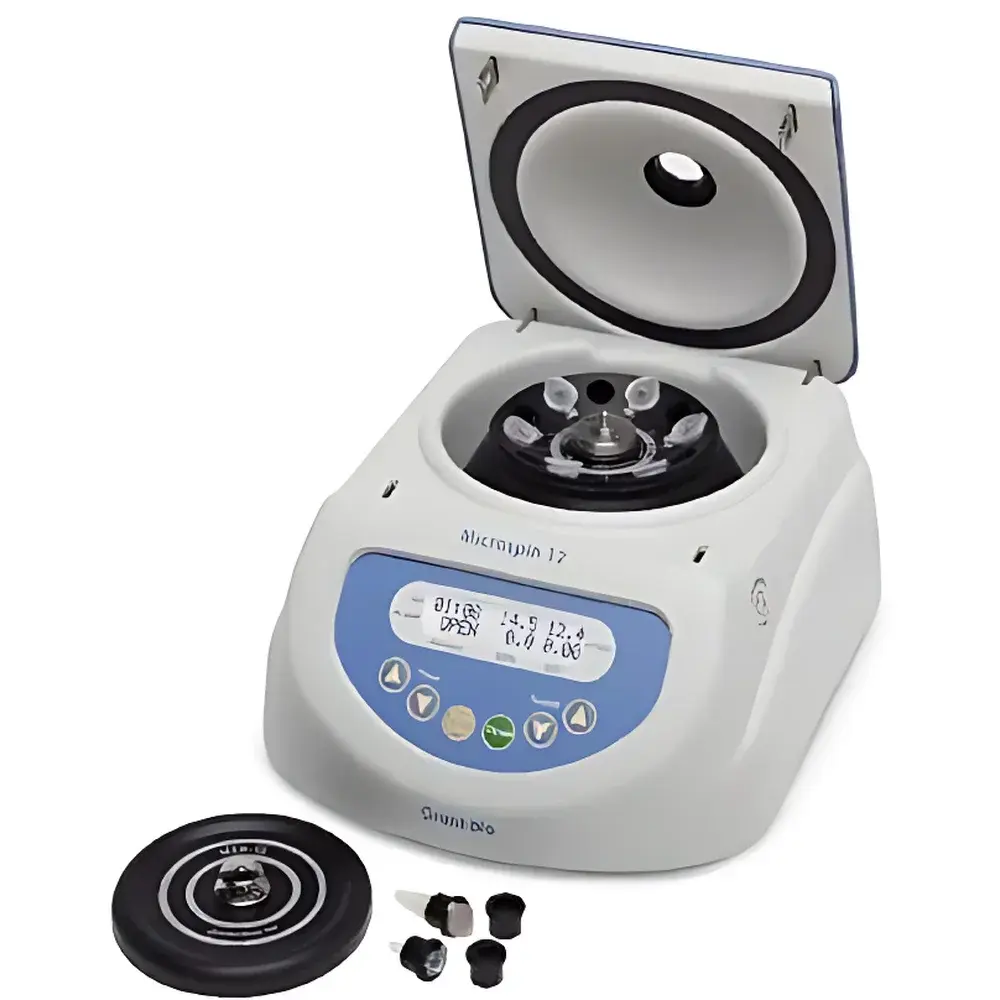
Grant Microspin12 Benchtop High-Speed Centrifuge
| Brand | Grant Instruments (Cambridge) Ltd. |
|---|---|
| Origin | United Kingdom |
| Model | Microspin12 |
| Type | Benchtop Fixed-Angle Microcentrifuge |
| Max Speed | 14,500 rpm |
| Max RCF | 12,400 × g |
| Capacity | 12 × 1.5/2.0 mL tubes |
| Optional Adapters | 12 × 0.5 mL and 12 × 0.2 mL |
| Timer Range | 1–30 min with auto-shutoff |
| Acceleration Time | 20 s |
| Deceleration Time | 10 s |
| Operating Temperature | +4 °C to +25 °C |
| Power Supply | 100–240 V AC, 50/60 Hz |
| Power Consumption | 60 W |
| Dimensions (L×W×H) | 240 × 200 × 125 mm |
| Weight | 3.2 kg |
| Housing Material | Robust metal chassis with integrated metal safety lid |
| Safety Features | Automatic rotor imbalance detection, lid interlock, and deceleration-based coast-down braking |
Overview
The Grant Microspin12 is a compact, high-performance benchtop microcentrifuge engineered for precision and reliability in demanding life science laboratories. Utilizing brushless DC motor technology and a fixed-angle aluminum rotor, it delivers consistent centrifugal forces up to 12,400 × g at speeds ranging from 100 to 14,500 rpm—optimized for rapid pelleting of cellular and bacterial suspensions, nucleic acid precipitation, and protein recovery. Its thermally stable design enables safe operation within refrigerated environments (+4 °C to +25 °C), supporting cold-sensitive workflows such as RNA isolation and enzyme assays. The unit’s low-profile footprint (240 × 200 × 125 mm) and minimal power draw (60 W) make it ideal for crowded biosafety cabinets, cold rooms, or shared core facilities where space and energy efficiency are critical constraints.
Key Features
- Fixed-angle aluminum rotor accommodating 12 × 1.5/2.0 mL microtubes—certified for long-term durability and thermal conductivity
- Optional adapter sets for 0.2 mL and 0.5 mL PCR tubes, enabling seamless integration into molecular biology workflows
- Intelligent safety architecture: automatic imbalance detection, mechanical lid interlock, and controlled deceleration (10 s stop time) to prevent sample disturbance
- Two-line 16-character LCD display showing real-time rpm, RCF, remaining time, and set parameters—no ambiguity during protocol execution
- Quiet operation (<52 dB(A)) achieved via precision-balanced rotor assembly and vibration-dampening chassis
- Auto-shutoff timer (1–30 minutes) with memory retention across power cycles—ensures reproducible run conditions without manual reset
- Corrosion-resistant metal housing and integrated metal safety lid compliant with IEC 61010-1:2010 for laboratory electrical equipment safety
Sample Compatibility & Compliance
The Microspin12 supports standard polypropylene and polycarbonate microcentrifuge tubes (1.5/2.0 mL) and accommodates smaller formats via certified adapters—ensuring compatibility with common consumables used in ISO 15189-accredited clinical labs and GLP-compliant research settings. Its operational temperature range aligns with CLSI EP17-A2 guidelines for low-temperature centrifugation of unstable analytes. While not classified as a Class II medical device, the instrument meets essential requirements of the EU Machinery Directive 2006/42/EC and carries CE marking. It is routinely deployed in workflows adhering to ASTM D7281 (for particulate separation validation) and USP analytical instrument qualification frameworks.
Software & Data Management
The Microspin12 operates as a standalone, firmware-controlled instrument with no external software dependency—minimizing IT validation burden in regulated environments. All operational parameters are stored in non-volatile memory, supporting audit-ready traceability per FDA 21 CFR Part 11 Annex 11 principles when paired with lab-wide electronic lab notebook (ELN) systems. The absence of network connectivity eliminates cybersecurity risks while preserving data integrity through deterministic hardware-based timing and motor control. For multi-user facilities, the intuitive button interface ensures rapid protocol recall without training overhead—critical for high-throughput sample preparation in academic core labs or QC departments.
Applications
- DNA/RNA extraction protocols requiring rapid pelleting of silica-membrane columns or ethanol-precipitated nucleic acids
- Bacterial cell harvesting (e.g., E. coli, Bacillus spp.) prior to lysis or plasmid isolation
- Clarification of crude lysates and removal of cellular debris in protein purification pipelines
- Microfiltration support for nanoparticle concentration and exosome isolation workflows
- Pre-analytical processing of clinical specimens—including serum separation from whole blood in point-of-care diagnostics setups
- Routine maintenance of restriction enzyme stocks and other temperature-labile reagents
FAQ
Can the Microspin12 be operated inside a refrigerated cabinet?
Yes—the unit is rated for continuous operation between +4 °C and +25 °C, making it suitable for placement inside cold rooms or under laminar flow hoods with active cooling.
Is rotor calibration required annually?
No routine recalibration is needed; the fixed-angle aluminum rotor is factory-balanced and certified for lifetime use under normal operating conditions per ISO 15195:2019 guidance.
Does it support rotor identification or RFID tracking?
No—the Microspin12 uses a dedicated fixed rotor; however, its consistent geometry eliminates cross-rotor variability, simplifying SOP documentation and reducing validation complexity.
What maintenance is recommended?
Wipe exterior with 70% ethanol; inspect rotor threads and lid seal quarterly; avoid autoclaving or ultrasonic cleaning of the rotor—clean only with lint-free cloth and isopropanol.
Is it compatible with GMP documentation requirements?
Yes—its deterministic behavior, non-volatile parameter memory, and absence of proprietary software enable straightforward IQ/OQ/PQ execution in pharmaceutical QC environments.
Related Products



