
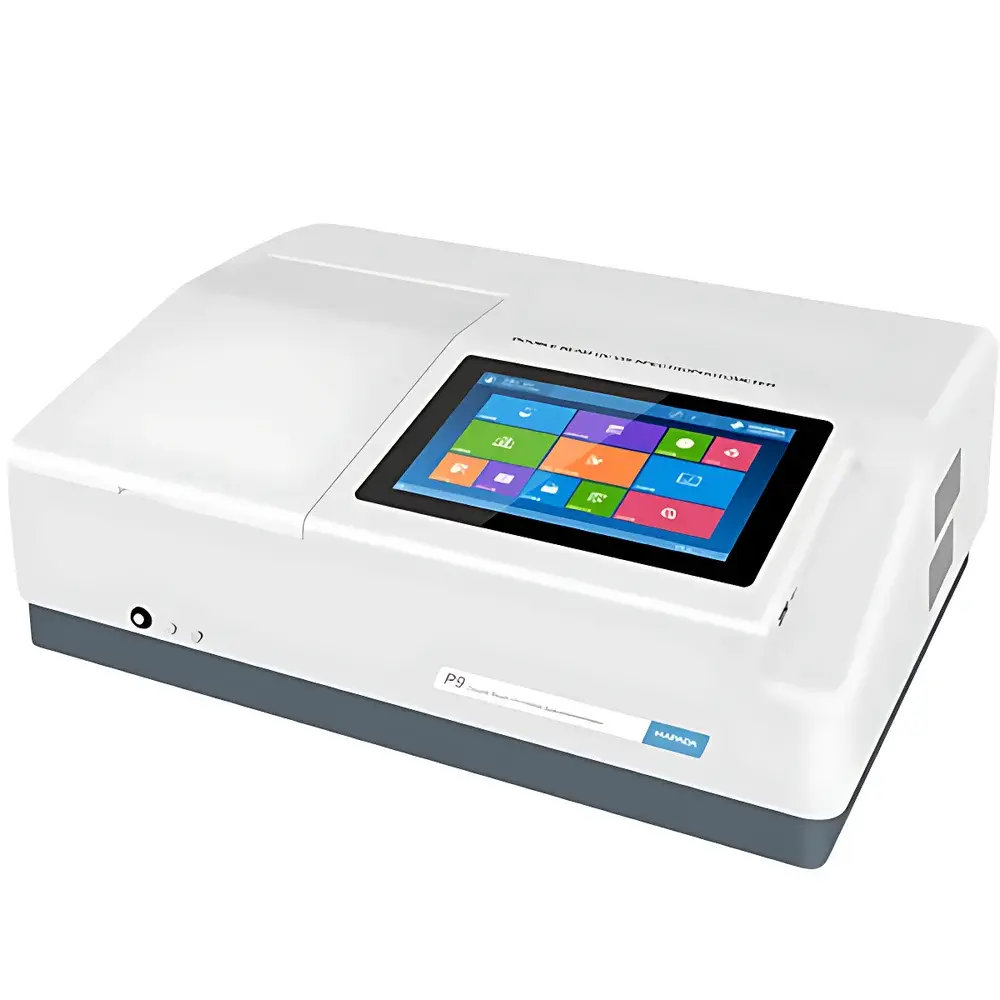
MAPADA P9 Dual-Beam Ultraviolet-Visible Spectrophotometer
| Brand | MAPADA |
|---|---|
| Origin | Shanghai, China |
| Manufacturer Type | Original Equipment Manufacturer (OEM) |
| Product Category | Domestic |
| Model | P9 |
| Price Range | USD 9,800 – 14,000 (FOB Shanghai) |
| Optical Design | Dual-Beam |
| Detector Type | Silicon Photocell |
| Wavelength Range | 190 – 1100 nm |
| Wavelength Scanning Mode | Motorized Automatic |
| Spectral Bandwidth | Adjustable at 0.5, 1.0, 2.4, and 5.0 nm |
| Wavelength Accuracy | ±0.3 nm |
| Wavelength Repeatability | ±0.1 nm |
Overview
The MAPADA P9 Dual-Beam Ultraviolet-Visible Spectrophotometer is an engineered analytical instrument designed for high-fidelity absorbance, transmittance, and reflectance measurements across the ultraviolet, visible, and near-infrared spectral regions (190–1100 nm). Based on classical double-beam optical architecture, the P9 employs a split-light-path configuration where reference and sample beams traverse identical optical paths simultaneously—enabling real-time compensation for lamp intensity drift, detector response variation, and environmental fluctuations. This design inherently minimizes baseline instability and enhances measurement reproducibility, particularly during extended kinetic or temperature-dependent assays. The system utilizes a holographic grating monochromator with motorized wavelength drive and precision-encoded stepper positioning, delivering smooth spectral scanning with zero mechanical backlash or audible noise. All optical components—including quartz-coated mirrors, low-stray-light cuvette holders, and thermally stabilized photodiode detection—are selected and aligned to meet ISO 9001-certified manufacturing tolerances, ensuring long-term photometric integrity.
Key Features
- Dual-beam optical path with real-time reference beam correction, reducing photometric error from source aging and thermal drift
- Adjustable spectral bandwidth (0.5 / 1.0 / 2.4 / 5.0 nm) optimized for resolution–sensitivity trade-off in quantitative and qualitative analysis
- Integrated 10.1-inch industrial-grade capacitive touchscreen running Windows 10 IoT Enterprise, supporting multi-touch gesture navigation and embedded application workflows
- Full peripheral connectivity: HDMI and VGA video output, dual USB 2.0 ports (for keyboard/mouse and flash storage), RJ-45 Ethernet for LAN-based data export and remote diagnostics
- Large-capacity sample compartment accommodating standard 10-mm cuvettes, micro-volume cells (down to 50 µL), solid-sample holders, fiber-optic probes, and temperature-controlled flow cells
- Motorized wavelength drive with closed-loop position feedback ensures ±0.1 nm repeatability and <0.3 nm absolute accuracy traceable to NIST-traceable holmium oxide and didymium filters
Sample Compatibility & Compliance
The P9 supports liquid, semi-solid, and solid-state samples via interchangeable accessories—including variable-pathlength cuvettes (1–100 mm), integrating spheres for diffuse reflectance, and Peltier-controlled cell holders (±0.1 °C stability from 5–60 °C). Its optical performance complies with key international standards for spectrophotometric validation: ASTM E275 (describing terminology and practices for UV-Vis instrumentation), ISO 6425 (photometric accuracy verification), and USP (spectrophotometric absorption measurements in pharmaceutical quality control). Data acquisition and report generation support audit trail functionality compliant with FDA 21 CFR Part 11 requirements when operated in networked GLP/GMP environments using optional MAPADA LabManager™ software.
Software & Data Management
The embedded Windows 10 platform hosts MAPADA SpectraPro™ v3.2—a validated, menu-driven application enabling full-spectrum scanning, multi-wavelength quantitation, kinetics, DNA/protein A260/A280 ratio analysis, and method storage with user-level access control. Raw spectral data are exported in CSV, TXT, and JCAMP-DX formats; reports include instrument metadata (lamp hours, calibration date, operator ID), spectral overlays, and statistical summaries (RSD%, confidence intervals). Network deployment allows centralized firmware updates, method distribution, and encrypted cloud backup via TLS 1.2–secured API endpoints. All data modifications are logged with timestamp, user credential, and reason-for-change fields—fully satisfying ALCOA+ (Attributable, Legible, Contemporaneous, Original, Accurate, Complete, Consistent, Enduring, Available) principles.
Applications
The P9 serves routine and research-grade applications across academic, pharmaceutical, environmental, food & beverage, and materials science laboratories. Typical use cases include: quantification of nucleic acids and proteins per Beer–Lambert law; verification of dye concentrations in textile effluent (EPA Method 450.1); monitoring enzymatic reaction kinetics (e.g., NADH oxidation at 340 nm); characterization of nanomaterial extinction spectra; validation of sunscreen UV-filter transmission profiles (ISO 24443); and QC testing of active pharmaceutical ingredients against pharmacopoeial monographs (USP, EP, ChP). Its dual-beam stability and low stray light (<0.05% at 220 nm) make it suitable for high-dynamic-range measurements—from 0.001 AU to 3.5 AU without range switching.
FAQ
What is the maximum scan speed and minimum data interval supported by the P9?
The P9 achieves up to 3,000 nm/min scanning speed with configurable data point intervals from 0.1 nm to 5.0 nm; typical high-resolution scans (1.0 nm step, 0.5 nm SBW) complete in under 45 seconds over 190–1100 nm.
Is the instrument compatible with third-party LIMS or ELN systems?
Yes—via TCP/IP socket communication and standardized ASCII command protocol (SCPI-like), enabling integration with LabVantage, Thermo Fisher SampleManager, and Benchling ELN through middleware or direct API calls.
Does the P9 require annual recalibration, and what documentation is provided?
Factory calibration includes wavelength and photometric verification with NIST-traceable standards; a Certificate of Conformance (CoC) and raw calibration report are supplied. Annual recalibration is recommended per ISO/IEC 17025 guidelines and can be performed onsite by MAPADA-certified service engineers.
Can the P9 operate in a GMP-regulated environment out-of-the-box?
With optional SpectraPro™ GxP Edition enabled, the system provides electronic signatures, 21 CFR Part 11-compliant audit trails, role-based permissions, and IQ/OQ documentation packages—meeting baseline requirements for regulated QC laboratories.
What is the expected lifetime of the deuterium and tungsten-halogen lamps?
Typical rated lifetimes are 2,000 hours for the deuterium lamp and 5,000 hours for the tungsten-halogen lamp; lamp usage time is tracked automatically and displayed in the status panel.
Related Products






