
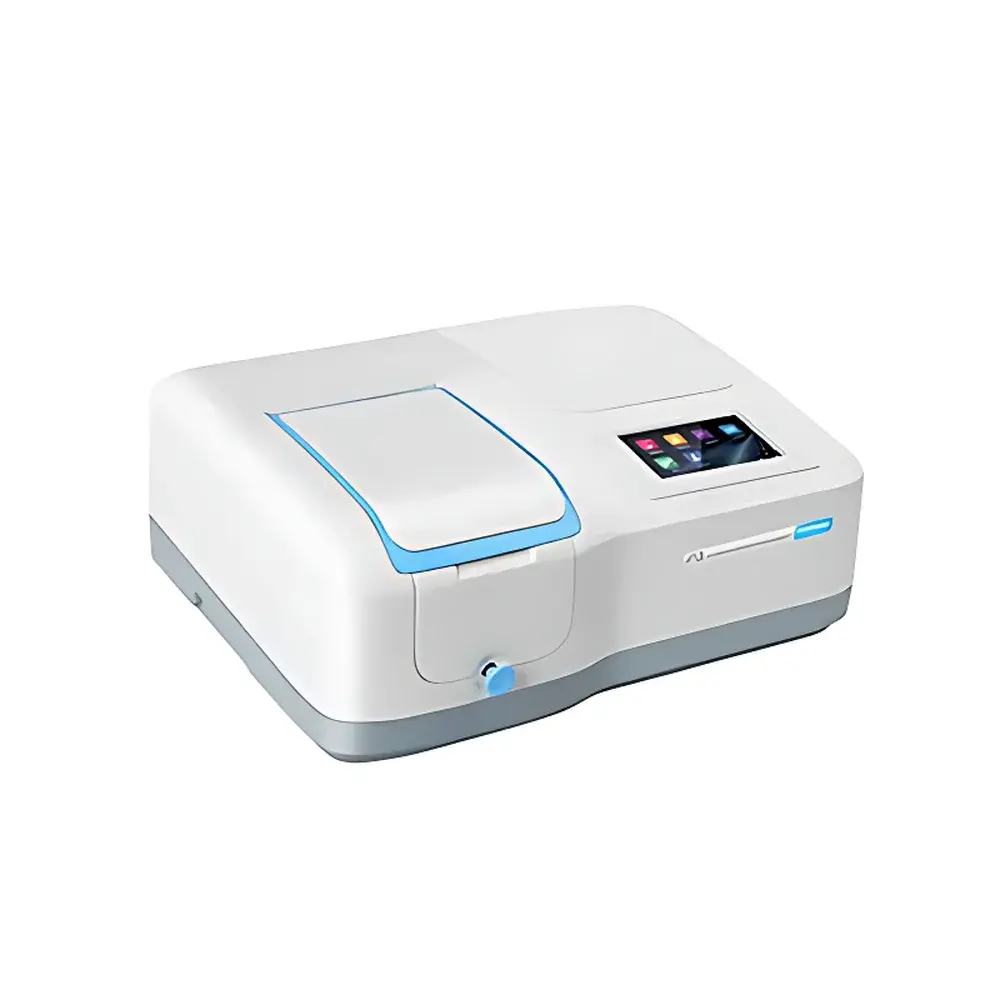
MPB P3 PC Economical UV-Vis Spectrophotometer
| [Brand | MPB |
|---|---|
| Origin | Shanghai, China |
| Manufacturer Type | Direct Manufacturer |
| Instrument Architecture | Single-Beam |
| Detector Type | Silicon Photocell |
| Wavelength Range | 190–1100 nm |
| Wavelength Accuracy | ±0.5 nm |
| Spectral Bandwidth | 4 nm |
| Wavelength Scanning Mode | Motorized Auto-Scanning |
| Compliance | ISO/IEC 17025-compatible validation protocols supported] |
Overview
The MPB P3 PC Economical UV-Vis Spectrophotometer is a single-beam optical absorption instrument engineered for routine quantitative and qualitative analysis in academic teaching laboratories, quality control environments, and small-scale industrial R&D settings. It operates on the fundamental principle of Beer–Lambert law-based absorbance measurement, where sample-induced attenuation of monochromatic light across the ultraviolet to near-infrared spectrum (190–1100 nm) is converted into quantifiable photometric data. Its fixed 4 nm spectral bandwidth ensures sufficient resolution for standard applications—including concentration determination, kinetic monitoring, and spectral scanning—while maintaining robust signal-to-noise performance through temperature-stabilized silicon photocell detection. Designed with mechanical simplicity and operational reliability as core priorities, the P3 PC integrates motorized wavelength positioning for automated spectral acquisition without requiring manual adjustment, reducing operator dependency and improving inter-user reproducibility.
Key Features
- Single-beam architecture with motorized wavelength drive enabling precise, repeatable auto-scanning from 190 nm to 1100 nm
- Silicon photocell detector delivering stable photometric response across full spectral range with low dark-current drift
- Real-time A/T mode switching with immediate recalibration upon toggling between absorbance and transmittance display
- Quantitative analysis suite supporting single- and dual-wavelength methodologies—including dual-wavelength difference and ratio modes—for interference correction in complex matrices
- Standard curve construction using up to ten reference standards; supports linear (with/without zero-intercept) and second-order polynomial regression models
- Comprehensive file management system allowing batch export to TXT and CSV formats, filename editing, and secure local storage with memory status monitoring
- Integrated system calibration routines: dark current correction, wavelength verification using holmium oxide or didymium filters, and baseline flattening across full scan range
- Multi-language UI support (English, Spanish, French, German, Chinese) configurable via system settings without firmware update
Sample Compatibility & Compliance
The P3 PC accommodates standard 10 mm rectangular cuvettes (glass, quartz, or plastic), with optional accessories available for microvolume, flow-cell, or solid-sample reflectance configurations. All optical path components are aligned and sealed during factory assembly to minimize alignment drift under typical ambient lab conditions (15–30 °C, <80% RH). While not certified to GLP or GMP out-of-the-box, the instrument supports traceable performance verification per ISO 6506-1 (spectrophotometer verification) and ASTM E275 (standard practice for describing and measuring performance of UV-Vis spectrophotometers). Users may implement internal SOPs for periodic wavelength accuracy checks (±0.5 nm tolerance), photometric linearity verification (using neutral density filters), and stray light assessment (via sodium nitrite solution at 340 nm) in alignment with ISO/IEC 17025 documentation requirements.
Software & Data Management
The embedded firmware provides local data handling without external PC dependency for basic operations; however, full functionality—including spectral export, report generation, and method archiving—is accessed via the dedicated Windows-based MPB Control Suite. This application enables audit-trail-capable session logging, user-defined method templates with parameter locking, and timestamped data export compliant with FDA 21 CFR Part 11 principles when deployed on validated IT infrastructure. Raw absorbance/time or absorbance/wavelength datasets are stored in proprietary .mpb format and convertible to open-standard CSV for integration with LIMS or statistical analysis platforms (e.g., JMP, OriginLab). No cloud connectivity or remote access features are implemented—ensuring data sovereignty and minimizing cybersecurity exposure vectors.
Applications
- Concentration determination of nucleic acids (A260), proteins (A280), and enzymatic reaction products in life science education labs
- Quality assurance testing of pharmaceutical excipients and active ingredients per USP guidelines
- Water quality analysis including nitrate, phosphate, and COD estimation using colorimetric reagents
- Thin-film thickness estimation and bandgap calculation in materials science coursework
- Stability-indicating assays for oxidation or hydrolysis kinetics under controlled thermal conditions
- Teaching fundamental spectroscopic concepts such as Lambert–Beer law deviations, solvent effects, and chromophore identification
FAQ
What is the recommended calibration frequency for routine use?
For daily QC workflows, perform dark current and wavelength calibration before first use each day; full system baseline verification is advised weekly or after lamp replacement.
Can the P3 PC be used with non-standard cuvette pathlengths?
Yes—pathlength correction factors can be manually applied during quantitative analysis; however, automatic pathlength compensation is not supported.
Is the instrument compatible with third-party LIMS interfaces?
Direct API integration is not provided, but exported CSV files contain structured metadata (wavelength, absorbance, timestamp, method ID) suitable for scripted ingestion into most LIMS platforms.
How is lamp lifetime monitored?
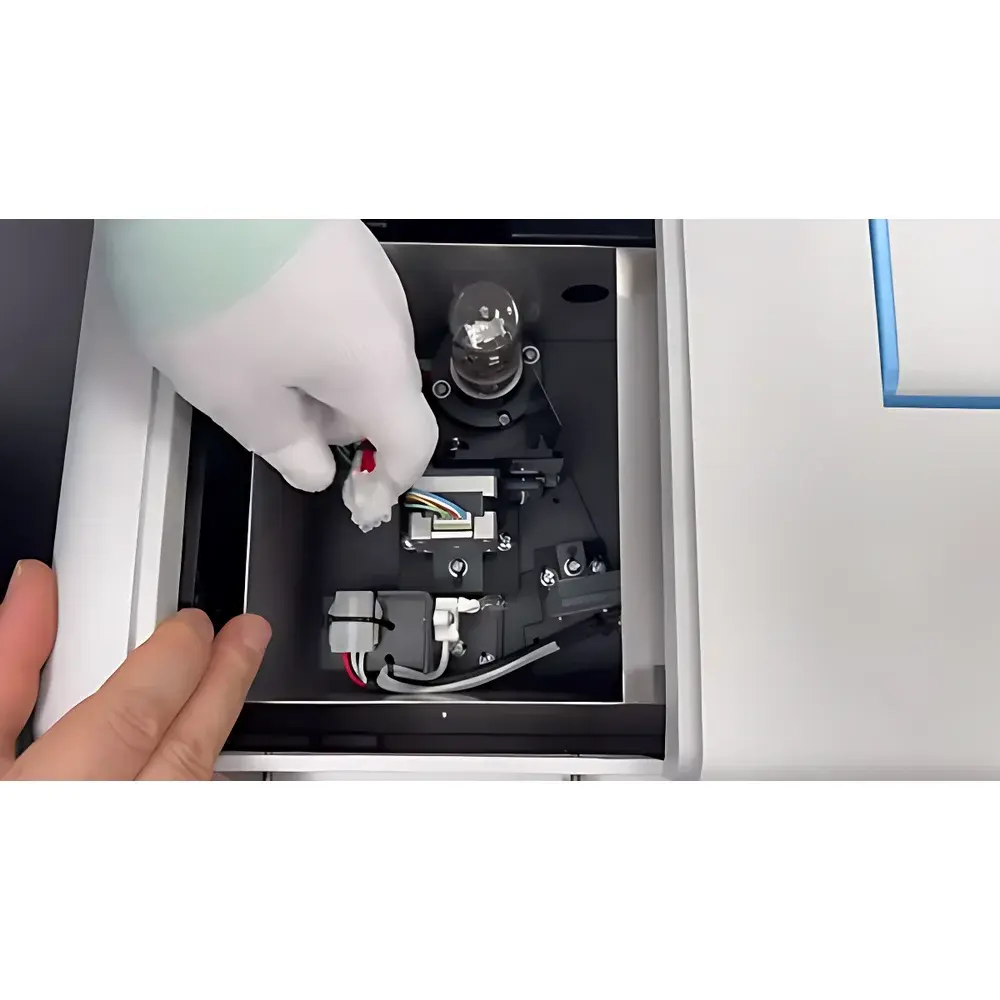
The onboard source timer logs cumulative ON-hours and triggers visual alerts at 1,000-hour intervals; deuterium and tungsten-halogen lamps are field-replaceable using standard tools.
Does the system support GLP-compliant electronic signatures?
No—the embedded interface lacks role-based access control or digital signature capture; compliance requires external software layering and procedural controls.
Related Products







