
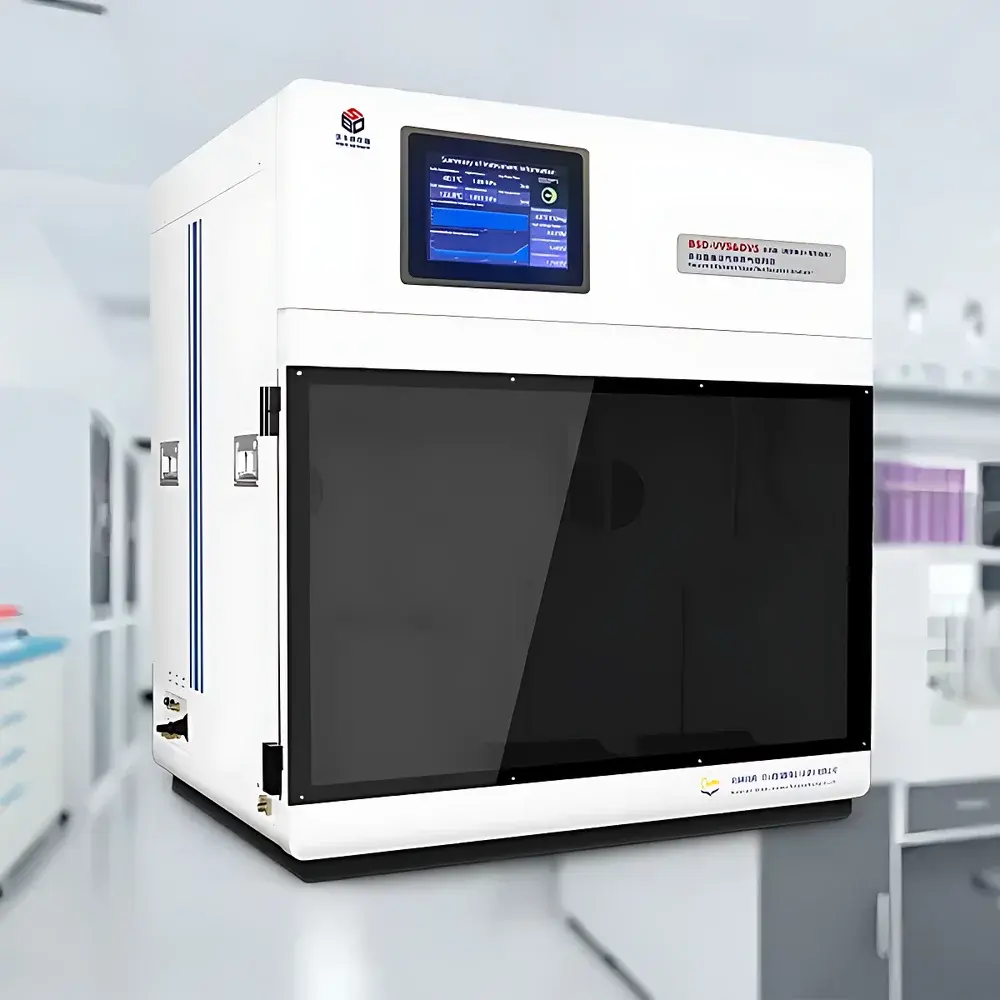
Beishide BSD-VVS+DVS Multi-Station Gravimetric Vapor and Gas Sorption Analyzer
| Key | Brand: Beishide Instrument |
|---|---|
| Origin | Beijing, China |
| Manufacturer Type | OEM Manufacturer |
| Model | BSD-VVS+DVS |
| Weighing Resolution | 1 µg / 2000 mg (0.1 µg / 200 mg optional) |
| Weighing Range | 10–2000 mg (customizable up to 5000 mg |
| 0.1 µg sensitivity | 10–100 mg optional) |
| Temperature Control Range | −180 °C to 50 °C (accuracy ±0.1 °C, stability <0.1 °C) |
| Vapor Pressure Control Range | 0.1–98% P/P₀ (extendable to lower P/P₀ with optional saturator) |
| Dual Vacuum System | Rotary vane pump + vapor-tolerant turbomolecular pump (base pressure <1×10⁻⁶ torr) |
| Analytical Stations | 4 or 8 independent, fully synchronized gravimetric channels |
| Vapor Generation | Static saturation + carrier-gas dilution (dual-mode) |
| Compliance | ASTM D3663, ISO 15901-2, USP <1217>, IUPAC 2015 recommendations for physisorption |
Overview
The Beishide BSD-VVS+DVS is a high-precision, multi-station gravimetric sorption analyzer engineered for comprehensive characterization of solid materials under both vacuum (VVS/VGS) and dynamic flow (DVS/DGS) conditions. It integrates dual operational paradigms—static vacuum-based thermodynamic equilibrium measurement and dynamic flow-controlled kinetic profiling—within a single platform. The system employs microgravimetric detection based on high-stability industrial ultra-microbalances (1 µg resolution at 2000 mg load; optional 0.1 µg at 200 mg), coupled with dual-stage pressure sensing, cryogenic temperature control (−180 °C to 50 °C), and programmable vapor partial pressure regulation from 0.1% to 98% P/P₀. Its architecture supports simultaneous analysis across up to eight independent sample positions, each with identical thermal, pressure, and mass-tracking environments—enabling statistically robust inter-sample comparison and high-throughput screening of adsorbents, catalysts, MOFs, pharmaceutical excipients, and battery electrode materials.
Key Features
- Multi-modal sorption capability: Full support for vacuum vapor sorption (VVS), vacuum gas sorption (VGS), dynamic vapor sorption (DVS), dynamic gas sorption (DGS), temperature-programmed desorption (TPD), temperature-programmed reduction (TPR), and temperature-programmed oxidation (TPO).
- Eight-channel parallel analysis: Independent, real-time mass tracking per station with synchronized environmental control—eliminating batch-to-batch variability and accelerating method development.
- Dual vacuum architecture: Integrated oil-free rotary vane pump + vapor-resistant turbomolecular pump (base pressure <1×10⁻⁶ torr), enabling ultra-low residual vapor background for high-fidelity low-pressure isotherm acquisition.
- Advanced vapor delivery: Hybrid generation via static saturation and precision carrier-gas dilution, with full temperature-controlled vapor lines (up to 60 °C) to prevent condensation and ensure stable P/P₀ setpoints.
- Intelligent buoyancy correction: Three configurable modes—calculated Archimedean correction, blank-position background subtraction, and time-resolved background curve fitting—ensuring trace-level mass accuracy across wide temperature and pressure ranges.
- Modular corrosion resistance: Optional chemically resistant fluidic pathways and saturators for NH₃, SO₂, H₂S, and other reactive vapors, validated per ASTM D7251 for corrosive sorbate compatibility.
Sample Compatibility & Compliance
The BSD-VVS+DVS accommodates powders, pellets, monoliths, thin films, and fiber mats (10–2000 mg typical loading). Its design conforms to internationally recognized standards for sorption metrology, including ASTM D3663 (water vapor sorption), ISO 15901-2 (pore size distribution by gas adsorption), and USP (moisture sorption in pharmaceuticals). All data acquisition and instrument control modules comply with FDA 21 CFR Part 11 requirements for electronic records and signatures when configured with audit-trail-enabled software. The system supports GLP/GMP-aligned workflows through user-accessible calibration logs, version-controlled method templates, and timestamped raw-data archiving.
Software & Data Management
The proprietary SorptionMaster™ software provides unified control for isotherm acquisition, kinetic profiling, TPD/TPR/TPO ramping, and multi-step cycling protocols. It implements automated baseline stabilization detection, real-time drift compensation, and adaptive step sizing for optimal signal-to-noise ratio. Raw mass vs. time, pressure, and temperature datasets are stored in HDF5 format with embedded metadata (instrument ID, operator, calibration certificate IDs, environmental timestamps). Export options include ASTM-compliant CSV, ISO-standardized XML, and direct integration with third-party modeling platforms (e.g., MATLAB, Python via REST API). Batch report generation includes BET surface area (single-point and multipoint), Langmuir capacity, BJH mesopore distribution, t-plot and DR micropore analysis, and kinetic rate constants derived from Fickian and non-Fickian diffusion models.
Applications
This analyzer serves critical roles in catalyst development (e.g., CO₂ capture capacity, water tolerance of zeolites), pharmaceutical formulation (excipient hygroscopicity, amorphous content prediction), energy storage (Li-ion cathode moisture uptake, solid electrolyte stability), and nanomaterial qualification (MOF pore accessibility, graphene oxide functional group density). Its ability to resolve sub-milligram mass changes under controlled P/P₀ and temperature enables quantification of weak physisorption interactions, surface heterogeneity mapping, and aging-related degradation mechanisms—particularly valuable in accelerated stability testing and shelf-life modeling.
FAQ
What vapor species can be measured besides water?
The system supports organic vapors (ethanol, acetone, toluene), permanent gases (N₂, CO₂, CH₄), and—when equipped with optional corrosion-resistant modules—reactive species including NH₃, SO₂, and H₂S.
Is the 0.1 µg resolution option available for all weighing ranges?
Yes—the 0.1 µg sensitivity variant is offered for the 10–100 mg range; higher-load configurations retain 1 µg resolution optimized for reproducibility and long-term stability.
How does the system handle buoyancy effects during cryogenic measurements?
It applies real-time, temperature-dependent air density calculations using NIST-referenced equations, combined with optional blank-position referencing to decouple thermal expansion artifacts from true sorption mass change.
Can the instrument perform continuous cyclic adsorption-desorption life testing?
Yes—fully automated multi-cycle protocols with programmable dwell times, pressure ramps, and purge sequences are supported, including integrated solvent recovery via patented condensate trapping.
What vacuum level is required for accurate low-pressure CO₂ isotherms?
With the standard turbomolecular pump configuration, base pressure remains below 1×10⁻⁶ torr—sufficient for precise sub-monolayer CO₂ uptake measurement at 0 °C and pressures down to 10⁻³ torr.



