
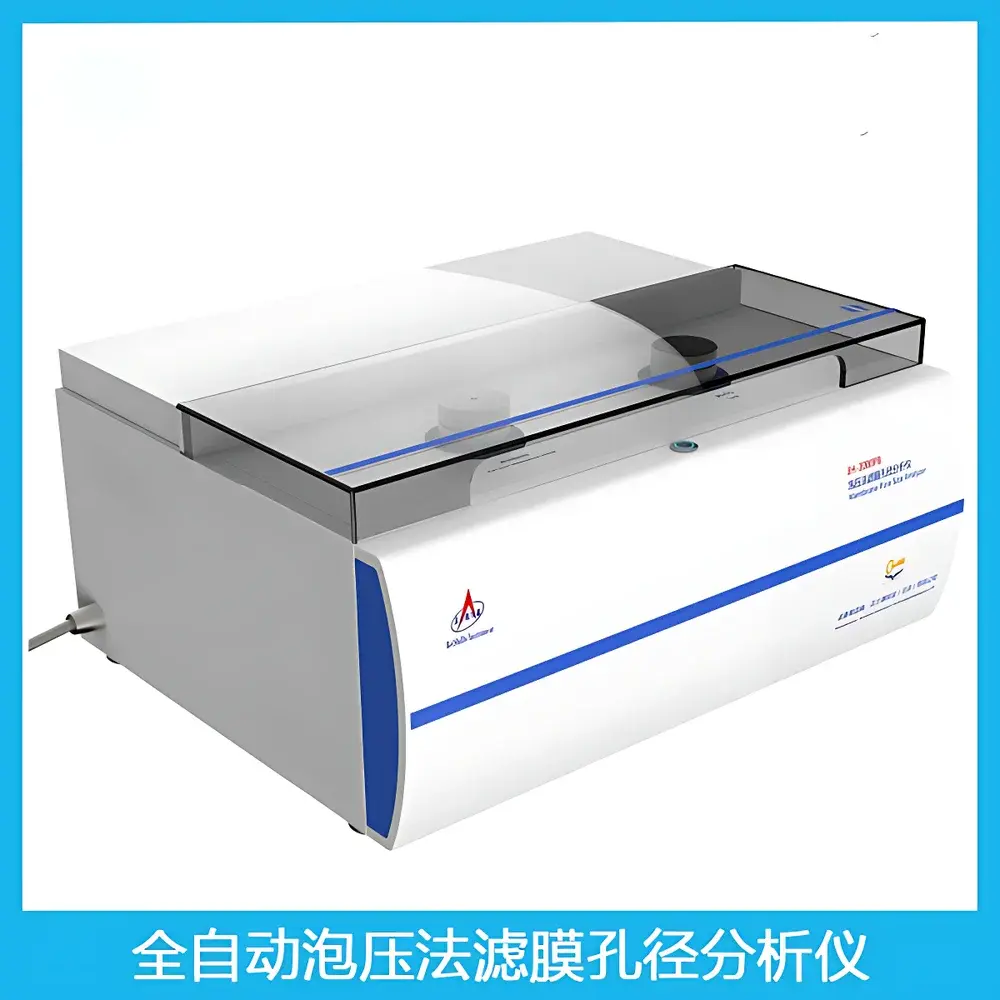
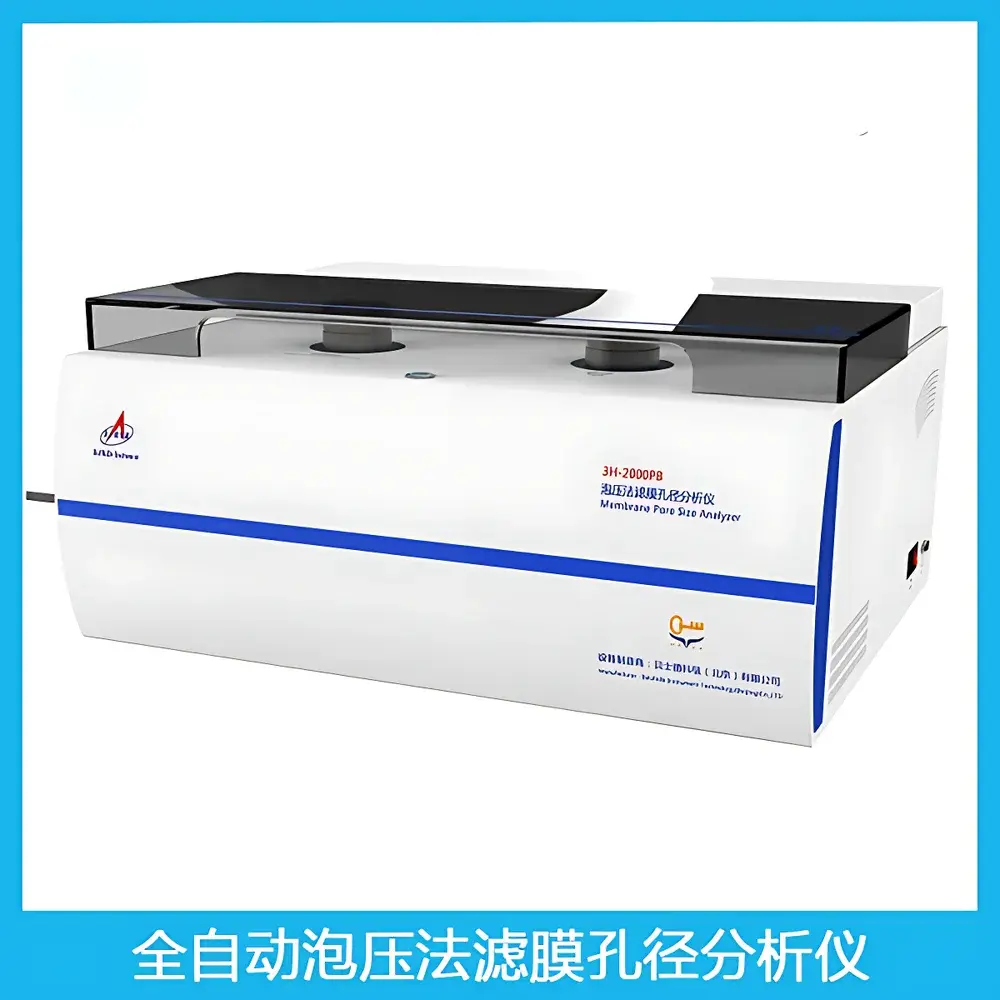
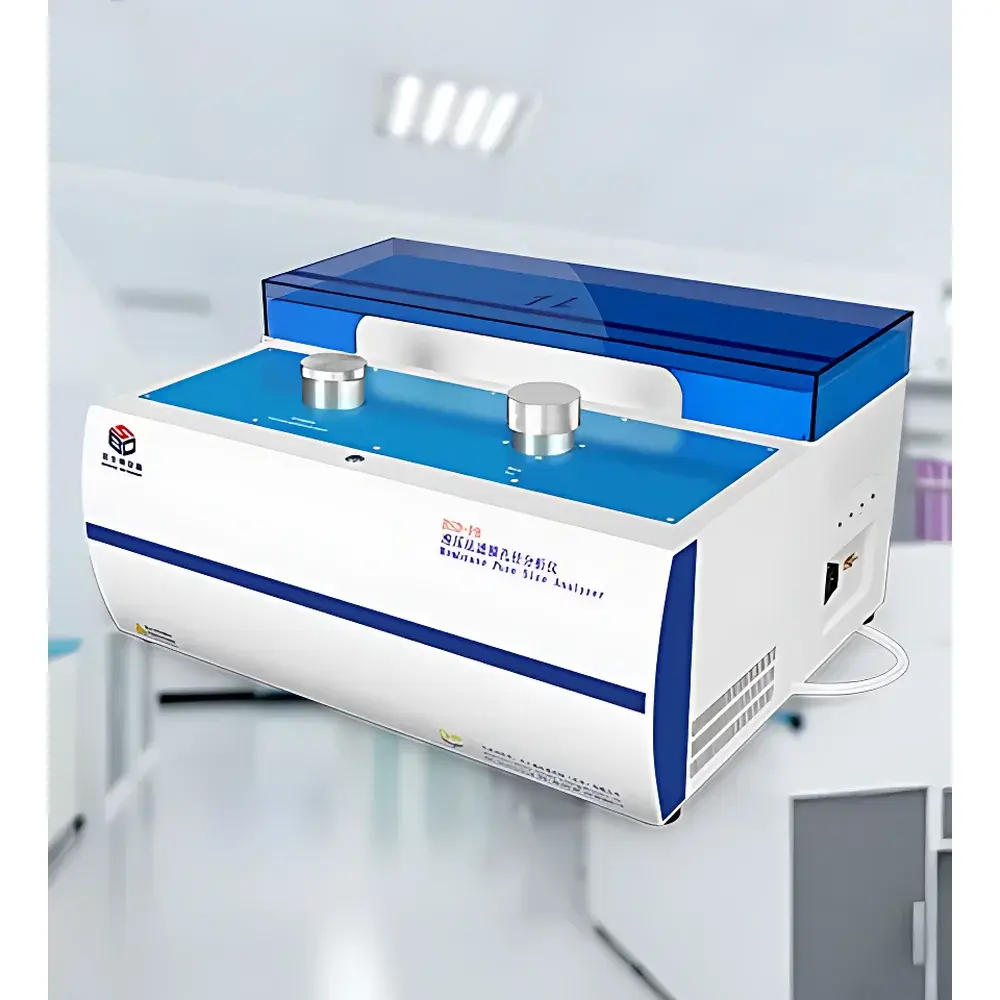
Beishide BSD-PB Bubble Point Pore Size Analyzer
| Brand | Beishide Instrument |
|---|---|
| Origin | Beijing, China |
| Manufacturer Type | Direct Manufacturer |
| Origin Category | Domestic (China) |
| Model | BSD-PB |
| Price Range | USD 14,000 – 70,000 |
| Pore Size Range (Gas-Liquid Method) | 0.02–500 µm |
| Pore Size Range (Liquid-Liquid Method) | 5–500 nm |
| Vacuum-Assisted Wetting System | Integrated, Automatic |
| Pressure Sensors | Dual, 0–1 bar & 0–40 bar, ±0.05 mbar accuracy |
| Flow Sensors | Dual, 0–1 L/min & 0–200 L/min, ±0.1 mL/min accuracy |
| Balance (BSD-PBL variant) | Sartorius, 0–2100 g, ±0.01 g |
| Compliance Standards | GB/T 32361-2015, ASTM F316-03, ASTM D6767-02, ISO 2942, DIN ISO 4003, BS 7591-4, HY/T 051, HY/T 064, GB/T 14041.1, GB/T 24219, GB/T 2679.14 |
Overview
The Beishide BSD-PB Bubble Point Pore Size Analyzer is a precision-engineered instrument designed for quantitative characterization of through-pore throat diameters in porous membranes and filtration media. It operates on the fundamental principle of capillary pressure displacement—specifically, the gas-liquid bubble point method (ASTM F316-03, GB/T 32361-2015) and the complementary liquid-liquid displacement method (Washburn-based). In the bubble point technique, a wetted sample is subjected to gradually increasing gas pressure across its thickness; when the applied pressure exceeds the Laplace pressure (ΔP = 4γ·cosθ/D) required to displace the wetting liquid from a pore of diameter D, gas breakthrough occurs. The resulting pressure-flow profile enables calculation of maximum (bubble point), minimum, mean, and most probable pore diameters, as well as full pore size distribution (PSD) via differential flow analysis: f(D) = −d[(Fw/Fd) × 100]/dD, where Fw and Fd denote wet and dry gas flow rates. The liquid-liquid method extends resolution into the sub-50 nm range by leveraging lower interfacial tension between immiscible liquids, making it suitable for nanofiltration membranes and ultrafine ceramic filters.
Key Features
- Integrated vacuum-assisted wetting module—patented (ZL 201420148359.9)—reduces immersion time by >50% for hydrophobic or low-energy surfaces such as PVDF, PTFE, or sintered metals.
- Dual-range high-fidelity sensing architecture: two pressure transducers (0–1 bar / 0–40 bar, ±0.05 mbar) and two mass flow sensors (0–1 L/min / 0–200 L/min, ±0.1 mL/min) enable seamless auto-ranging across micro- to macro-porous regimes.
- Modular sample holder system (patented ZL 201420148785.2) accommodates circular flat-sheet membranes (up to Ø100 mm), hollow-fiber modules, tubular ceramics, and irregular geometries without hardware reconfiguration.
- In-situ sidewall gas injection design ensures uniform pressure application, eliminates top-mounted seal leakage paths, and maintains structural integrity under sustained 40-bar operation.
- Full stainless-steel fluidic path with metal-to-metal sealing guarantees chemical resistance to alcohols, fluorinated solvents (e.g., Porofil™), and aqueous electrolytes—critical for battery separator and pharmaceutical filter validation.
- Real-time voice-guided workflow and second-resolution instrument log archiving support 21 CFR Part 11-compliant audit trails and GLP/GMP documentation requirements.
Sample Compatibility & Compliance
The BSD-PB supports diverse porous materials including polymeric microfiltration/ultrafiltration membranes (PVDF, PES, CA), ceramic monoliths, sintered stainless steel, geotextiles, nonwovens, filter papers, battery separators (PE/PP), rock cores, and cementitious composites. Its dual-method capability satisfies both coarse-pore validation (e.g., hydraulic filter integrity per ISO 2942) and nanoscale characterization (e.g., NF membrane pore cutoff per ASTM D6539). All test protocols align with internationally recognized standards: ASTM F316-03 (bubble point & mean flow pore size), ASTM D6767-02 (geotextile capillary flow), DIN ISO 4003 (sintered metal bubble test), BS 7591-4 (porosity assessment), and Chinese national standards GB/T 32361-2015 and HY/T 051–064 for hollow-fiber and ceramic membranes. Data outputs are traceable to NIST-traceable pressure and flow calibrations.
Software & Data Management
The proprietary Beishide PoreMaster™ software provides automated test sequencing, real-time curve overlay (wet/dry flow vs. pressure), and ISO/ASTM-compliant reporting. It calculates bubble point pressure, onset pressure, half-dry pressure, gas permeability (kgas), liquid permeability (kliq), and integral/differential pore size distributions. Raw sensor data—including timestamped pressure, flow, temperature, and balance readings (for BSD-PBL variant)—are stored in encrypted SQLite databases with SHA-256 hashing. Export options include CSV, PDF (with digital signature), and XML for LIMS integration. Audit trail functionality records all user actions, parameter changes, and calibration events—fully compliant with FDA 21 CFR Part 11 requirements for electronic records and signatures.
Applications
- Quality control of membrane manufacturing: verification of pore size consistency batch-to-batch per ISO 13485 and IATF 16949.
- Filter integrity testing for sterile-grade pharmaceutical filters (e.g., 0.22 µm PVDF) per USP and EU Annex 1.
- R&D of lithium-ion battery separators: correlation of pore structure (mean pore size, porosity, tortuosity) with ionic conductivity and dendrite resistance.
- Geotechnical engineering: pore throat distribution analysis of soil and rock core samples for permeability modeling.
- Automotive fuel/water coalescer development: quantification of coalescence efficiency via pore size distribution asymmetry.
- Textile functionalization: evaluation of breathable waterproof fabric pore architecture (e.g., Gore-Tex® analogs) per BS 3321.
FAQ
What pore size ranges does the BSD-PB cover?
The gas-liquid bubble point method measures 0.02–500 µm; the liquid-liquid displacement method extends resolution down to 5 nm.
Is the instrument compliant with regulatory requirements for pharmaceutical use?
Yes—software supports 21 CFR Part 11 audit trails, electronic signatures, and secure data archiving; hardware meets ISO 2942 and ASTM F316 for filter validation.
Can the BSD-PB test hollow-fiber membrane modules directly?
Yes—the patented multi-geometry sample holder accepts potted fiber bundles without cutting or mounting fixtures.
How is wetting efficiency validated for low-surface-energy membranes?
Vacuum-assisted wetting includes real-time pressure decay monitoring; full saturation is confirmed by stable baseline flow prior to pressurization.
Does the system support custom wetting liquids beyond Porofil™?
Yes—fluid compatibility is defined by surface tension (γ) and contact angle (θ); users may input γ and θ values for any certified wetting liquid in the software.





