
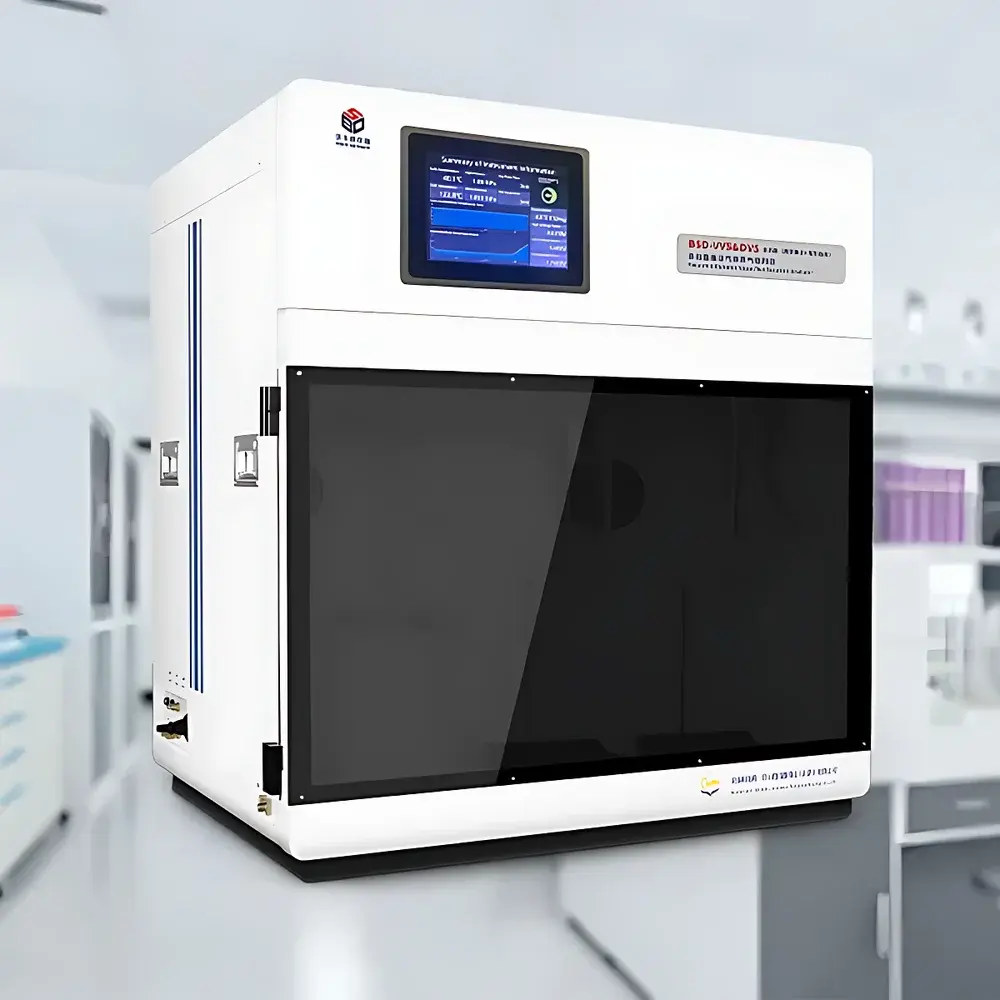
Beishide BSD-VVS&DVS Multi-Station Gravimetric Vapor and Gas Sorption Analyzer
| Key | Brand: Beishide Instrument |
|---|---|
| Origin | Beijing, China |
| Manufacturer Type | OEM Manufacturer |
| Model | BSD-VVS&DVS |
| Weighing Resolution | 1 µg / 2000 mg (0.1 µg / 100 mg optional) |
| Weighing Range | 1 µg to 2000 mg (customizable up to 5000 mg) |
| Temperature Range | −180 °C to 50 °C (accuracy ±0.1 °C, stability <0.1 °C) |
| Relative Humidity Range | 0.01–98% P/P₀ |
| Humidity Accuracy | <0.001 torr (7×10⁻⁶ mbar) |
| Sorption Modes | Static (vacuum) & Dynamic (flow-through) gravimetric |
| Analysis Stations | 4 or 8 independent, fully synchronized positions |
| Gas/Vapor Compatibility | H₂O, organic vapors, CO₂, alkanes/alkenes |
| Vacuum System | Dual-pump configuration (mechanical + vapor pump) |
| Pressure Sensing | Dual capacitive diaphragm gauges (segmented range) |
| Flow Control | High-precision mass flow controllers (MFCs) |
| Thermal Management | Full-path thermostating (vapor lines, sample chamber, balance enclosure) |
| Software Compliance | Audit trail, user access control, electronic signatures per FDA 21 CFR Part 11 |
Overview
The Beishide BSD-VVS&DVS is a multi-station, gravimetric sorption analyzer engineered for high-precision characterization of solid materials under controlled vapor and gas atmospheres. It operates on the fundamental principle of microgravimetric measurement—detecting mass changes in real time as adsorbates interact with porous or functionalized surfaces. The instrument uniquely integrates both static (vacuum-based) and dynamic (flow-based) sorption methodologies within a single platform, enabling comprehensive thermodynamic and kinetic analysis across diverse analytes—including water vapor, polar organics, nonpolar gases (e.g., CO₂, N₂, hydrocarbons), and optionally corrosive species (NH₃, SO₂, H₂S). Its dual-mode architecture supports standardized protocols such as IUPAC-recommended vapor sorption isotherms, ASTM D6034 for moisture uptake kinetics, and ISO 15901-2 for pore size distribution via adsorption/desorption hysteresis. Designed for research laboratories requiring reproducible, traceable data under GLP/GMP-aligned workflows, the BSD-VVS&DVS delivers metrological integrity through temperature-stabilized weighing cells, active buoyancy compensation, and vacuum-grade fluidic pathways.
Key Features
- Eight independently controlled analysis stations (4-station configuration also available), each equipped with identical thermal, pressure, and mass-sensing environments—enabling parallel, statistically robust inter-sample comparison and accelerated throughput.
- Ultra-high-resolution microbalance with 1 µg resolution over 2000 mg capacity (0.1 µg option available for sub-milligram samples), calibrated against NIST-traceable standards and continuously compensated for thermal drift and convective artifacts.
- Full-path thermostatic control: sample chamber (−180 °C to 50 °C, ±0.1 °C), vapor generation lines (up to 60 °C, ±0.1 °C), and balance enclosure—all maintained at setpoint to eliminate condensation and ensure thermodynamic equilibrium during low-P/P₀ measurements.
- Dual-mode vapor generation: static evaporation for precise P/P₀ control down to 0.01%, and carrier-gas dilution with MFC-regulated flow for dynamic rate studies; integrated solvent recovery system minimizes reagent consumption and improves long-term operational sustainability.
- Modular vacuum architecture: standard dual-pump system (rotary + vapor pump) with programmable condensate removal; optional turbomolecular pumping achieves base pressures <10⁻⁶ torr, critical for low-background CO₂ or cryogenic adsorption studies.
- Comprehensive thermal treatment suite: 32-segment programmable TPD/TPR/TPO sequences with real-time mass monitoring, visual confirmation of sample stabilization, and automatic endpoint detection based on mass constancy thresholds.
Sample Compatibility & Compliance
The BSD-VVS&DVS accommodates powders, granules, monoliths, membranes, and catalysts across pharmaceutical, battery, MOF, carbon, and zeolite domains. Its corrosion-resistant fluidic path (optional Hastelloy C-276 or electropolished stainless steel) permits safe operation with aggressive adsorbates—validated per ASTM E2912 for hazardous vapor handling. All hardware and software modules comply with ISO/IEC 17025 requirements for testing laboratories. Data acquisition meets FDA 21 CFR Part 11 criteria: full audit trail, role-based permissions, electronic signatures, and immutable raw-data archiving. Calibration records, maintenance logs, and method validation reports are exportable in PDF/A-1b format for regulatory submission.
Software & Data Management
The proprietary SorptionStudio™ platform provides unified control of all hardware subsystems and automated execution of multi-step methods—including sequential degassing, isotherm acquisition, kinetic profiling, and cyclic aging tests. Raw mass vs. time datasets are processed using built-in models (BET, Langmuir, BJH, t-plot, D-R, HK) with uncertainty propagation according to GUM guidelines. Batch reporting supports customizable templates aligned with journal submission standards (e.g., ACS, RSC, Elsevier). Export formats include CSV, Excel, and XML; raw binary files retain full metadata (sensor IDs, timestamps, environmental conditions) for third-party reprocessing. Remote monitoring via secure HTTPS interface enables off-site experiment oversight without compromising data sovereignty.
Applications
- Pharmaceutical solid-state stability: quantifying moisture-induced phase transitions, hydrate formation kinetics, and excipient compatibility under ICH Q1A–Q5C conditions.
- Battery electrode materials: measuring Li-ion electrolyte vapor uptake, SEI evolution under humidified CO₂, and thermal decomposition profiles of cathode precursors.
- Porous framework screening: evaluating MOF/COF water tolerance, competitive co-adsorption selectivity (e.g., H₂O vs. VOCs), and structural resilience during cyclic adsorption-desorption.
- Catalyst deactivation studies: correlating sulfur poisoning (SO₂ uptake) or ammonia inhibition with surface area loss and pore blocking via in situ TPD-MS coupling.
- Food packaging barrier assessment: determining water vapor transmission rates (WVTR) and diffusion coefficients in polymer films under variable RH gradients.
- Carbon capture material development: characterizing CO₂ working capacity, regenerability, and humidity interference across flue-gas-relevant P/P₀ ranges.
FAQ
What distinguishes static (VVS) from dynamic (DVS) sorption modes?
Static mode establishes thermodynamic equilibrium under fixed P/P₀ in a closed, evacuated system—ideal for isotherm construction and micropore analysis. Dynamic mode uses continuous carrier gas flow to impose controlled partial pressures, enabling true kinetic rate measurement and mimicking process-relevant conditions such as fixed-bed adsorption.
Can the system perform simultaneous multi-analyte competition experiments?
Yes—via programmable MFC blending, the instrument can introduce two or more vapors/gases at defined ratios and monitor competitive uptake in real time, supporting selectivity coefficient derivation and breakthrough curve modeling.
Is calibration traceable to international standards?
All mass, temperature, pressure, and flow sensors are factory-calibrated against NIST, EURAMET, or PTB reference standards; calibration certificates include uncertainty budgets and validity periods.
How is buoyancy error corrected during low-density vapor measurements?
Three independent correction strategies are implemented: theoretical density-based calculation, blank-position background subtraction, and empirical background curve fitting—each selectable per experiment to maximize accuracy for foam, aerogel, or low-density MOF samples.
What safety provisions exist for corrosive gas operation?
Corrosion-resistant wetted parts, redundant leak detection, automated emergency venting, and real-time concentration monitoring via integrated IR or electrochemical sensors ensure compliance with OSHA 1910.1200 and local chemical hygiene plans.



