
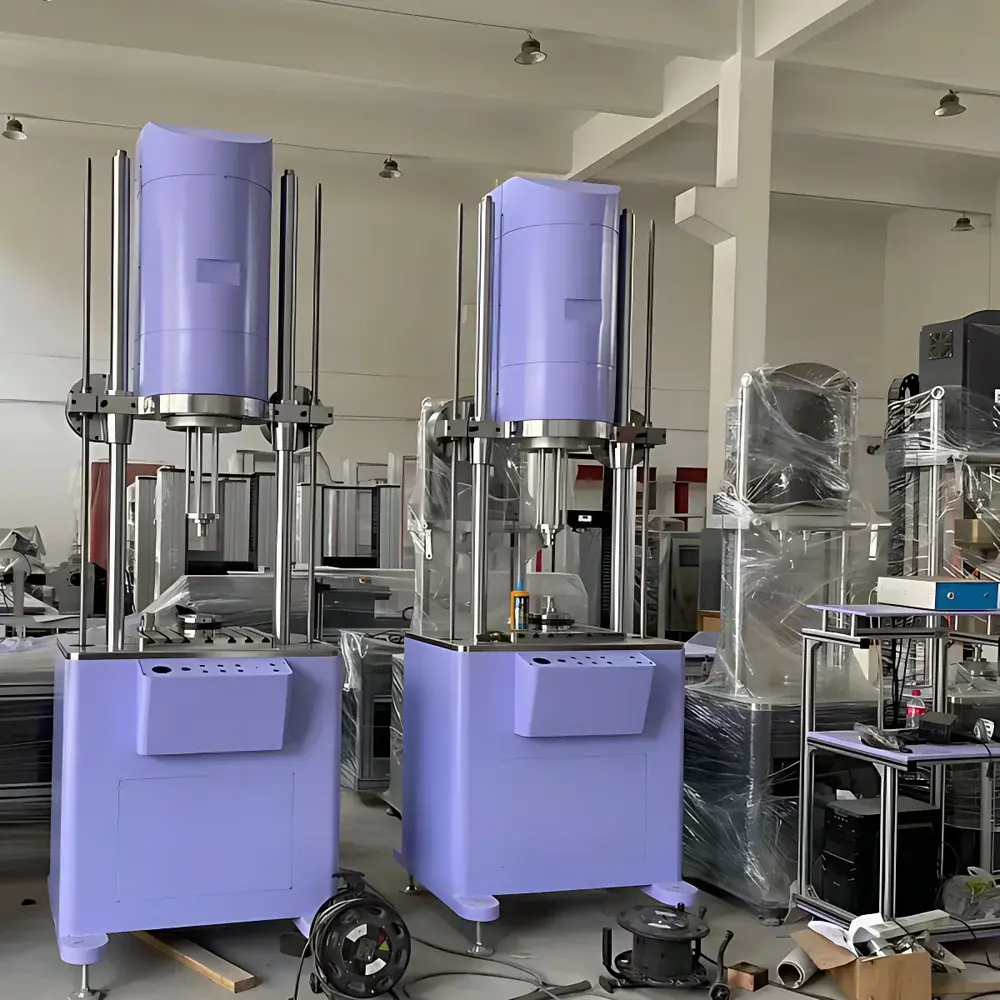
Hengyi HY(DP)50205 Electromechanical Dynamic Tension-Compression-Torsion Fatigue Testing System for Biomaterials
| Brand | Hengyi |
|---|---|
| Origin | Shanghai, China |
| Manufacturer Type | Direct Manufacturer |
| Country of Origin | China |
| Model | HY(DP)50205 |
| Max Test Load | ±5000 N / ±50 N·m |
| Force Range | 50–5000 N |
| Torque Range | 0.5–50 N·m |
| Frequency Range | 0–50 Hz |
| Actuator Stroke | ±100 mm (200 mm total) |
| Angular Displacement | 0–1000° |
| Test Space (L×W×H) | 680×700×2500 mm |
| Weight | 800 kg |
| Power Supply | 380 V, 8 kW |
| Compliance | ISO 7886-1, ASTM F1800, ISO 14879-1, ISO 12417-1, FDA 21 CFR Part 11 (software audit trail enabled) |
Overview
The Hengyi HY(DP)50205 is a fully electromechanical, closed-loop controlled dynamic fatigue testing system engineered for high-fidelity mechanical characterization of load-bearing biomedical materials and implantable devices under combined tension-compression-torsion loading conditions. Unlike hydraulic or servo-pneumatic systems, this instrument employs precision brushless servo motors coupled with high-resolution linear and rotary encoders to deliver deterministic, low-noise force and torque actuation across frequencies from static (0 Hz) up to 50 Hz. Its core architecture follows the principles of controlled cyclic loading per ISO 14879-1 (fatigue testing of orthopedic implants) and ASTM F1800 (standard practice for fatigue testing of spinal implant assemblies), enabling reproducible simulation of in vivo physiological loading profiles—including gait-cycle-mimicking waveforms (sinusoidal, triangular, trapezoidal, ramp, block-spectrum), multi-axis phase-shifted inputs, and amplitude-modulated duty cycles. Designed specifically for regulatory-grade preclinical evaluation, the system supports real-time monitoring of mechanical hysteresis, stiffness degradation, and progressive microstructural damage accumulation—critical metrics for assessing functional longevity of shape-memory alloys, biodegradable polymers, ceramic composites, and metallic bone fixation systems.
Key Features
- Triaxial electromechanical actuation: Independent, synchronized control of axial (±5000 N) and torsional (±50 N·m) loads with sub-millisecond command response time
- High-fidelity waveform generation: Programmable real-time execution of sinusoidal, cosine, square, triangular, sawtooth, ramp, and user-defined block-spectrum waveforms with adjustable phase offset between axes
- Integrated metrology: Dual-channel force/torque transducers calibrated to ISO 376 Class 1 accuracy; linear displacement resolution of 0.01 mm; angular resolution of 0.01°; closed-loop position/force/torque control stability ≤ ±1% of setpoint
- Modular environmental integration: Standard mounting interfaces for optional high-temperature furnaces (up to 1000°C), thermal chambers (−70°C to +250°C), and corrosion test enclosures (pH-controlled saline immersion)
- Hardware-level safety architecture: Redundant torque overload cutoff, specimen fracture detection via sudden force drop (>10% threshold), mechanical end-stop limit switches, and comprehensive electrical protection (overvoltage, overcurrent, overtemperature, ground fault, short-circuit)
- Structural rigidity: Monolithic steel frame with 450 mm horizontal clearance and 500 mm vertical test height; designed to minimize parasitic bending moments during off-axis loading
Sample Compatibility & Compliance
The HY(DP)50205 accommodates standardized and custom-configured specimens per ISO 5832 (metallic implant materials), ISO 13357 (ceramics), ASTM F2214 (polymeric scaffolds), and ISO 1099 (metal fatigue testing). It supports tensile, compressive, three-point/four-point bending, pure torsion, and coupled tension-torsion or compression-torsion fatigue protocols. Fixture kits include self-aligning wedge grips for brittle biomaterials, low-friction ball-joint torsion adapters, and modular jaw inserts compatible with ASTM F2503 (spinal rod fatigue) and ISO 12417-1 (dental implant abutment testing). All software operations comply with FDA 21 CFR Part 11 requirements—including electronic signatures, full audit trails, role-based access control, and immutable data archiving. System validation documentation aligns with ISO/IEC 17025 and GLP/GMP laboratory practices.
Software & Data Management
The embedded control and analysis platform operates on Windows OS with native support for English-language GUI navigation via virtual keyboard or physical input. Real-time data acquisition occurs at ≥1 kHz sampling rate, with synchronized storage of force, torque, displacement, angle, and derived parameters (stiffness, hysteresis area, cycle count). Users may define multiple stop criteria—including fatigue life (Nf), torque decay >5% from initial value, stiffness reduction ≥10%, or deviation from reference cycle amplitude. Curve visualization supports dynamic scaling, grid customization, overlay comparison of multiple tests, and export in vector (SVG/PDF) or raster (PNG/TIFF) formats. Reporting modules generate compliant PDF/Word/Excel outputs containing test metadata, environmental conditions, specimen geometry, raw and processed datasets, statistical summaries (mean ± SD, Weibull distribution fitting), and annotated failure mode annotations—all traceable to operator ID and timestamp.
Applications
- Fatigue lifetime assessment of orthopedic implants (femoral stems, acetabular cups, spinal rods, bone plates)
- Cyclic mechanical behavior of bioresorbable polymers (PLLA, PCL, Mg alloys) under simulated physiological strain rates
- Shape recovery quantification of NiTi shape-memory alloys under thermomechanical coupling
- Viscoelastic damping characterization of hydrogels and soft tissue mimics
- Mechanical integrity validation of 3D-printed porous scaffolds under multiaxial loading
- Regulatory submission testing per ISO 14242-1 (hip joint wear), ISO 14243-1 (knee joint wear), and ASTM F2028 (acetabular cup fatigue)
FAQ
What standards does the HY(DP)50205 support for regulatory submissions?
It is configured to meet ISO 14879-1, ASTM F1800, ISO 12417-1, ISO 1099, and FDA 21 CFR Part 11 requirements, with full validation documentation available upon request.
Can the system perform simultaneous tension and torsion loading with independent waveform control?
Yes—each axis operates under independent PID control loops with programmable phase delay, amplitude modulation, and frequency sweep capability.
Is environmental chamber integration factory-certified?
All thermal and corrosive environment options are mechanically and electrically validated by Hengyi’s engineering team prior to shipment, including thermal gradient mapping and EMI shielding verification.
What data security features are implemented in the software?
Role-based user permissions, encrypted local database storage, tamper-evident audit logs, automatic backup to network drives, and digital signature workflows compliant with 21 CFR Part 11 Subpart B.
Does the system support third-party transducer calibration?
Yes—the control firmware accepts NIST-traceable calibration coefficients via USB import, and supports dual-channel transducer verification using reference load cells and torque standards.
Related Products



