
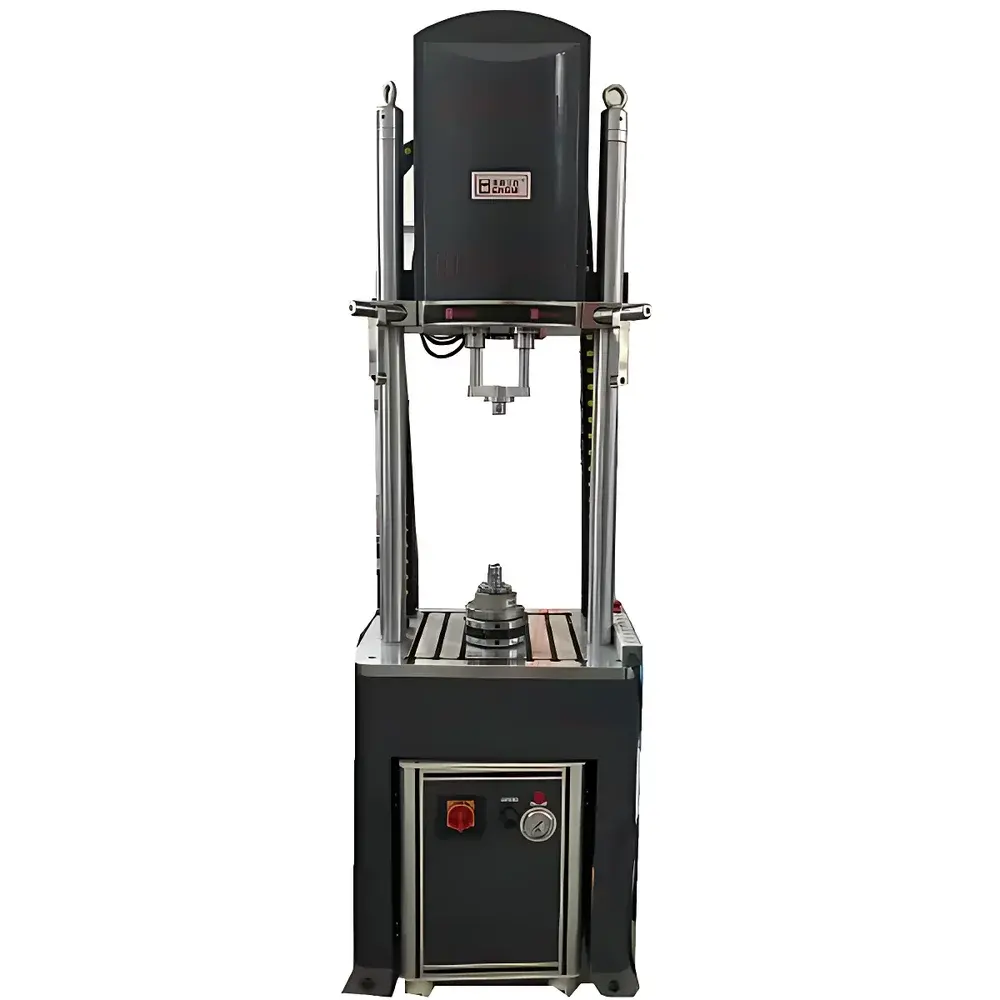
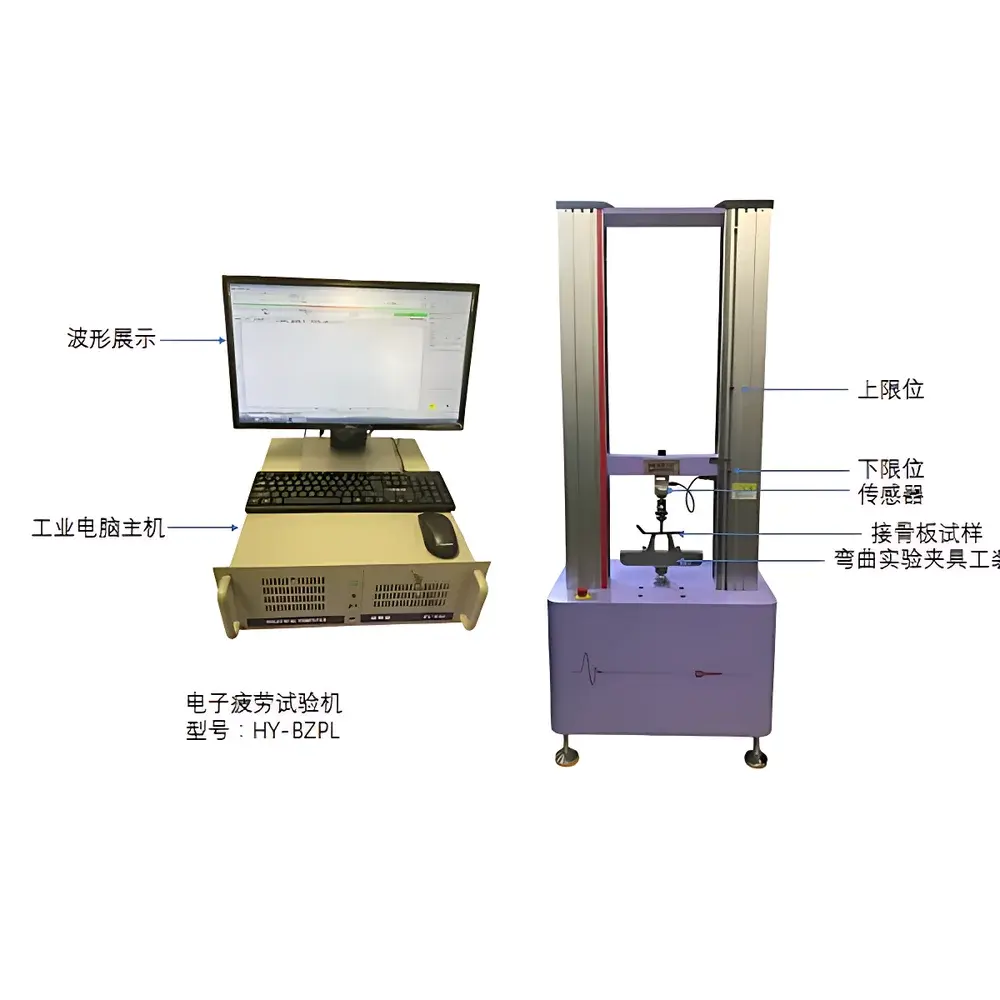
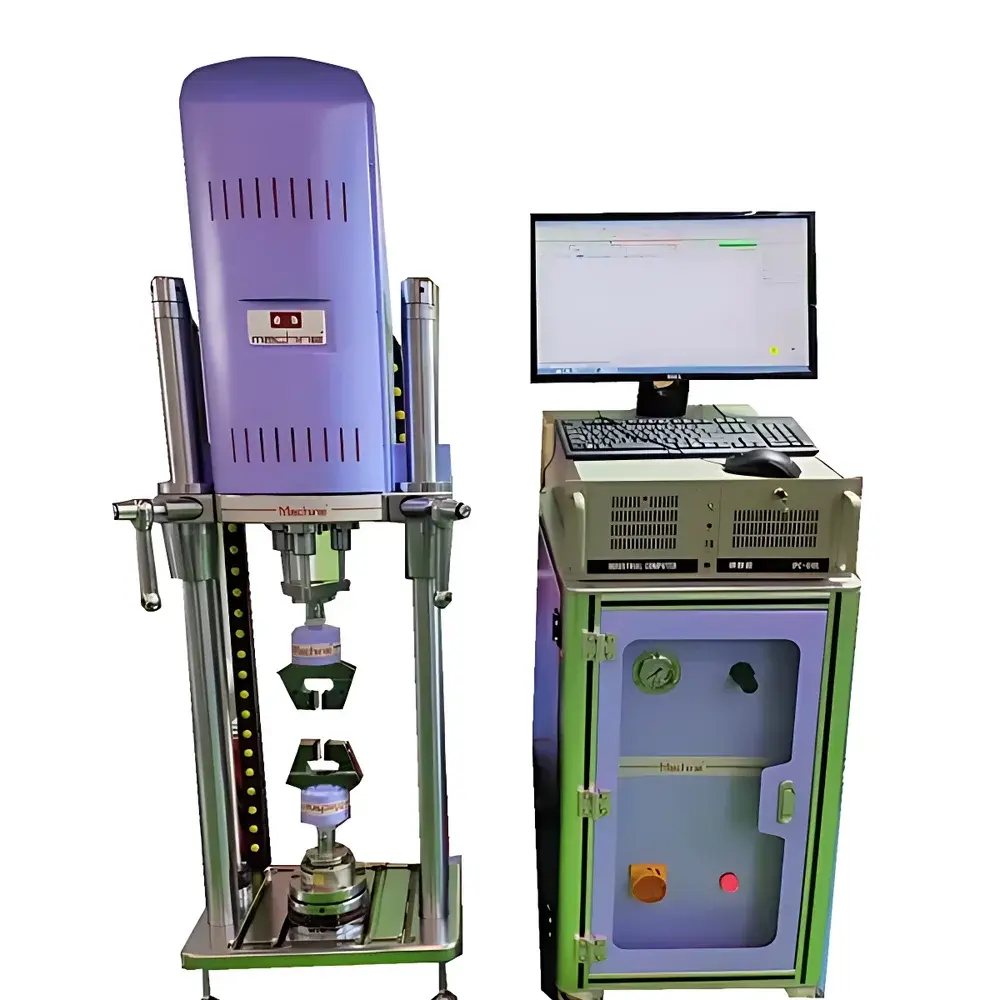
Hengyi HY(DP)502005TGG Dynamic Fatigue Testing Machine for Orthopedic Bone Plates
| Brand | Hengyi |
|---|---|
| Origin | Shanghai, China |
| Manufacturer Type | Direct Manufacturer |
| Product Category | Domestic |
| Model | HY(DP)502005TGG |
| Instrument Type | High-Frequency Fatigue Testing Machine |
| Maximum Test Load | ±5000 N |
| Torque Capacity | ±50 N·m |
| Frequency Range | 0–20 Hz |
| Actuator Displacement | 0–200 mm (±100 mm) / Rotational Angle: 0–1000° |
| Force Resolution | 0.01 N / 0.01 N·m |
| Force Accuracy | Class 1 (e.g., ±1 N at 100 N full scale) |
| Displacement Accuracy | Class 1 |
| Load Measurement Range | 50–5000 N / 0.5–50 N·m |
| Displacement Resolution | 0.01 mm |
| Control Accuracy | ±1% |
| Waveform Options | Sine, Cosine, Square, Triangle, Sawtooth |
| Horizontal Test Space | 450 mm |
| Vertical Test Height | 500 mm |
| Tensile/Compression Clearance | 300 mm / 500 mm |
| Dimensions (L×W×H) | ≈680 × 700 × 2500 mm |
| Power Supply | 380 V AC, 8 kW |
| Weight | 850 kg |
Overview
The Hengyi HY(DP)502005TGG Dynamic Fatigue Testing Machine is a microcomputer-controlled electro-mechanical testing system engineered specifically for biomechanical evaluation of orthopedic bone plates and related implant components under cyclic loading conditions. It operates on the principle of servo-controlled dynamic actuation, applying precisely regulated sinusoidal, cosine, square, triangular, or sawtooth waveforms to replicate in vivo mechanical stresses experienced by metallic and composite bone fixation devices. Designed for low-to-medium load regimes (±5000 N axial force and ±50 N·m torque), this high-frequency fatigue tester supports test frequencies up to 20 Hz—enabling accelerated life-cycle simulation while maintaining metrological traceability per ISO 7886-1, ASTM F1717, and ISO 14879-1 standards for orthopedic implant mechanical testing. Its modular architecture accommodates both uniaxial tension-compression and combined axial-torsional loading configurations, making it suitable for ISO 5832-3 (titanium alloys), ISO 5832-11 (cobalt-chromium), and ASTM F2503 (radiopacity marking) compliance verification workflows.
Key Features
- Integrated dual-sensor measurement system for simultaneous high-resolution force (0.01 N) and torque (0.01 N·m) acquisition, calibrated to Class 1 accuracy per ISO 376
- Electro-dynamic actuator with ±100 mm linear stroke and 0–1000° rotational capability, enabling coupled axial-torsional fatigue protocols per ASTM F2118/F2118M
- Real-time closed-loop control with ±1% setpoint fidelity across full frequency range (0–20 Hz), supporting waveform superposition and phase-shifted multi-axis excitation
- Adjustable test envelope: 450 mm horizontal clearance and 500 mm vertical height accommodate standard AO/ASIF plate fixtures and custom jigs; tensile/compression spaces configurable per ISO 14801 specimen geometry requirements
- Rugged welded steel frame (850 kg mass) minimizes resonance interference and ensures mechanical stability during high-cycle testing (>10⁶ cycles)
- Industrial-grade 380 V, 8 kW power supply with active cooling ensures thermal stability during extended duty cycles typical in ASTM F1160 fatigue-to-failure protocols
Sample Compatibility & Compliance
The HY(DP)502005TGG accommodates standardized bone plate specimens per ISO 14801 Annex A (single- and multi-hole titanium alloy plates), ASTM F382 (metallic bone plates), and EN 12010-1 (implant mechanical testing). Fixture interfaces comply with ISO 12189 for universal mounting of ASTM F1717 four-point bending fixtures, as well as custom three-point bending and torsion adapters. All force and displacement transducers are factory-calibrated and documented per ISO/IEC 17025 requirements. The system supports audit-ready operation under GLP and GMP environments, with optional digital signature and electronic record retention compatible with FDA 21 CFR Part 11 data integrity frameworks.
Software & Data Management
The embedded Windows-based control software provides ISO 14879-1–compliant test sequence scripting, including ramp-hold-cyclic profiles, stepwise amplitude modulation, and run-out detection logic. Raw data streams (force, torque, displacement, angle, time) are acquired at ≥1 kHz sampling rate and stored in HDF5 format for interoperability with MATLAB, Python (SciPy/Pandas), and third-party biomechanics analysis platforms. Built-in statistical modules calculate fatigue life (Nf), hysteresis loop area, stiffness degradation slope, and crack initiation thresholds. Audit trails log operator ID, calibration timestamps, parameter changes, and emergency stop events—fully traceable for regulatory submissions.
Applications
- Fatigue life assessment of stainless steel, Ti-6Al-4V, and CoCrMo bone plates per ISO 14801 and ASTM F382
- Cyclic torsional stability testing of locking screw–plate interfaces under physiological angular displacements
- Combined axial-torsional fatigue evaluation simulating gait-induced coupled loading in femoral or tibial plating systems
- Validation of finite element models using experimentally derived hysteresis and stiffness decay curves
- Preclinical durability screening of novel additively manufactured porous bone plates under variable R-ratio loading
- ISO 12189 fixture validation and inter-laboratory round-robin testing coordination
FAQ
What standards does this system support for orthopedic implant testing?
It complies with ISO 14801, ASTM F382, ASTM F1717, ISO 14879-1, ISO 7886-1, and EN 12010-1 for mechanical characterization of bone plates and associated fixation hardware.
Can the system perform combined axial and torsional fatigue tests?
Yes—the dual-actuator configuration enables synchronized or phase-controlled axial (±5000 N) and torsional (±50 N·m) loading, essential for simulating complex in vivo joint kinematics.
Is the software compliant with FDA 21 CFR Part 11 requirements?
The base software includes user access controls, electronic signatures, and immutable audit logs; full 21 CFR Part 11 compliance requires optional validated installation package and IQ/OQ documentation.
What is the maximum achievable test duration for high-cycle fatigue experiments?
With continuous cooling and stable power supply, the system supports uninterrupted operation for >1000 hours—sufficient for 10⁷-cycle tests at 20 Hz or extended low-frequency protocols at 1–5 Hz.
Does the machine support custom fixture integration?
Yes—standard M6 and M8 threaded mounting interfaces, along with 450 mm × 500 mm open test volume, facilitate rapid integration of AO/ASIF, ASTM, or customer-specific fixtures.



