
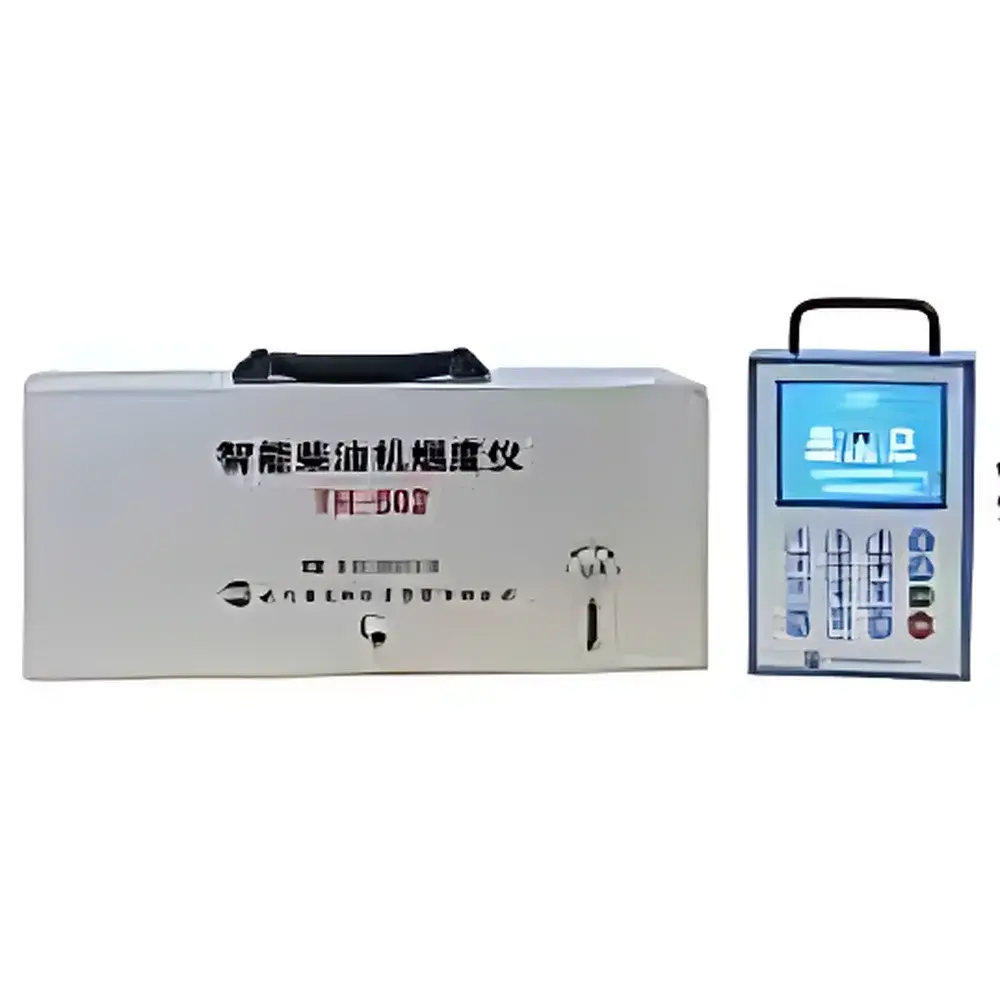
Tianhong TH-500 Intelligent Diesel Smoke Analyzer
| Brand | Tianhong |
|---|---|
| Origin | Hubei, China |
| Model | TH-500 |
| Instrument Type | Portable |
| Detection Principle | Non-Dispersive Infrared (NDIR) Absorption |
| Maximum Permissible Error | ±1% |
| Zero Drift | ±1.5% FS/8h |
| Span Drift | ±3% FS/8h |
| Repeatability | ≤1% |
Overview
The Tianhong TH-500 Intelligent Diesel Smoke Analyzer is a portable, field-deployable emission measurement instrument engineered for quantitative assessment of smoke opacity and gaseous pollutants in diesel engine exhaust streams. While the device name references “smoke,” its core analytical architecture integrates dual-modal sensing: non-dispersive infrared (NDIR) absorption for CO, CO₂, HC, and NOₓ quantification, and electrochemical cells for O₂ measurement—consistent with standardized automotive exhaust analysis protocols. It is not a filter-based opacity meter (e.g., Bosch-type smokemeter), but rather a multi-gas analyzer optimized for regulatory compliance testing under Chinese national standards GB 18285–2005 and HJ/T 289–2006. The TH-500 operates on the principle that specific infrared wavelengths are selectively absorbed by target gas molecules; photodetectors measure attenuation across calibrated optical paths to compute concentration via Beer–Lambert law-derived algorithms. Its modular design separates the sampling probe and sensor module from the display/control unit, enabling safe, ergonomic operation during roadside inspections or workshop diagnostics.
Key Features
- Modular hardware architecture: detachable probe assembly and handheld display unit support single-operator remote deployment up to 5 m via shielded cable.
- High-contrast color graphical LCD with intuitive Chinese-language menu navigation—engineered for rapid training and minimal operator error in field environments.
- Dual-power capability: operates on AC 220 V ±10% / 50 Hz or DC 12 V input—compatible with standard vehicle cigarette lighter sockets for mobile use without external batteries.
- Integrated sample conditioning system featuring hydrophobic particulate filtration and Nafion™-based moisture removal, minimizing optical path contamination and sensor poisoning.
- Multi-interface connectivity: RS-232 serial port for real-time data streaming to external PCs; USB 2.0 host port for direct firmware updates and mass storage of internal measurement logs (up to 10,000 records).
- Optional Bluetooth thermal printer integration enables on-site generation of auditable test reports compliant with inspection record retention requirements.
- Optical components utilize stabilized tungsten-halogen sources and thermopile detectors with temperature-compensated signal processing to maintain long-term calibration integrity.
Sample Compatibility & Compliance
The TH-500 is validated for exhaust sampling from light-duty diesel vehicles, heavy-duty trucks, agricultural machinery, and motorcycles operating under idle, snap-acceleration, and steady-state conditions. It meets the metrological performance criteria specified in GB 18285–2005 (Limits and Measurement Methods for Exhaust Pollutants from Spark-Ignition Engine Vehicles) and HJ/T 289–2006 (Technical Requirements for Dual-Idle Test Equipment for Gasoline Vehicles)—though its NDIR platform is equally applicable to diesel-specific verification per GB 3847–2018 (Limits and Measurement Methods for Smoke Emissions from Compression Ignition Engines and Compression Ignition Engine Vehicles). All gas channel materials comply with ISO 16145:2015 (Compatibility of Sampling Systems with Automotive Exhaust Gases). The instrument’s documented uncertainty budget, zero/span drift stability, and repeatability metrics align with GLP-aligned quality assurance frameworks used by provincial environmental monitoring stations.
Software & Data Management
The TH-500 supports bidirectional communication with proprietary PC-based software (Windows 10/11 compatible), enabling full configuration management, calibration certificate generation, and statistical reporting—including pass/fail flagging against jurisdictional limit values. Raw data export is available in CSV and XML formats, preserving timestamp, ambient temperature/pressure metadata, and sensor diagnostic flags. Audit trail functionality records all calibration events, parameter modifications, and firmware updates with user ID and UTC timestamps—supporting traceability requirements analogous to FDA 21 CFR Part 11 principles where local regulatory adoption permits. Internal memory retains date-stamped measurement sessions with automatic overwrite protection for critical compliance records.
Applications
- Routine emissions screening at motor vehicle inspection & maintenance (I/M) stations and traffic law enforcement checkpoints.
- Pre-delivery quality assurance testing in OEM assembly plants and Tier-1 component supplier validation labs.
- Periodic technical supervision for municipal bus fleets, logistics operators, and municipal sanitation vehicle depots.
- Field research by environmental science institutions evaluating aftertreatment system efficiency (e.g., DPF regeneration cycles, SCR urea dosing accuracy).
- Training platforms in vocational colleges delivering certified technician curricula aligned with China’s Motor Vehicle Inspection Technician Qualification Standards.
FAQ
Does the TH-500 measure particulate matter (PM) or PM2.5 directly?
No. It does not quantify mass concentration of suspended particulates. Its “smoke” designation reflects its intended use in diesel exhaust opacity correlation studies—not gravimetric PM analysis. For regulatory PM measurement, refer to EN 16454-compliant tapered element oscillating microbalances or laser scattering spectrometers.
Can the TH-500 be calibrated using certified gas standards traceable to NIM?
Yes. The instrument accepts multi-point calibration with NIM-traceable NIST-equivalent gas mixtures (e.g., CO/N₂, NO/N₂, C₃H₈/N₂) via its built-in calibration mode. Certificate of calibration must be retained per GB/T 27418–2017 guidelines.
Is firmware upgrade supported over USB without vendor intervention?
Yes. Field-upgradable firmware binaries are distributed via Tianhong’s authorized service portal. Updates preserve user-configured limits and historical data archives.
What is the recommended recalibration interval under continuous daily use?
Per Q/WTH 29–2012, zero and span checks are required before each shift; full multi-point calibration is mandated every 90 operational days or after 500 measurement cycles—whichever occurs first.
Does the device meet electromagnetic compatibility (EMC) requirements for roadside deployment?
Yes. Certified to GB/T 18655–2018 (equivalent to CISPR 25:2016) for radiated and conducted emissions in automotive environments.
Related Products







