
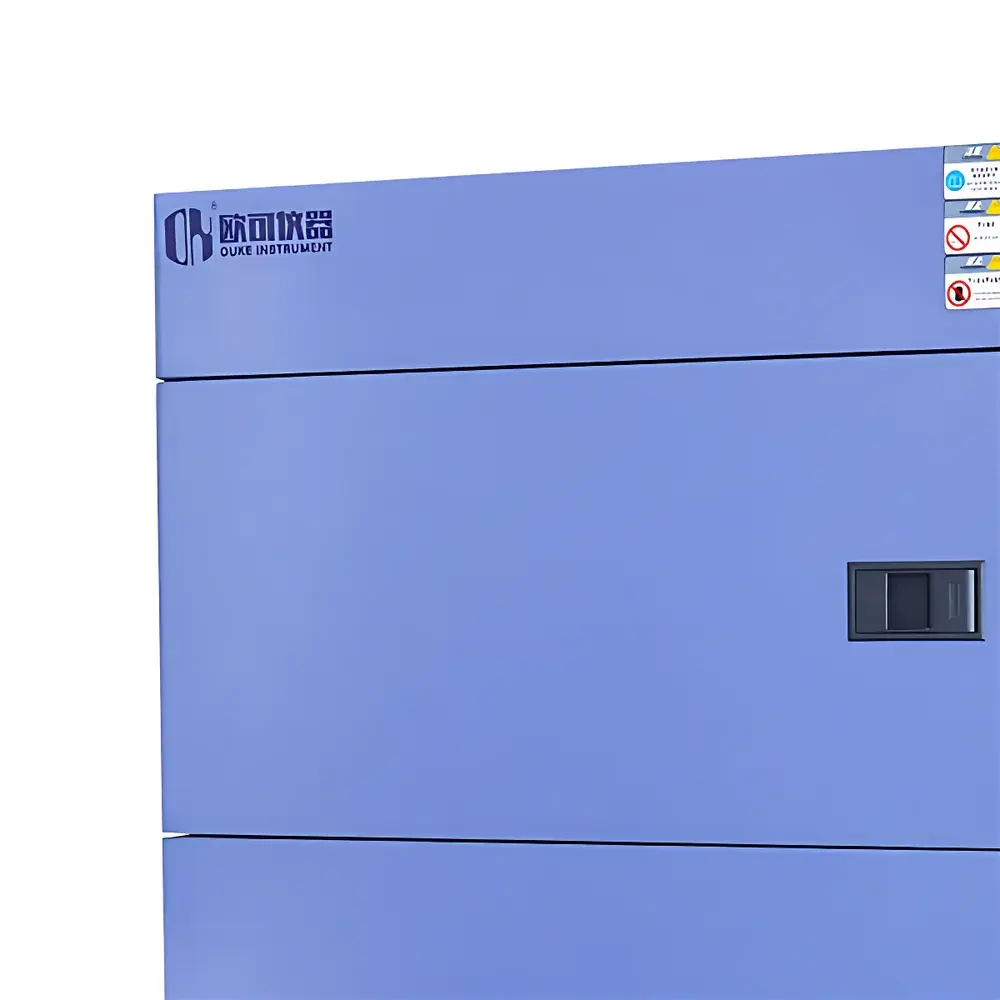
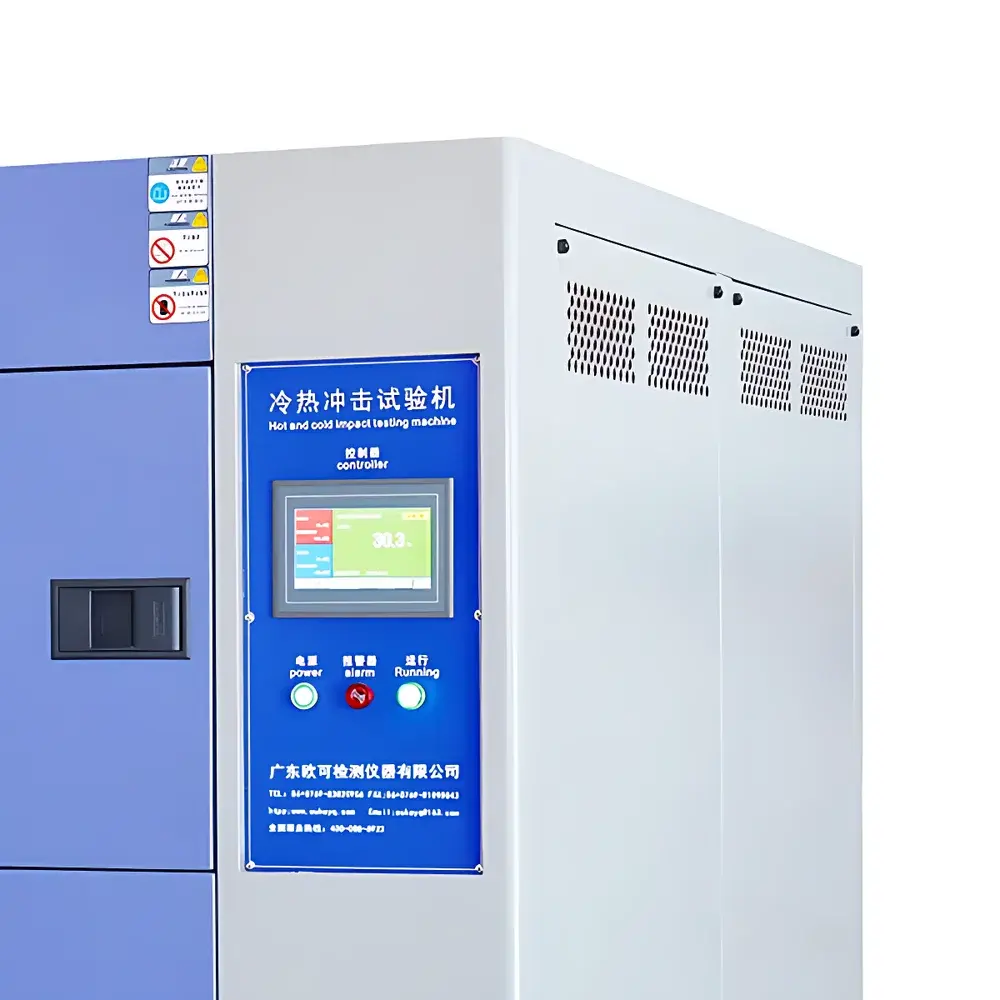
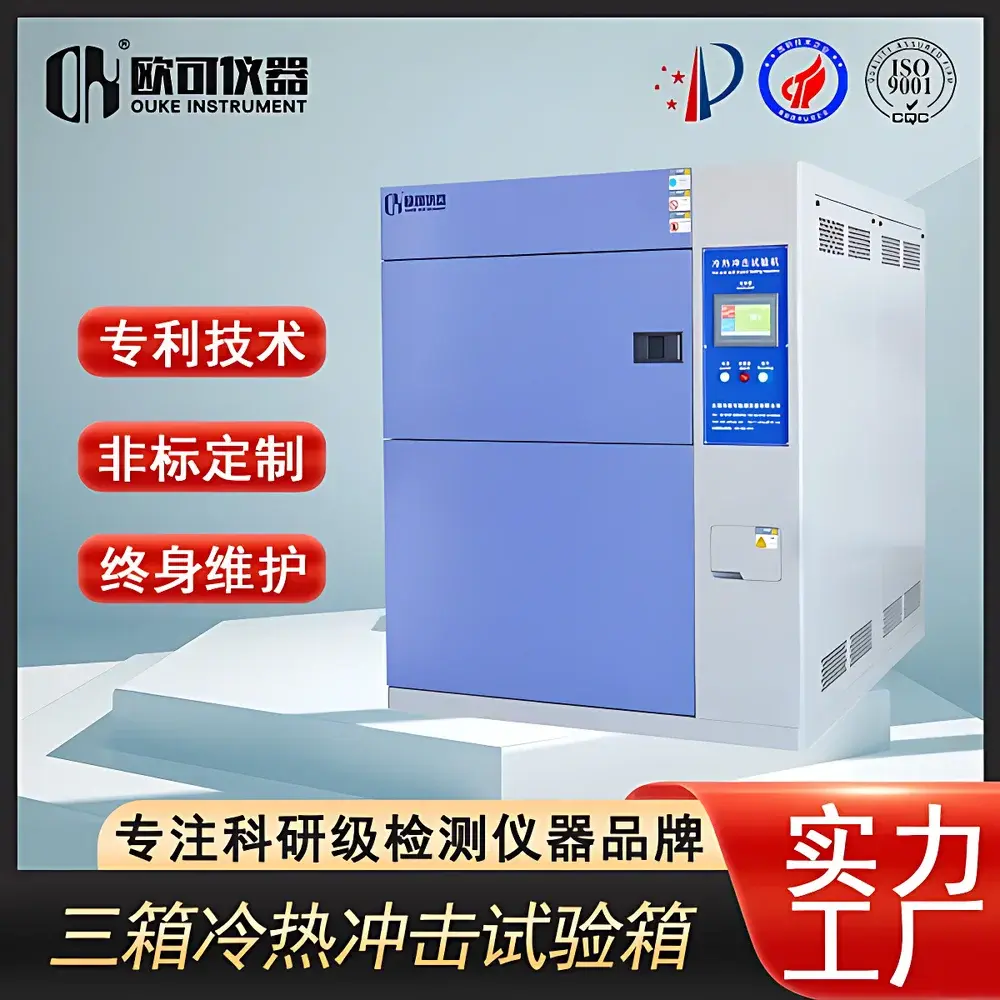
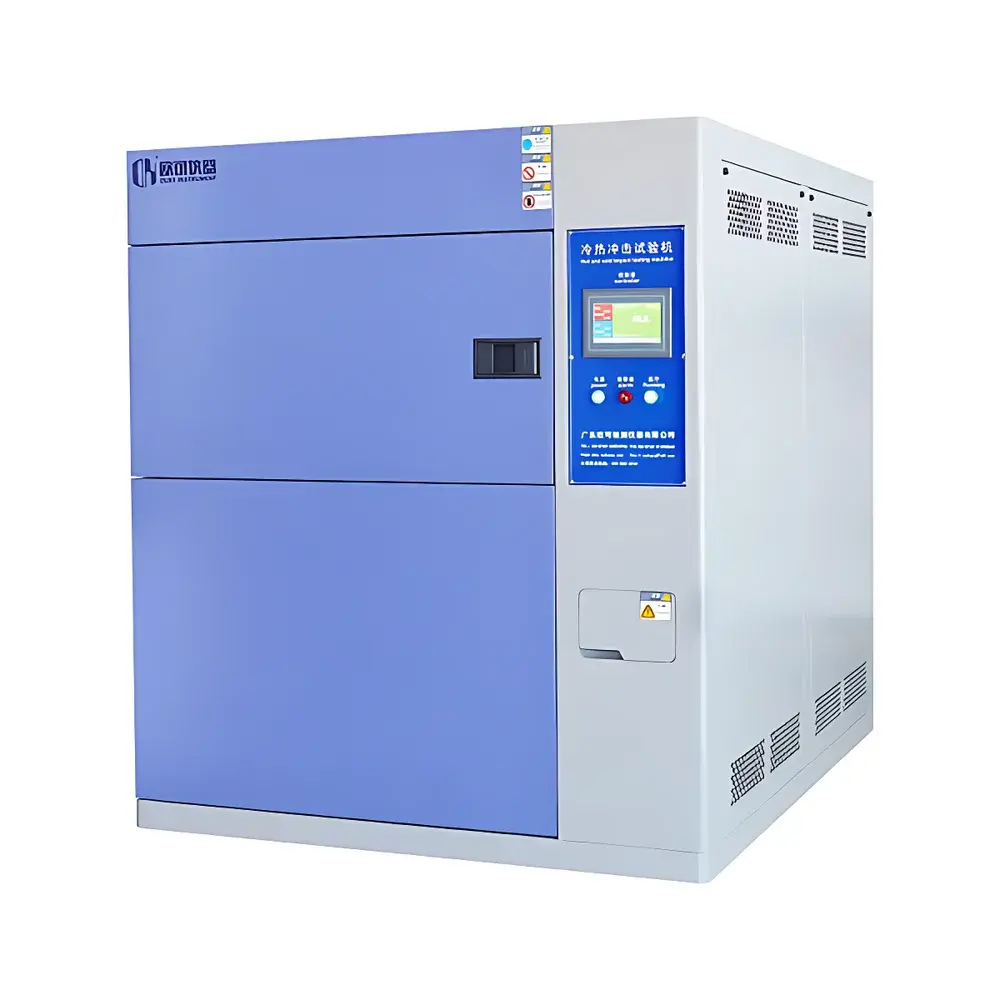
OK Instruments OK-TS-1.1 Thermal Shock Test Chamber
| Brand | OK Instruments |
|---|---|
| Origin | Guangdong, China |
| Manufacturer Type | OEM/ODM Manufacturer |
| Country of Origin | China |
| Model | OK-TS-1.1 |
| High Temperature Range | +180 °C |
| Low Temperature Range | −40 °C |
| Thermal Shock Range | −40 °C to +180 °C |
| Temperature Stability | ±2 °C |
| Heating Rate | 10 °C/min |
| Cooling Rate | 10 °C/min |
Overview
The OK Instruments OK-TS-1.1 Thermal Shock Test Chamber is an engineered environmental test system designed for rapid, repeatable, and high-fidelity thermal cycling evaluation of electronic components, automotive modules, aerospace assemblies, and polymer-based materials. It operates on the two-zone (hot/cold) air-blast principle—featuring independent high-temperature and low-temperature chambers with pneumatically actuated transfer doors—to subject stationary test specimens to abrupt temperature transitions without mechanical movement of the sample itself. This architecture ensures superior thermal shock repeatability, eliminates vibration-induced artifacts during transfer, and conforms to the physical assumptions underlying standards such as IEC 60068-2-14 (Test N: Change of Temperature) and MIL-STD-810H Method 503.7. The chamber employs a dual-stage cascade refrigeration system utilizing environmentally compliant refrigerants (R404A/R23), integrated with precision PID-controlled heating and forced-air circulation to achieve specified ramp rates and stabilization performance across its full operational envelope.
Key Features
- Two-zone static-sample configuration: test specimen remains fixed in central test compartment; hot/cold air is directed via high-speed pneumatic dampers—eliminating basket motion and associated mechanical stress or positional uncertainty
- Dual-stage cascade refrigeration system with semi-hermetic German compressors and water-cooled condensers (external cooling tower required: 10 m³/h flow capacity)
- Temperature ramp rates up to 10 °C/min (heating and cooling), validated per ASTM E1545 and IEC 60068-3-5
- Stable operating range: −40 °C to +180 °C, with temperature uniformity ≤ ±2.0 °C and control accuracy ±0.5 °C (measured at load center per ISO 16750-4 Annex C)
- Interior constructed from mirror-finish SUS#304 stainless steel; exterior options include brushed stainless or powder-coated steel; insulation via high-density, flame-retardant polyurethane foam (≥30 mm thickness)
- Integrated safety architecture: over-temperature cut-off, refrigerant pressure monitoring, door interlock, and emergency stop circuit compliant with EN 61000-6-2/6-4 EMC requirements
Sample Compatibility & Compliance
The OK-TS-1.1 accommodates standard industrial test samples up to 40 × 35 × 30 cm (W×H×D), with customizable internal dimensions available upon request (e.g., OK-TS-80, OK-TS-150). Its design satisfies rigorous qualification protocols across multiple regulatory domains: it fully implements GB/T 2423.22–2002 (equivalent to IEC 60068-2-14), GJB 150.5–2009 (military thermal shock), QC/T 17–2019 (automotive component durability), and EIA-364-32 (electrical connector thermal cycling). All control firmware and data logging functions support audit-ready operation under GLP and GMP frameworks, including optional 21 CFR Part 11-compliant user access controls, electronic signatures, and immutable event logs when paired with OK-DataLink™ software.
Software & Data Management
Equipped with OK-DataLink™ v4.2 embedded controller, the system delivers real-time monitoring of chamber setpoints, actual temperatures (multi-point sensor array), refrigerant pressures, door status, and cycle phase progression. All parameters are timestamped with millisecond resolution and stored internally (≥100,000 records) plus exportable via USB or Ethernet to CSV/Excel. Optional cloud synchronization enables remote diagnostics, predictive maintenance alerts (compressor runtime, refrigerant charge estimation), and integration into enterprise MES/QMS platforms via Modbus TCP or OPC UA. Calibration traceability is maintained through NIST-traceable thermistor probes (certified annually), with full calibration history archived alongside test reports.
Applications
- Qualification testing of PCBAs, solder joints, and encapsulated ICs per IPC-9701A and JEDEC JESD22-A104E
- Accelerated life assessment of battery cells (Li-ion, solid-state) under extreme thermal transients
- Validation of thermal interface materials (TIMs), conformal coatings, and potting compounds
- Aerospace avionics box certification per DO-160 Section 4 (Temperature Variation)
- Automotive ECUs and ADAS sensors per ISO 16750-4 and LV-124
- Reliability screening of medical device housings and sterilizable components
FAQ
What is the difference between two-zone and three-zone thermal shock configurations?
The OK-TS-1.1 uses a two-zone design: separate hot and cold chambers with rapid air transfer. Three-zone systems add a dedicated test zone and require specimen movement—increasing mechanical complexity and potential for positional error. Two-zone designs offer higher reproducibility for static-mount applications.
Is external cooling infrastructure mandatory?
Yes. The cascade refrigeration system requires a dedicated water-cooled condenser loop with ≥10 m³/h flow capacity at 32 °C inlet temperature. A closed-loop cooling tower must be installed externally by the end user.
Can the chamber be validated for IQ/OQ/PQ protocols?
Yes. Factory-installed Class A PT100 sensors (±0.15 °C accuracy), documented calibration certificates, and configurable alarm thresholds support full GxP validation per ASTM E2500 and Annex 15.
What maintenance intervals are recommended?
Compressor oil analysis every 2,000 operating hours; refrigerant leak check quarterly; damper actuator lubrication biannually; full system calibration annually or after major component replacement.
Does the system support custom test profiles with dwell time, ramp rate, and cycle count programming?
Yes. Up to 99 programmable steps per profile, including variable ramp rates, hold durations, and conditional branching (e.g., “if T > 175 °C, pause for 2 min before next step”). Profiles are saved and recalled via encrypted SD card or network upload.



