
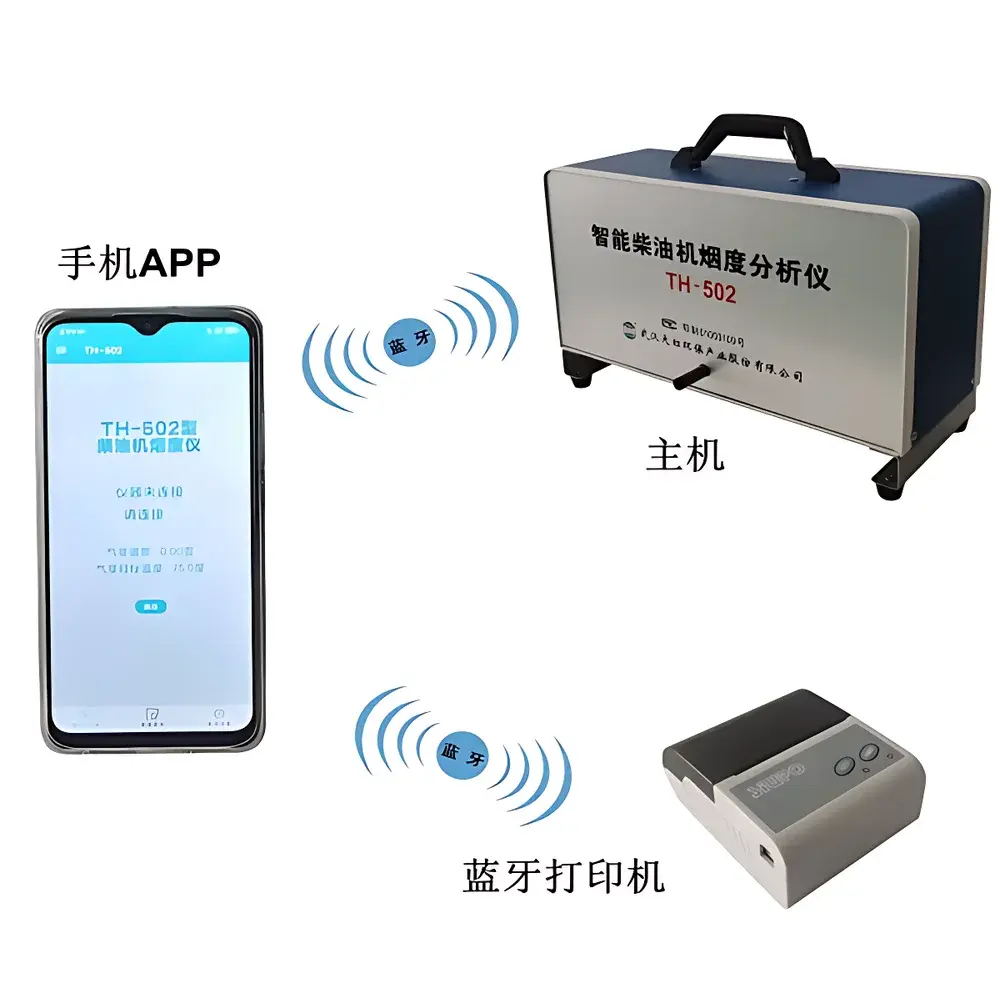
Tianhong TH-502 Intelligent Diesel Engine Opacity Analyzer
| Brand | Tianhong |
|---|---|
| Origin | Hubei, China |
| Manufacturer Type | Authorized Distributor |
| Origin Category | Domestic (China) |
| Model | TH-502 |
| Price Range | USD 3,500 – 5,600 |
| Measurement Principle | Split-stream opacimetric (non-transmissivity) optical method |
| Operating Temperature | 80 ± 1 °C (measurement chamber) |
| Power Supply | Rechargeable Li-ion battery (≥8 h continuous operation) |
| Data Interface | Bluetooth 4.0 (host-to-mobile), optional GPRS module |
| Output Units | Opacity (%) and Light Absorption Coefficient (k, m⁻¹) |
| Compliance Standards | GB 3847–2018, GB 36886–2018, HJ/T 395–2007 |
| Calibration | Auto-zero and auto-span via single-button initiation |
| Sample Interface | Direct exhaust coupling via probe and flexible sampling line |
| Display & Storage | Real-time visualization and logging via Android/iOS app |
| Printing | Bluetooth thermal printer support |
| Environmental Protection | Dual air curtain optical protection system |
| Warm-up Time | ≤5 min to operational temperature |
Overview
The Tianhong TH-502 Intelligent Diesel Engine Opacity Analyzer is a field-deployable, battery-powered opacimeter engineered for regulatory-compliant measurement of diesel exhaust smoke opacity under real-world operating conditions. It operates on the split-stream non-transmissivity optical principle—where a stable LED light source passes through a heated, temperature-controlled measurement chamber, and photodetectors quantify attenuation of light intensity caused by suspended particulate matter in the exhaust stream. The instrument calculates both opacity (%) and light absorption coefficient (k, expressed in m⁻¹), two internationally recognized metrics defined in ISO 8549, ASTM D2156, and harmonized with China’s national standards GB 3847–2018 (for on-road vehicles) and GB 36886–2018 (for non-road mobile machinery). Its core architecture integrates thermally stabilized optics, dual air curtain isolation, and embedded microprocessor-based signal conditioning to ensure high reproducibility across ambient temperature fluctuations and repeated field use.
Key Features
- Battery-operated design with high-capacity lithium-ion pack supporting ≥8 hours of continuous measurement—enabling fully cordless operation at roadside checkpoints, repair shops, or remote inspection sites without AC infrastructure.
- Bluetooth 4.0 wireless communication enables seamless pairing with Android and iOS smartphones or tablets; all instrument control, real-time data visualization, and configuration are managed via a dedicated, validated mobile application.
- Dual air curtain technology isolates the optical path from exhaust condensates and soot deposition, significantly extending optical component service life and reducing maintenance frequency.
- Heated measurement chamber maintains precise 80 ± 1 °C operating temperature—suppressing water vapor condensation and minimizing refractive index drift, thereby enhancing measurement stability during high-humidity conditions.
- Sub-5-minute warm-up time ensures rapid deployment; heating rate is dynamically optimized based on battery charge level and ambient temperature.
- One-touch automatic calibration routine performs simultaneous zero-point (clean air reference) and full-scale (100% opacity reference) alignment—eliminating manual adjustment steps and reducing operator dependency.
- Multi-mode testing capability: supports free-acceleration test (per GB 3847), steady-state loaded measurement, real-time continuous monitoring, and optional Ringelmann scale correlation (via image-based post-processing).
Sample Compatibility & Compliance
The TH-502 is designed exclusively for gaseous exhaust streams from compression-ignition (diesel) engines, including light-duty and heavy-duty on-road vehicles, construction equipment, agricultural machinery, generators, and marine auxiliary engines. It interfaces directly with standard exhaust probes and flexible sampling lines (ID: 6 mm), accommodating flow rates typical of transient and steady-state engine operation. All hardware and firmware comply with the metrological and functional requirements specified in GB 3847–2018, GB 36886–2018, and HJ/T 395–2007—including photometric accuracy, response time (<1 s), temperature control tolerance, and calibration traceability. While not certified to ISO/IEC 17025 for accredited laboratory use, its design aligns with GLP-aligned field verification practices and supports audit-ready digital records when paired with timestamped, geotagged mobile app logs.
Software & Data Management
Data acquisition, processing, and reporting are handled entirely through the companion mobile application, which implements local on-device storage using encrypted SQLite databases. Each measurement record includes: test mode, timestamp, GPS coordinates (optional), engine RPM (if externally interfaced), opacity (%), k-value (m⁻¹), chamber temperature, battery status, and operator ID. Export options include CSV for laboratory integration and PDF report generation—compatible with Bluetooth thermal printers for immediate hard-copy issuance at inspection points. The device reserves space for an optional GPRS module, enabling scheduled or event-triggered upload of measurement archives to centralized environmental monitoring platforms—supporting fleet-level emissions trend analysis and regulatory reporting workflows. All software updates are delivered over-the-air (OTA) with version-controlled release notes and change logs.
Applications
The TH-502 serves as a primary field tool for regulatory enforcement agencies conducting roadside emissions inspections, vehicle inspection & maintenance (I/M) programs, and periodic technical supervision of non-road diesel equipment. It is widely deployed in automotive OEM R&D labs for pre-certification engine calibration validation, in independent repair facilities for post-repair smoke diagnostics, and in academic research settings studying particulate formation mechanisms under varying fuel injection strategies and aftertreatment configurations. Its portability and low operational overhead also make it suitable for mobile environmental monitoring units performing ambient air quality impact assessments near transportation corridors or industrial zones.
FAQ
What standards does the TH-502 comply with for official emissions testing?
It meets the functional, metrological, and procedural requirements of GB 3847–2018, GB 36886–2018, and HJ/T 395–2007—making it suitable for statutory inspections in China’s motor vehicle and non-road diesel equipment regulatory frameworks.
Can the TH-502 be used for continuous emission monitoring (CEM)?
No—it is designed for spot-check and transient testing (e.g., free acceleration), not for permanent stack-mounted CEM systems requiring 24/7 unattended operation and certified data integrity per EN 14181.
Is the mobile app compatible with enterprise-grade MDM (mobile device management) systems?
Yes—the Android APK supports standard Android Enterprise enrollment and can be provisioned via Google Play Private Channel or sideloaded with signed certificates for institutional deployment.
Does the instrument support external sensor inputs (e.g., RPM, O₂)?
The base model does not include analog/digital I/O ports; however, the firmware architecture reserves UART and GPIO interfaces for future OEM-integrated expansion modules.
How often does the optical system require cleaning or recalibration?
Under normal field use (≤10 tests/day), optical cleaning is recommended every 3 months; automatic calibration is performed before each test session, and annual verification against NIST-traceable opacity standards is advised for regulatory continuity.
Related Products







