
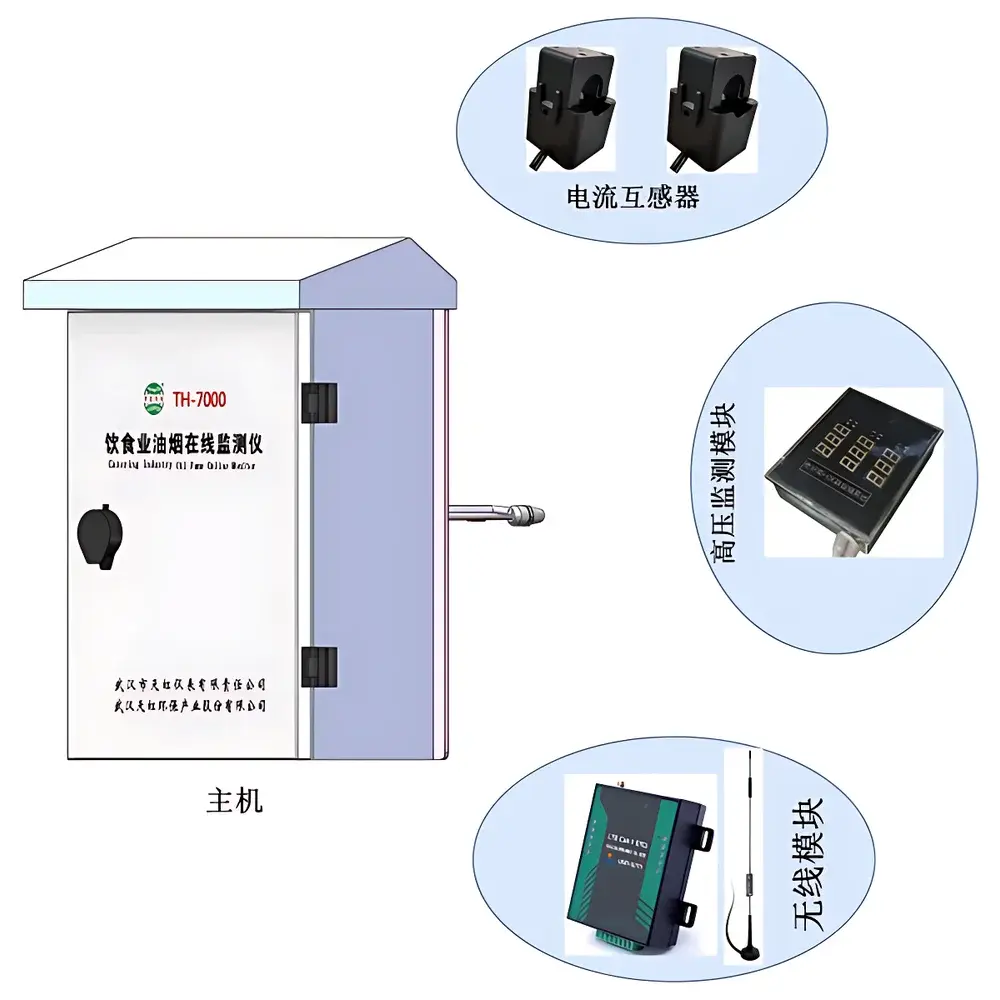
Tianhong TH-7000 Portable Cooking Oil Fume Monitoring Analyzer
| Brand | Tianhong |
|---|---|
| Origin | Hubei, China |
| Model | TH-7000 |
| Compliance | GB 18483–2001, Q/WTH 30–2017 |
| Measurement Principle | Laser Light Scattering (for oil fume particulate mass concentration), Electrochemical Sensing (for Non-Methane Hydrocarbons, NMHC) |
| Display | 7-inch Color TFT Touchscreen (Chinese UI) |
| Data Storage | Up to 45,000 records |
| Communication Interfaces | RS232, RS485, Ethernet, GPRS/DTU |
| Environmental Operating Range | 0–40 °C with Internal Thermostatic Control |
| Explosion-Proof Enclosure | IP65-rated Industrial Housing |
| Flow Measurement | Integrated S-type Pitot Tube (factory-calibrated in proprietary wind tunnel) |
| Sensor Lifetime | >2 years (typical field service life under routine maintenance) |
| Power Input | AC 220 V ±10%, 50 Hz |
| Dimensions | 420 × 320 × 180 mm |
| Weight | ~8.5 kg |
Overview
The Tianhong TH-7000 Portable Cooking Oil Fume Monitoring Analyzer is an integrated, field-deployable instrument engineered for regulatory-compliant measurement of cooking-related emissions from commercial kitchen exhaust systems. It operates on two parallel physical detection principles: laser light scattering for real-time quantification of airborne oil fume particulate mass concentration (expressed as mg/m³), and electrochemical sensing for non-methane hydrocarbon (NMHC) gas-phase concentration (expressed as mg/m³ or ppm C₁–C₆ equivalent). Designed specifically to meet the technical requirements of China’s GB 18483–2001 “Emission Standard of Odor Pollutants from Catering Services”, the TH-7000 performs simultaneous, synchronized acquisition of emission concentration, flue gas velocity, temperature, volumetric flow rate, and auxiliary operational parameters—including fan current, purifier high-voltage output (voltage, current, power), and ambient air cleanliness index. Its embedded calibration model library—developed through multi-year empirical correlation studies across diverse regional cuisines—enables traceable conversion from raw particulate scattering signals to standardized oil fume concentration values referenced to 2000 m³/h baseline flow.
Key Features
- Integrated tri-functional architecture: Simultaneous monitoring of oil fume particulates, NMHC gases, and flue duct operational parameters (velocity, temperature, static pressure, flow rate)
- Factory-calibrated S-type Pitot tube with proprietary wind tunnel traceability for ISO/IEC 17025-aligned flow measurement uncertainty ≤ ±5% FS
- Laser scattering sensor with temperature-stabilized optical path and automatic zero drift compensation; electrochemical NMHC sensor with linear output and built-in temperature/pressure compensation
- Thermostatically controlled enclosure (0–40 °C operating range) featuring active heating below 5 °C and forced-air cooling above 35 °C to ensure sensor stability and signal fidelity
- Explosion-proof industrial housing rated IP65 per IEC 60529, suitable for installation in grease-laden, high-humidity kitchen utility rooms and basement-level duct access points
- Modular sensor design enabling field-replaceable units without recalibration; documented mean time between failures (MTBF) >12,000 hours for core optical and electrochemical modules
- Onboard data logging capacity of 45,000 timestamped records with UTC synchronization, supporting GLP-compliant audit trails
Sample Compatibility & Compliance
The TH-7000 is validated for use with hot, humid, and particle-laden exhaust streams typical of Chinese-style wok cooking, steam-boiling, deep-frying, and roasting operations. It accommodates flue gas temperatures up to 120 °C (with optional high-temp probe extension), particulate loadings from 0.1 to 50 mg/m³, and NMHC concentrations spanning 0.5–200 mg/m³ (as propane equivalent). All measurement algorithms and calibration curves are derived from reference datasets traceable to national standard substances (GBW(E) standards) and verified against gravimetric filter-based reference methods per GB/T 16157–1996. The instrument conforms to GB 18483–2001 Annex B (field measurement protocol), Q/WTH 30–2017 enterprise specification, and supports documentation generation compliant with local environmental supervision reporting formats (e.g., HJ 972–2018).
Software & Data Management
The TH-7000 runs embedded Linux-based firmware with a 7-inch capacitive touchscreen interface offering full Chinese-language operation, intuitive menu navigation, and context-sensitive help. Data export is supported via USB mass storage, SD card, or network protocols (TCP/IP, Modbus TCP). Optional cloud integration enables remote data upload to municipal environmental monitoring platforms using TLS-secured MQTT or HTTP POST. Audit logs record all configuration changes, calibration events, and alarm triggers with user ID and timestamp. Firmware updates are performed via signed binary packages to maintain integrity. While not certified for FDA 21 CFR Part 11, the system supports manual electronic signature workflows and provides immutable record timestamps aligned with NTP servers—facilitating internal GLP/GMP-aligned quality review processes.
Applications
- Regulatory field inspections by municipal ecological environment bureaus and district-level enforcement teams
- Pre-commissioning verification and periodic performance audits of electrostatic precipitators (ESPs) and UV-catalytic oxidation units
- Real-time emission trending during peak-hour kitchen operation to optimize purifier duty cycles and maintenance scheduling
- Baseline characterization for environmental impact assessments (EIAs) of new food service developments
- Research applications in indoor air quality (IAQ) studies focusing on occupational exposure limits (OELs) for cooking-related aerosols
- Supporting sustainability reporting by quantifying emission reductions post-upgrade of ventilation and purification infrastructure
FAQ
Does the TH-7000 require external calibration gases or reference filters during routine operation?
No. The instrument uses factory-established calibration models and internal reference checks. Gravimetric validation using quartz fiber filters (per GB/T 16157) is recommended annually or after sensor module replacement.
Can the TH-7000 operate continuously inside a smoke duct?
It is designed for external mounting on duct access ports using the supplied Pitot tube assembly. Direct in-duct insertion is not supported; continuous in-situ deployment requires the TH-7000-Rack stationary variant.
Is the NMHC sensor cross-sensitive to ethanol or acetaldehyde commonly emitted during steaming?
The electrochemical cell is optimized for C₂–C₆ aliphatic hydrocarbons. Ethanol interference is <3% at 100 ppm; acetaldehyde response is negligible below 50 ppm—verified per Q/WTH 30–2017 interference testing protocol.
How is flow rate calculated when duct geometry is irregular or upstream turbulence exists?
The S-type Pitot tube follows ISO 10780 guidance for multi-point traverse averaging. Users may input duct cross-sectional area manually or select from predefined shapes (circular, rectangular, oval); velocity profiles are corrected using built-in turbulence compensation coefficients.
What data security measures are implemented for remote GPRS transmission?
All wireless transmissions use AES-128 encryption. DTU modules support APN lockdown, SIM PIN locking, and configurable heartbeat intervals to prevent unauthorized access or session hijacking.
Related Products







