
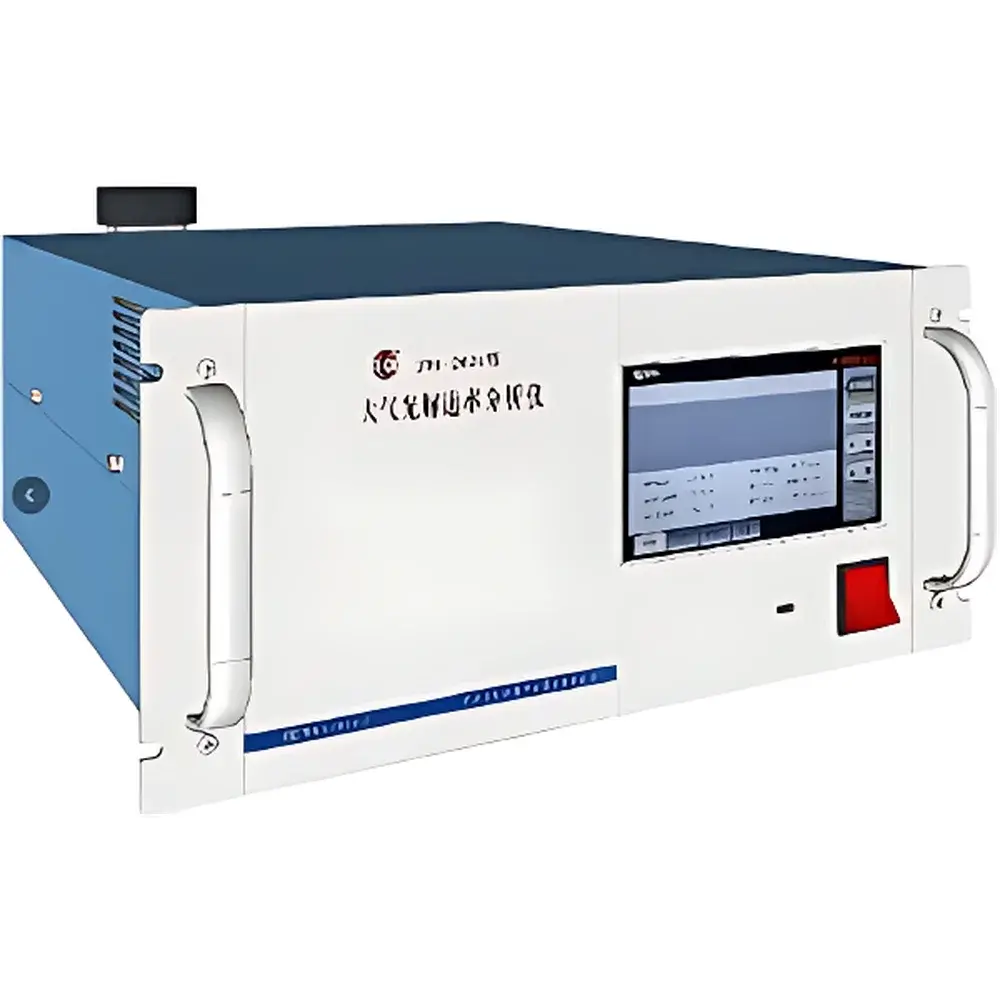
Tianhong TH-2024 Atmospheric Photolysis Rate Analyzer
| Brand | Tianhong |
|---|---|
| Origin | Hubei, China |
| Model | TH-2024 Atmospheric Photolysis Rate Analyzer |
| Detection Principle | Broadband Solar Spectral Irradiance Measurement (280–450 nm) |
| Detector Type | Thermoelectrically Cooled CCD Array Spectrometer |
| Spectral Resolution | ≤1.5 nm (FWHM) |
| Integration Time Range | 10 ms – 60 s |
| Output Data | J-value spectra (s⁻¹), wavelength-resolved photolysis rates for NO₂, HCHO, O₃, HONO, and other key atmospheric precursors |
| Compliance | Q/WTH 206–2022 |
Overview
The Tianhong TH-2024 Atmospheric Photolysis Rate Analyzer is a field-deployable, spectroradiometric instrument engineered to quantify actinic flux-weighted photolysis frequencies (J-values) of critical atmospheric trace species under ambient solar irradiance. It operates on the fundamental principle of broadband spectral irradiance measurement: a cosine-corrected optical head collects hemispherical solar radiation across the biologically and photochemically active UV–visible range (280–450 nm), which is then dispersed by a high-fidelity grating spectrometer and detected by a thermoelectrically cooled CCD array. The system computes wavelength-resolved photolysis rates using pre-loaded quantum yield and absorption cross-section datasets compliant with JPL and IUPAC recommendations. Unlike passive filter-based radiometers or single-wavelength photodiodes, the TH-2024 delivers full-spectrum resolution, enabling simultaneous derivation of J(NO₂), J(HCHO), J(O₃), J(HONO), and other tropospheric photolysis channels—essential inputs for photochemical box modeling, air quality forecasting, and ozone formation potential assessment.
Key Features
- Thermoelectrically cooled CCD detector with dark-current suppression, delivering stable signal-to-noise ratios (SNR > 1000:1 at 30 s integration) across the 280–450 nm range
- Optically optimized cosine receptor with <±3% angular response deviation up to 80° zenith angle, certified per ISO 9060:2018 Class C specifications
- Adjustable integration time (10 ms – 60 s) for dynamic adaptation to diurnal irradiance variation and low-light conditions (e.g., overcast, winter solstice)
- Real-time spectral acquisition and on-board J-value computation via embedded Linux-based firmware; raw spectra and processed photolysis rates exported in NetCDF-4 format
- Robust aluminum alloy housing (IP65-rated) with passive thermal stabilization, suitable for unattended operation at fixed-site monitoring stations or mobile platforms
- Calibration traceable to NIM (National Institute of Metrology, China) standards; factory calibration certificate includes spectral responsivity, linearity, and cosine error characterization
Sample Compatibility & Compliance
The TH-2024 does not require sample collection or chemical reagents—it measures ambient actinic flux directly. Its optical design ensures compatibility with standard meteorological tower installations (e.g., 2 m or 10 m height), rooftop arrays, and mobile laboratories. Data output conforms to the FAIR principles (Findable, Accessible, Interoperable, Reusable) and supports ingestion into EPA AQS, EMEP, and GAW metadata frameworks. Instrument performance and reporting align with the technical requirements outlined in Q/WTH 206–2022, and its spectral processing algorithms incorporate temperature- and pressure-corrected absorption cross-sections consistent with the latest JPL Publication 19-5 and IUPAC Evaluated Kinetic Data. While not FDA- or GLP-regulated (as it performs physical radiometric measurement, not clinical or pharmaceutical analysis), its data integrity features—including timestamped audit logs, firmware version tracking, and non-volatile memory write protection—meet minimum requirements for environmental regulatory monitoring under China’s Ambient Air Quality Standard (GB 3095–2012) Annex D.
Software & Data Management
The TH-2024 ships with Tianhong’s Photolysis Analysis Suite (PAS v3.2), a Windows/Linux-compatible desktop application for instrument configuration, remote diagnostics, spectral visualization, and batch J-value post-processing. PAS supports automated alignment of spectral data with concurrent meteorological parameters (e.g., solar zenith angle, total column ozone from co-located Brewer spectrophotometers). All raw spectra are stored with embedded EXIF-style metadata (GPS coordinates, UTC timestamp, detector temperature, integration time). Export formats include ASCII tab-delimited files (for MATLAB/Python ingestion), CF-compliant NetCDF-4 (with CF-1.8 conventions), and CSV reports formatted for direct import into CAMx, CMAQ, or GEOS-Chem input preprocessors. Firmware updates are delivered via signed OTA packages with SHA-256 verification to ensure chain-of-custody integrity.
Applications
- Quantification of photolytic lifetimes of reactive nitrogen and carbonyl compounds in urban, rural, and coastal boundary layers
- Evaluation of photochemical ozone production efficiency (POPE) and radical budget closure studies
- Validation of satellite-derived actinic flux products (e.g., TROPOMI, OMI) and radiative transfer model outputs (TUV, libRadtran)
- Long-term trend analysis of photolysis rate variability linked to aerosol loading, cloud cover, and stratospheric ozone recovery
- Supporting Tier 2 and Tier 3 emissions inventory refinement where photolysis-driven secondary formation dominates VOC reactivity
- Field intercomparison campaigns coordinated under ACTRIS, PEGASOS, or CARES protocols
FAQ
What photolysis reactions can the TH-2024 directly quantify?
The instrument computes J-values for NO₂ → NO + O(³P), HCHO → H + HCO, O₃ → O₂ + O(¹D), HONO → OH + NO, and CH₃ONO₂ → CH₃O + NO₂, based on built-in spectral databases aligned with JPL 19-5 recommendations.
Is external calibration required after installation?
Yes—a field calibration using a NIST-traceable tungsten-halogen lamp and cosine diffuser is recommended annually or after any optical component replacement; procedures are documented in the Calibration Manual (Ref. TH-2024-CAL-EN v2.1).
Can the TH-2024 operate autonomously for extended periods?
Yes—when powered by a regulated 12 V DC source (e.g., solar-charged battery bank), it supports unattended operation for >30 days with internal storage for >10,000 spectral acquisitions.
Does the system support synchronization with other atmospheric instruments?
Yes—via RS-485 Modbus RTU or optional Ethernet TCP/IP, enabling time-synchronized triggering with co-located NOₓ analyzers, ozone monitors, or scanning mobility particle sizers.
Are software updates provided free of charge during the warranty period?
Yes—firmware and PAS desktop software updates are included for 24 months post-purchase, with version-controlled release notes and backward-compatible data file handling.







