
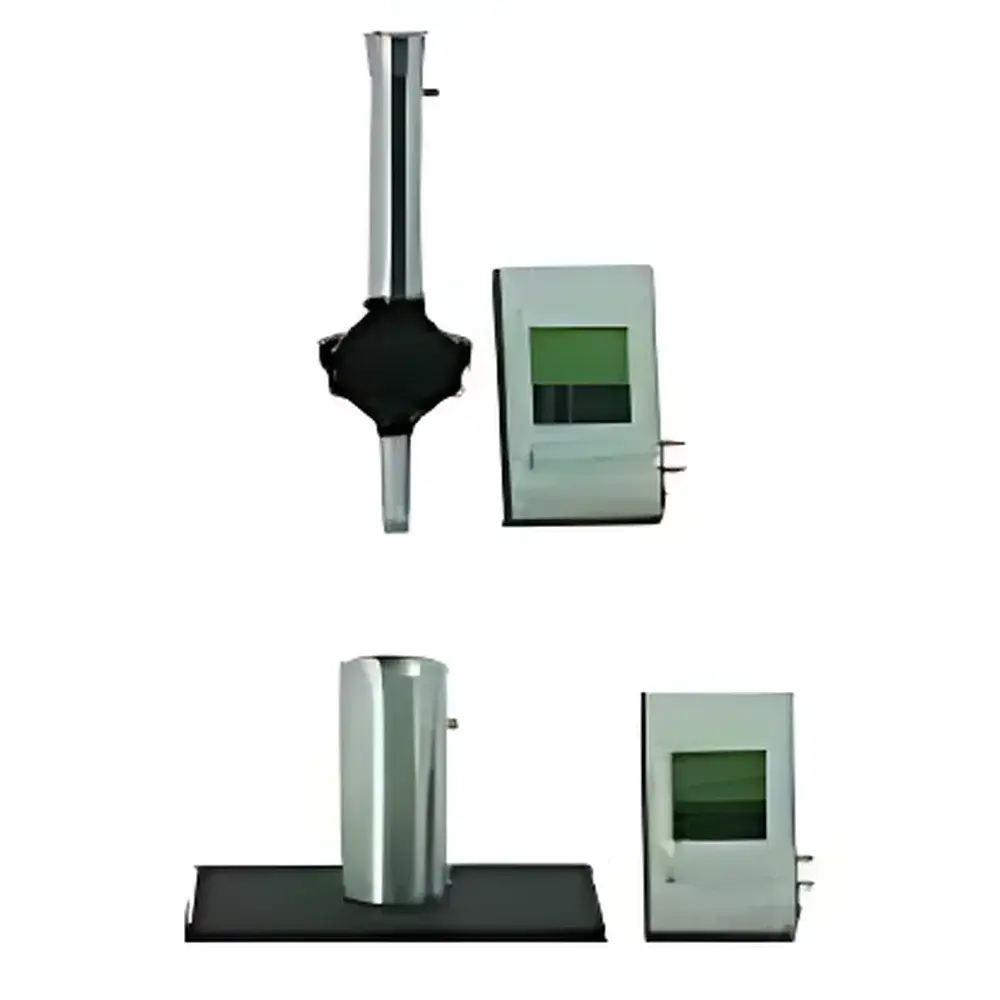
THM-1200/150 Microcomputer-Based High/Medium-Flow Calibrator
| Origin | Hubei, China |
|---|---|
| Manufacturer Type | Authorized Distributor |
| Origin Category | Domestic (PRC) |
| Model | THM-1200/150 |
| Pricing | Upon Request |
| Flow Range | 0.8–1.2 m³/min |
| Accuracy | ±1.5% of reading |
| Repeatability | ≤0.5% |
| Power Supply | AC 220 V ±10%, 50 Hz ±1 Hz |
| Compliance | HJ/T 368–2007, Q/WTH 05–2011 |
| Data Storage | 5000 sets with timestamped T, P, flow, and volume (actual & standard conditions) |
Overview
The THM-1200/150 Microcomputer-Based High/Medium-Flow Calibrator is a precision-engineered instrument designed for field and laboratory calibration of high- and medium-flow total suspended particulate (TSP) samplers used in ambient air quality monitoring networks. It operates on the orifice plate differential pressure principle: airflow through a calibrated orifice generates a measurable pressure drop across the constriction, which—when combined with real-time temperature and absolute pressure measurements—is converted to volumetric flow rate using standardized gas law corrections per ISO 5167-2 and EPA Method 4. The device computes and displays both actual (operational) and standard (25 °C, 101.325 kPa) volumetric flow rates, cumulative volume, ambient temperature, and barometric pressure—enabling direct traceability to national reference standards under China’s environmental monitoring regulatory framework.
Key Features
- Integrated micro-differential pressure sensor with temperature-compensated analog signal conditioning for stable low-range ΔP measurement (±0.1 Pa resolution typical)
- Dual-condition flow computation engine compliant with HJ/T 368–2007, supporting simultaneous display of actual flow (m³/min), standard flow (m³/min @ STP), accumulated volume (m³), ambient temperature (°C), and atmospheric pressure (kPa)
- Onboard microcomputer with embedded real-time clock (RTC) ensures time-stamped data logging; internal non-volatile memory retains up to 5000 calibration records with full parameter sets
- Portable ergonomic housing (≤3.2 kg) with integrated lithium-ion backup battery option (optional accessory) for uninterrupted operation during field deployments
- Front-panel membrane keypad and high-contrast LCD display optimized for outdoor readability under variable lighting and temperature conditions (–10 °C to +50 °C operating range)
- Compliant power input: AC 220 V ±10%, 50 Hz ±1 Hz; includes overvoltage and EMI filtering per GB/T 17626 series
Sample Compatibility & Compliance
The THM-1200/150 is validated for calibration of TSP samplers operating within the 0.8–1.2 m³/min nominal flow range—including models compliant with HJ 618–2011 (ambient air—determination of total suspended particulates—gravimetric method) and equivalent international designs (e.g., EPA TO-13A compatible inlets). Its orifice-based architecture meets the metrological requirements defined in HJ/T 368–2007 for primary field calibrators used in China’s National Ambient Air Quality Monitoring Network (NAAQMN). The instrument adheres to enterprise standard Q/WTH 05–2011, which specifies verification protocols for zero drift, span stability, linearity, and environmental robustness. While not certified to ISO/IEC 17025 as a standalone calibration laboratory, it supports GLP-aligned field verification when operated with documented procedures, traceable reference gauges, and annual third-party verification reports.
Software & Data Management
Data export is supported via USB 2.0 interface (CDC class) to Windows-based PCs running proprietary calibration management software (supplied on secure USB drive). The software enables batch download, chronological sorting, CSV/Excel export, and generation of calibration certificates compliant with internal QA documentation requirements. Audit trails include operator ID, calibration date/time, instrument serial number, and environmental metadata. Although the THM-1200/150 does not implement FDA 21 CFR Part 11 electronic signature functionality, its deterministic firmware architecture and write-once data storage model support basic ALCOA+ principles (Attributable, Legible, Contemporaneous, Original, Accurate) for routine environmental compliance reporting.
Applications
- Field verification and adjustment of high-volume TSP samplers prior to and following filter collection campaigns
- Periodic performance checks of continuous ambient air monitoring stations (e.g., PM10/TSP modules in multi-pollutant systems)
- Validation of flow controllers in stack testing setups where medium-flow sampling (≥0.8 m³/min) is required per HJ 75–2017
- Technical training and metrology education in provincial environmental monitoring centers and accredited laboratories
- Supporting accreditation audits under CNAS-CL01:2018 (equivalent to ISO/IEC 17025) through documented calibration history and uncertainty budgeting
FAQ
Is the THM-1200/150 suitable for calibrating low-flow samplers (<0.1 m³/min)?
No—this instrument is specifically engineered for high/medium-flow applications (0.8–1.2 m³/min). Low-flow calibration requires dedicated laminar flow elements or critical orifices with higher sensitivity differential pressure transducers.
Does the device provide NIST-traceable calibration certificates?
The unit ships with a factory verification report referencing internal master standards traceable to China’s National Institute of Metrology (NIM). End-user NIST-traceable certification requires separate third-party calibration against primary standards.
Can the stored data be exported without proprietary software?
Raw binary logs require the supplied application for parsing; however, exported CSV files are fully compatible with Python, MATLAB, or Excel for secondary analysis and reporting.
What maintenance intervals are recommended?
Annual verification of pressure and temperature sensors is advised. Orifice plates should be inspected visually before each deployment for particulate accumulation or mechanical damage.
Is the THM-1200/150 compatible with ISO 5167 or ASTM D5467 flow calculation algorithms?
Its firmware implements orifice flow equations aligned with ISO 5167-2:2003 (discharge coefficient methodology) and incorporates compressibility and expansion factor corrections appropriate for dry air at ambient conditions.







