
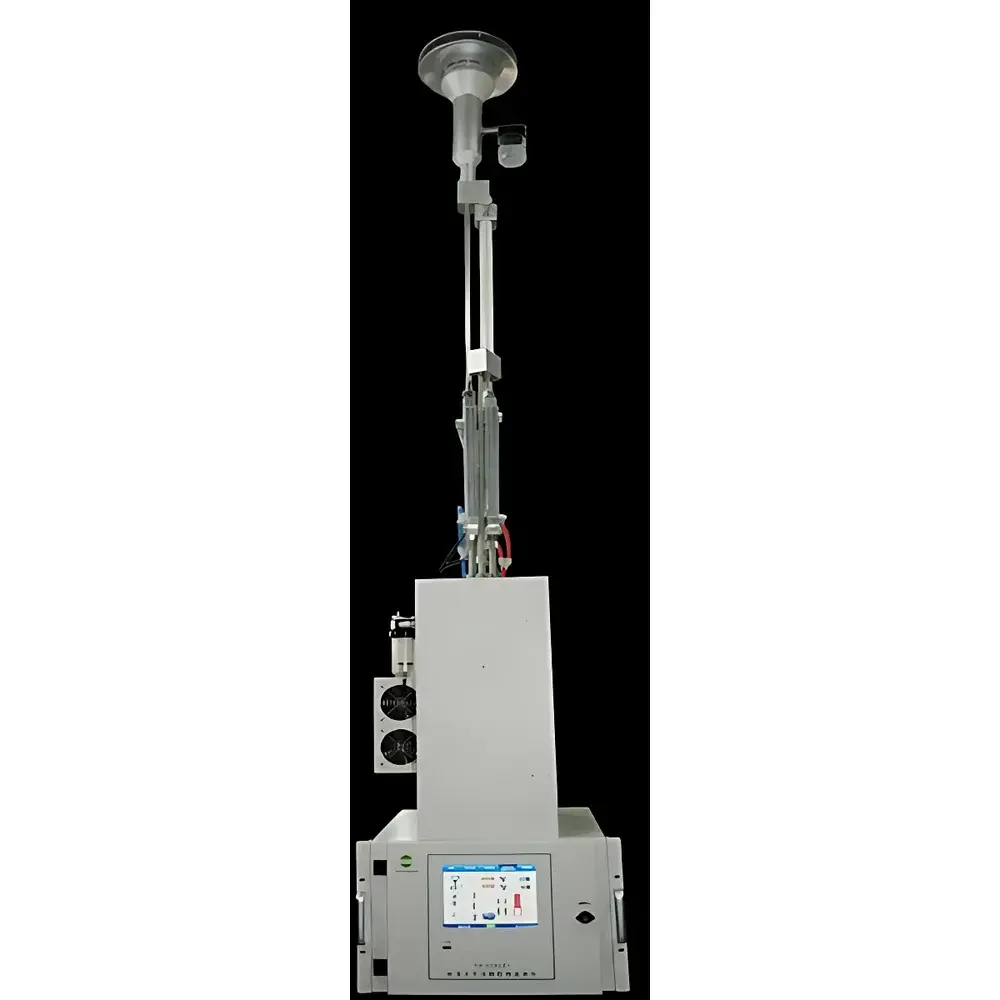
Tianhong TH-2000Z1 TEOM-Based Atmospheric Particulate Matter Monitor
| Brand | Tianhong |
|---|---|
| Origin | Hubei, China |
| Model | TH-2000Z1 |
| Measurement Principle | Tapered Element Oscillating Microbalance (TEOM) |
| Measured Parameters | PM₁₀, PM₂.₅ |
| Mass Range | 0–10,000 µg/m³ |
| Resolution | 0.01 µg/m³ |
| LOD | 0.06 µg/m³ |
| Single-Channel Flow Rate | (1.67 ± 15) L/min |
| Dual-Channel Flow Rate | (1.67 + 1.67 + 13.3) L/min |
| Flow Control Accuracy | ±1.5% of setpoint |
| Flow Repeatability | ≤1.5% RSD |
| Flow Indication Error | ±1.5% |
| Data Interfaces | RS232, RS485, USB 2.0, RJ45 Ethernet |
| Power Supply | AC 90–264 V, 50/60 Hz (main unit) |
| Power Consumption | <0.66 kW (including pump) |
| Dimensions (H×W×D) | 980 × 370 × 310 mm (main unit) |
| Weight | 39 kg (main unit), 6.5 kg (pump) |
Overview
The Tianhong TH-2000Z1 is a regulatory-grade, continuous ambient particulate matter monitor engineered for high-precision measurement of PM10 and PM2.5 mass concentrations using the Tapered Element Oscillating Microbalance (TEOM) principle. Unlike optical or beta-attenuation methods, TEOM provides real-time, gravimetrically traceable mass concentration data by directly measuring the incremental mass deposited on a vibrating tapered quartz element. As sampled air passes through a size-selective inlet—such as a PM2.5 cyclone—the particulate fraction is collected onto a filter substrate mounted on the oscillating element. The resonant frequency shift of the element is continuously monitored; this shift is inversely proportional to the accumulated mass, enabling sub-microgram resolution and long-term stability without calibration drift. To address volatile artifact interference—a known limitation in uncorrected TEOM systems—the TH-2000Z1 integrates a dual-phase sampling protocol with a heated zero-air scrubber, allowing dynamic compensation of semi-volatile aerosol losses during collection.
Key Features
- Patented microbalance sensor architecture incorporating a fused-silica tapered oscillating tube (ZL201020578431.3) with optimized thermal and mechanical stability.
- Dual-channel configuration supporting simultaneous PM2.5 and reference channel operation at total flow rates up to 16.67 L/min, compliant with U.S. EPA EQOA requirements for co-located monitoring.
- Integrated volatile compensation system: alternating sample and zero-air cycles enable real-time subtraction of evaporative mass loss, yielding net non-volatile PM mass consistent with gravimetric reference methods.
- Modular inlet system compatible with certified cut-points: TSP, PM10, PM5, PM2.5, and PM1.0 cyclones and impactors (e.g., 15 L/min PM2.5 cyclone per ISO 10473 and EN 12341).
- High-fidelity flow control via mass flow controllers (MFCs) with ±1.5% accuracy and ≤1.5% relative standard deviation across operating conditions.
- Industrial 8.4-inch true-color touchscreen interface with bilingual (English/Chinese) firmware, real-time concentration trend plots, and 3D status visualization of pressure, temperature, flow, and balance amplitude.
- Low-power design (<0.66 kW total) with programmable pump duty cycling and thermal management for extended field deployment.
Sample Compatibility & Compliance
The TH-2000Z1 is designed for continuous outdoor ambient air monitoring in fixed-site regulatory networks, mobile laboratories, and research-grade field campaigns. Its inlet train—including optional glass fiber or PTFE membrane filters, Nafion™-based gas dryers (ZL201420295118.7), and precision-cut cyclones—meets performance criteria outlined in ISO 12103-1 (test dusts), EPA Method PS-11 (PM2.5 FRM equivalence), and EN 14907 (ambient air quality — reference method for PM2.5 and PM10). The instrument’s data output structure supports automated reporting under national air quality standards frameworks, including China’s HJ 653–2013 and the U.S. EPA’s Air Quality System (AQS) metadata schema. All internal calibration routines, flow verifications, and maintenance logs are timestamped and stored with audit-trail capability—facilitating GLP-compliant data governance and 21 CFR Part 11 readiness when deployed with validated software configurations.
Software & Data Management
Embedded firmware enables fully autonomous operation with configurable averaging intervals (1-min to 24-h), automatic zero/span checks, and event-triggered data logging. Raw frequency, temperature, pressure, and flow signals are archived at 1-Hz resolution alongside derived PM mass concentrations. Communication protocols include ASCII-over-RS232/RS485, USB 2.0 host mode for external storage, and TCP/IP Ethernet (RJ45) for integration into SCADA or centralized environmental data platforms. Optional PC-based software provides remote diagnostics, spectral analysis of oscillation harmonics, and batch export in CSV, NetCDF, or EPA AQS-compliant formats. Firmware updates are performed via signed package files to ensure integrity and version traceability—critical for regulatory audits and inter-laboratory comparison studies.
Applications
- Regulatory compliance monitoring for national and municipal ambient air quality networks (AAQNs).
- Source apportionment studies requiring temporally resolved, gravimetrically referenced PM data.
- Indoor air quality assessment in sensitive environments (e.g., cleanrooms, hospitals) when equipped with low-flow sampling adapters.
- Field validation of optical particle counters (OPCs) and low-cost sensor networks using TEOM as a transfer standard.
- Long-term trend analysis of fine particulate burden in urban, rural, and background sites per WHO Air Quality Guidelines (AQG) metrics.
- Supporting health epidemiology cohorts where exposure misclassification must be minimized through metrologically robust PM2.5 time-series.
FAQ
How does the TH-2000Z1 compensate for semi-volatile aerosol losses?
It employs a two-phase sequential sampling cycle: one phase collects ambient air directly onto the oscillating filter; the next phase draws zero air (heated and filtered) through the same path. The difference between the two mass accumulation rates yields the non-volatile PM mass, effectively correcting for evaporation artifacts.
Is the instrument suitable for unattended operation in harsh outdoor environments?
Yes—the main unit features IP54-rated enclosure, wide-input AC power conditioning, and internal thermal stabilization. The external pump module is rated for -20°C to +50°C ambient operation and includes vibration-damping mounts.
What maintenance intervals are recommended for routine field use?
Filter changes every 7–14 days depending on loading; dryer cartridge replacement every 6 months; annual verification of flow controller calibration and oscillating tube resonance characteristics using NIST-traceable reference masses.
Can the TH-2000Z1 be integrated into existing air quality data platforms?
Yes—it supports Modbus RTU over RS485 and HTTP-based RESTful API endpoints via Ethernet, enabling seamless ingestion into platforms such as OpenAQ, AQICN, or proprietary municipal dashboards.
Does the system meet U.S. EPA or EU reference method equivalency requirements?
While not individually certified as a Federal Reference Method (FRM) or Equivalent Method (EQM) under 40 CFR Part 53, its TEOM architecture, flow control fidelity, and volatility compensation protocol align with the technical basis of EPA-approved TEOM instruments (e.g., Thermo Fisher 1405-F) and EN 14907 Annex B test procedures.
Related Products







