
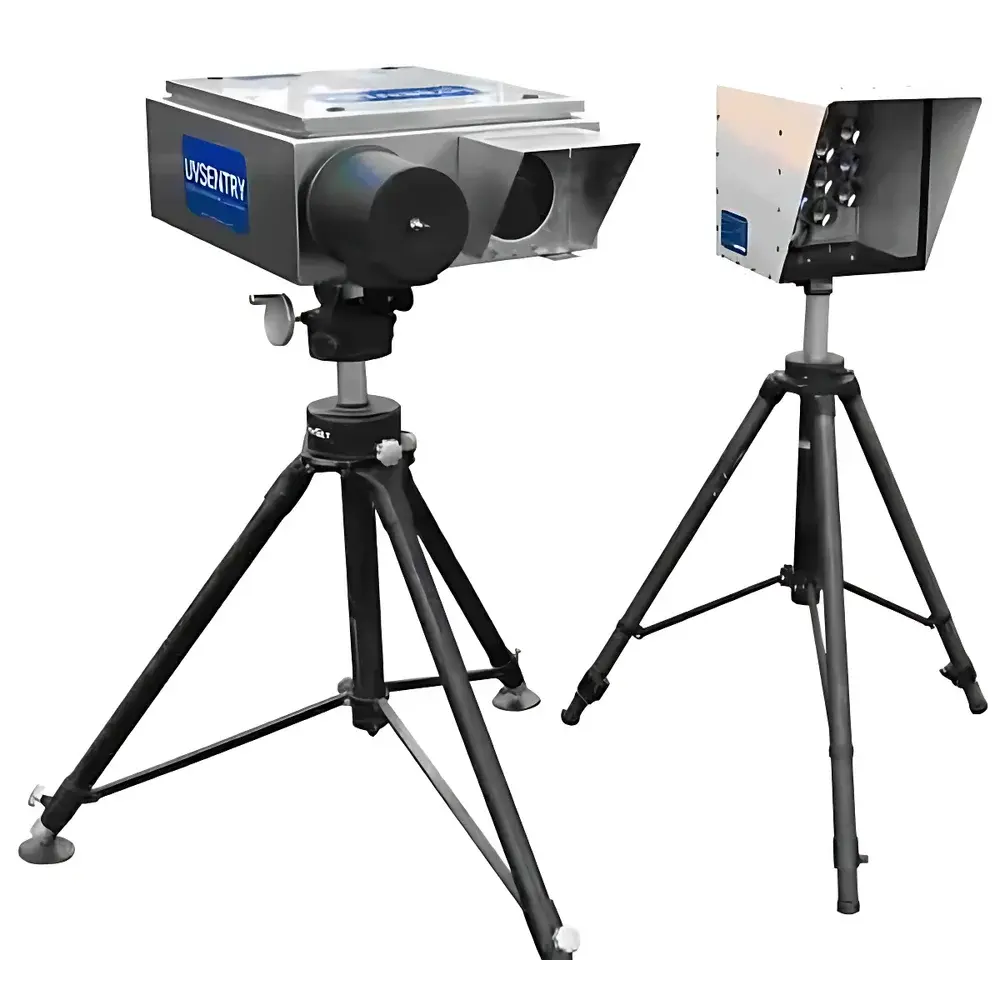
Cerex Open Path UV-DOAS Long-Path Differential Optical Absorption Spectrometer
| Brand | Cerex |
|---|---|
| Origin | Hubei, China |
| Manufacturer Type | Authorized Distributor |
| Country of Origin | China |
| Model | Open Path UV-DOAS |
| Detection Principle | Ultraviolet Differential Optical Absorption Spectroscopy (UV-DOAS) |
| Instrument Type | Online Continuous Emission Monitor |
| Typical Configuration | Multi-Component VOC & Inorganic Gas Analyzer |
| Detection Range | 0.1–10 ppb (gas-dependent) |
| Resolution | 0.1 ppb |
| Accuracy | ±0.1% of full scale |
| Response Time | <1 s |
| Optical Path Length | 0–2000 m |
| Compliance | ASTM D6348, ISO 12039, EN 15267-3 (configurable), US EPA Method TO-14/TO-15 compatible (with optional calibration gas manifold) |
Overview
The Cerex Open Path UV-DOAS Long-Path Differential Optical Absorption Spectrometer is an engineered solution for real-time, in-situ, multi-gas monitoring across extended open-path distances—from tens of meters to 2 km. Unlike extractive sampling systems, this instrument operates on the fundamental principle of ultraviolet differential optical absorption spectroscopy (UV-DOAS), where broadband UV light (185–420 nm) is transmitted through ambient air and analyzed for characteristic absorption signatures of target analytes. The system quantifies trace gases by fitting high-resolution spectral absorbance features against reference cross-sections—enabling simultaneous detection and quantification of over 40 gaseous species without physical sample extraction or chemical pre-concentration. Its long-path capability enhances sensitivity via integrated path-length amplification, achieving sub-ppb detection limits (e.g., 0.1 ppb for SO2, NO2, O3) and enabling ppt-level effective concentration resolution under optimal atmospheric conditions. Designed for unattended operation in industrial fence-line, ambient air quality, and remediation site monitoring, it meets the functional requirements of continuous emissions monitoring (CEM), fugitive emission detection, and compliance verification per regulatory frameworks including US EPA Methods, EU Industrial Emissions Directive (IED), and ISO 12039 for stack and ambient gas analysis.
Key Features
- True open-path architecture: No sample conditioning, no permeation losses, no catalytic interference—ideal for reactive, condensable, or thermally unstable compounds (e.g., HONO, ClO2, formaldehyde)
- Dual operational modes: Compact monostatic configuration (co-aligned transmitter/receiver) for rapid deployment; bistatic configuration (separated transceiver units) for flexible path geometry and large-area coverage
- High-fidelity UV spectrometer: 256-channel CCD detector with thermoelectric cooling, 0.2 nm spectral resolution, and >104 dynamic range
- Self-contained calibration: Internal reference cell with zero-air purge and user-configurable background acquisition—eliminates need for external span gases during routine operation
- Robust environmental housing: IP65-rated enclosure with integrated temperature stabilization (−20 °C to +50 °C operating range, optional extended range)
- Integrated computing platform: Embedded Windows® OS with local data storage, real-time spectral processing, and configurable alarm logic
- Multi-protocol connectivity: Dual Ethernet ports, Wi-Fi 802.11n, USB host/device, RS-232/422/485 serial interfaces, and MODBUS RTU/TCP support
- Industrial I/O: 4–20 mA analog outputs (up to 8 channels), relay-controlled alarm outputs, and configurable digital inputs for external trigger synchronization
Sample Compatibility & Compliance
The system detects gases based on their unique UV absorption fingerprints—requiring no consumables beyond the UV deuterium lamp (typical lifetime >2 years) and inlet particulate filter (replaced quarterly). It is inherently immune to sensor poisoning, humidity quenching, or cross-sensitivity common in electrochemical or MOS-based detectors. Certified for use in Class I, Division 2 hazardous locations (optional ATEX/IECEx certification available). Complies with data integrity requirements for regulated environments: audit-trail-enabled software logs all configuration changes, calibration events, and alarm triggers; raw spectral data and processed results are timestamped and stored in .csv format with SHA-256 hash verification. Optional firmware modules support 21 CFR Part 11-compliant electronic signatures and GLP/GMP audit trails when deployed in pharmaceutical or environmental laboratory settings.
Software & Data Management
AirSentry™ Control Software provides a browser-accessible interface for remote configuration, real-time spectral visualization, and historical trend analysis. Users define custom measurement cycles (1–300 s), multi-level alarms (pre-warning, action, critical), and automatic report generation (daily/weekly CSV exports with metadata). Data can be pushed via SMTP to designated email addresses, published to HTTP endpoints, or forwarded to SCADA systems using Modbus TCP or OPC UA (via optional gateway). All spectral acquisitions are archived locally (≥12 months at 1-min intervals) and synchronized to NTP servers. Firmware updates and configuration backups are performed over secure HTTPS or USB—no proprietary drivers required. Remote diagnostics include lamp intensity monitoring, signal-to-noise ratio tracking, and optical alignment validation.
Applications
- Refinery & petrochemical sites: Fence-line monitoring of benzene, toluene, ethylbenzene, xylenes (BTEX), H2S, and SO2
- Wastewater treatment plants: Real-time NH3, Cl2, and O3 leak detection in headworks and disinfection zones
- Metal smelting facilities: Mercury vapor (Hg⁰) and NOx emission tracking during roasting and converting processes
- Soil and sediment remediation: On-site detection of naphthalene, styrene, and 1,3-butadiene during thermal desorption or air sparging
- Chemical manufacturing: Chlorine and phosgene (COCl2) safety monitoring in synthesis and storage areas
- Mobile air quality platforms: Integration into monitoring vehicles for spatial mapping of formaldehyde, acetaldehyde, and ozone precursors
- Research-grade ambient networks: Long-term trend analysis of reactive nitrogen species (NO, NO2, HONO) and aromatic VOCs in urban and rural atmospheres
FAQ
Does the system require periodic calibration with certified gas standards?
No—internal zero-air purging and automated background subtraction eliminate the need for routine span calibration. However, annual verification using NIST-traceable standard gases is recommended for regulatory reporting.
Can it distinguish between isomers such as o-, m-, and p-xylene?
Yes—UV-DOAS resolves fine spectral structure; spectral fitting algorithms differentiate ortho-, meta-, and para-xylene based on distinct vibrational-rotational absorption bands in the 250–280 nm region.
Is meteorological data integration mandatory?
No—integrated temperature, pressure, and relative humidity sensors are optional. However, for quantitative conversion from optical density to mass concentration (µg/m³), concurrent meteorological measurements are required per ISO 12039 Annex B.
What maintenance is required beyond lamp and filter replacement?
None. The optical path is sealed and purge-protected; no alignment adjustments, mirror cleaning, or detector recalibration are needed during normal operation.
Can the system operate autonomously for extended periods without network connectivity?
Yes—local data logging continues uninterrupted; all alarms and reports queue for transmission upon network restoration. Battery-backed real-time clock ensures time-stamp integrity during power outages.
Related Products







