
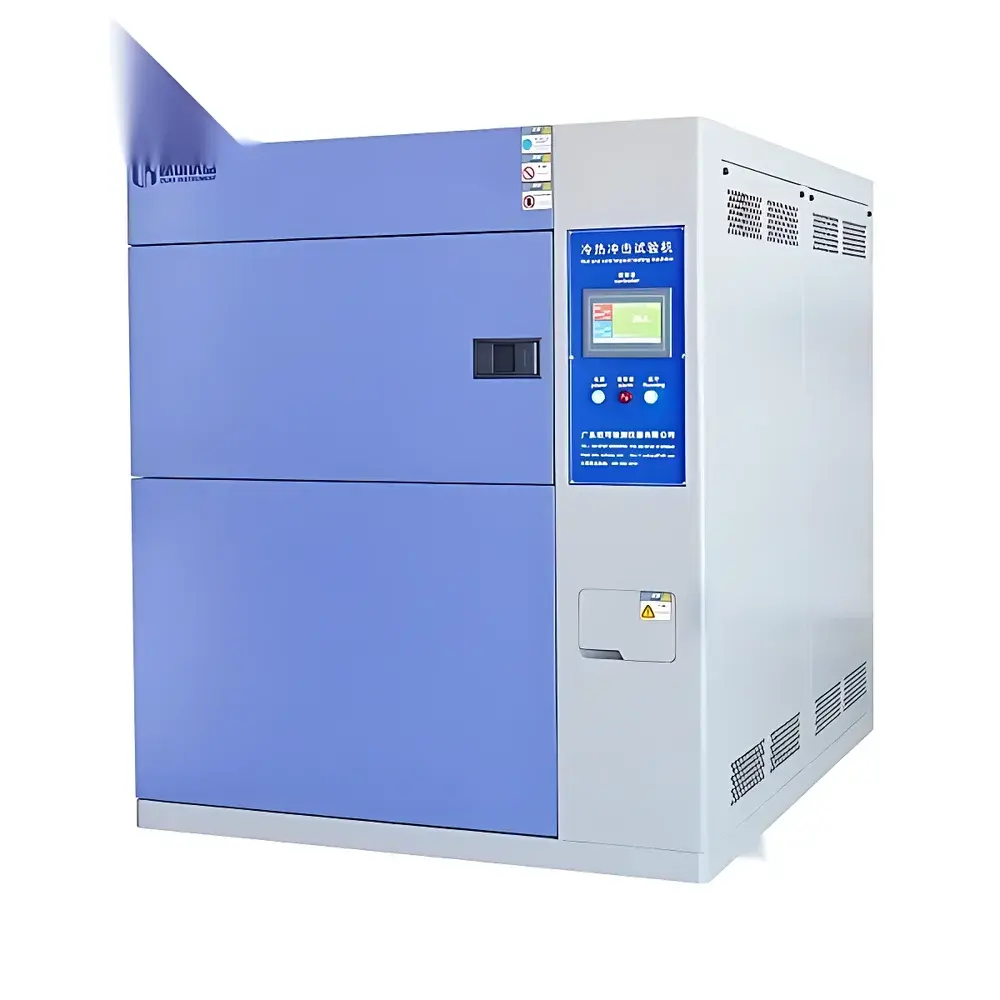
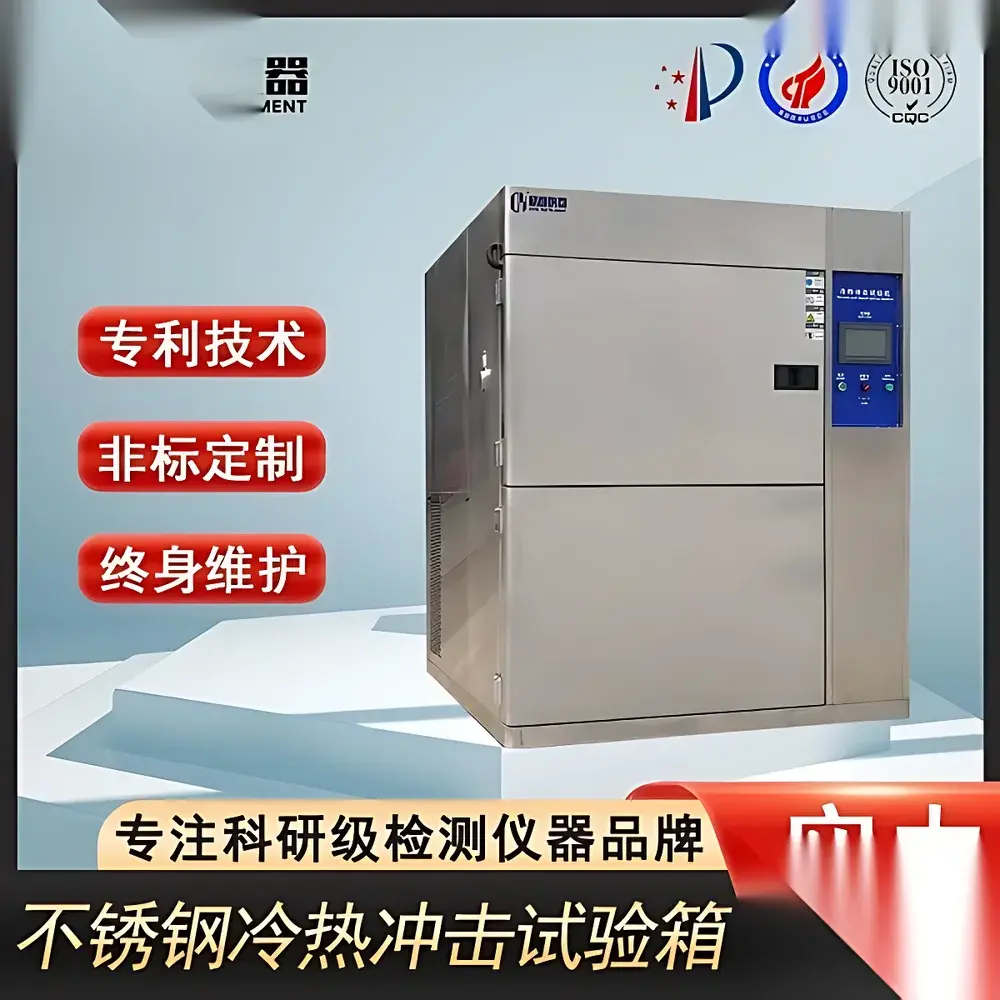
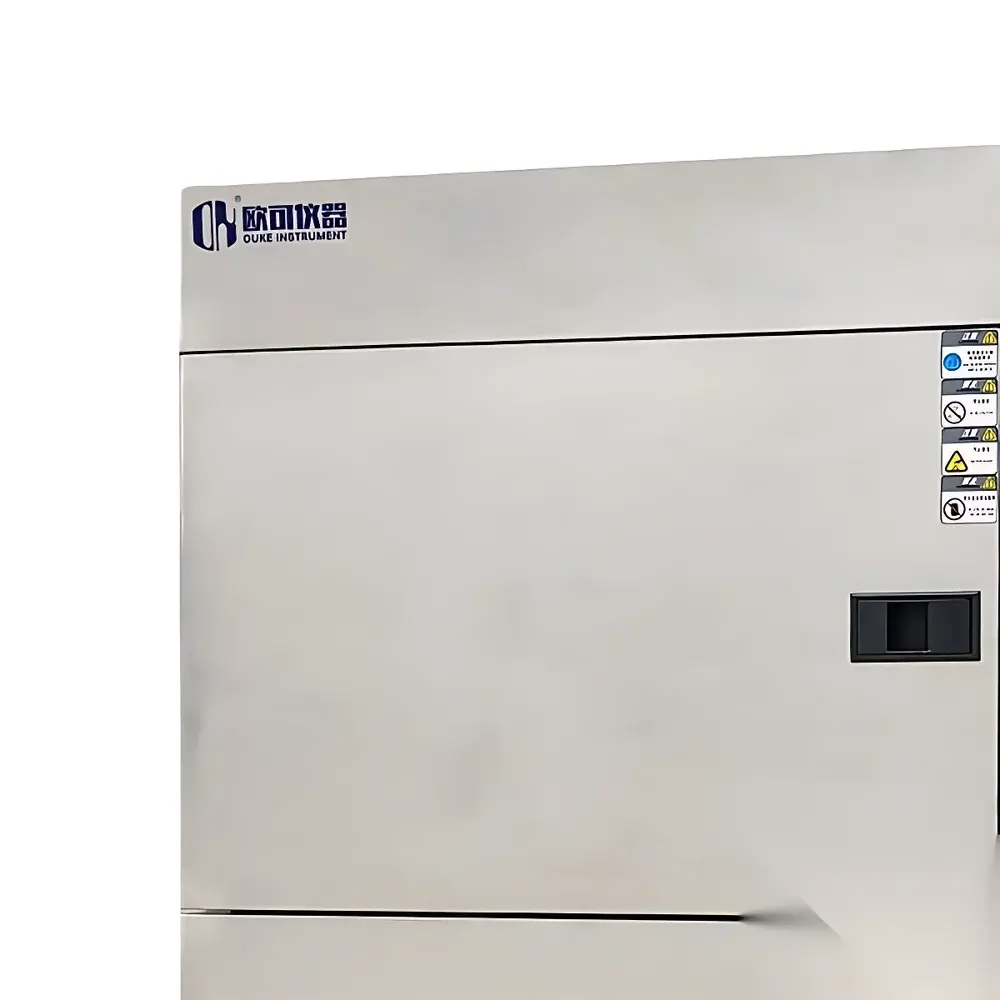
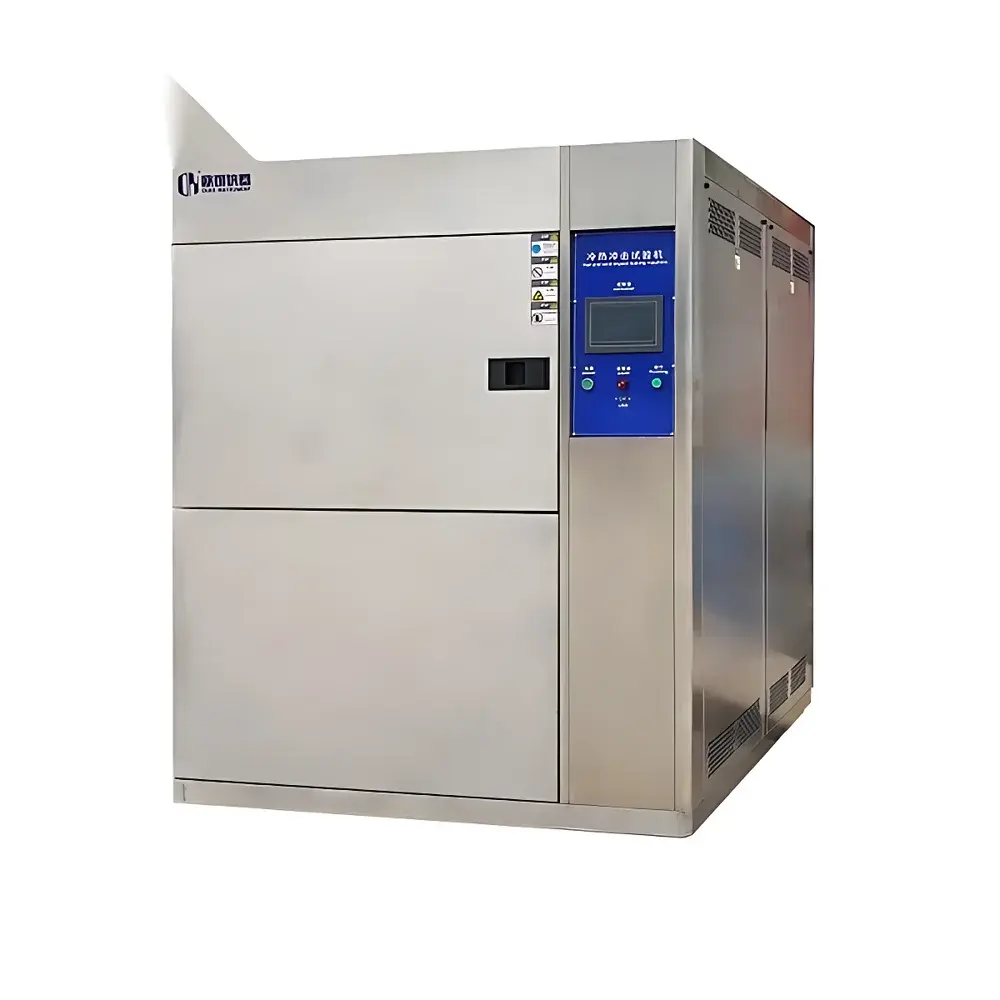
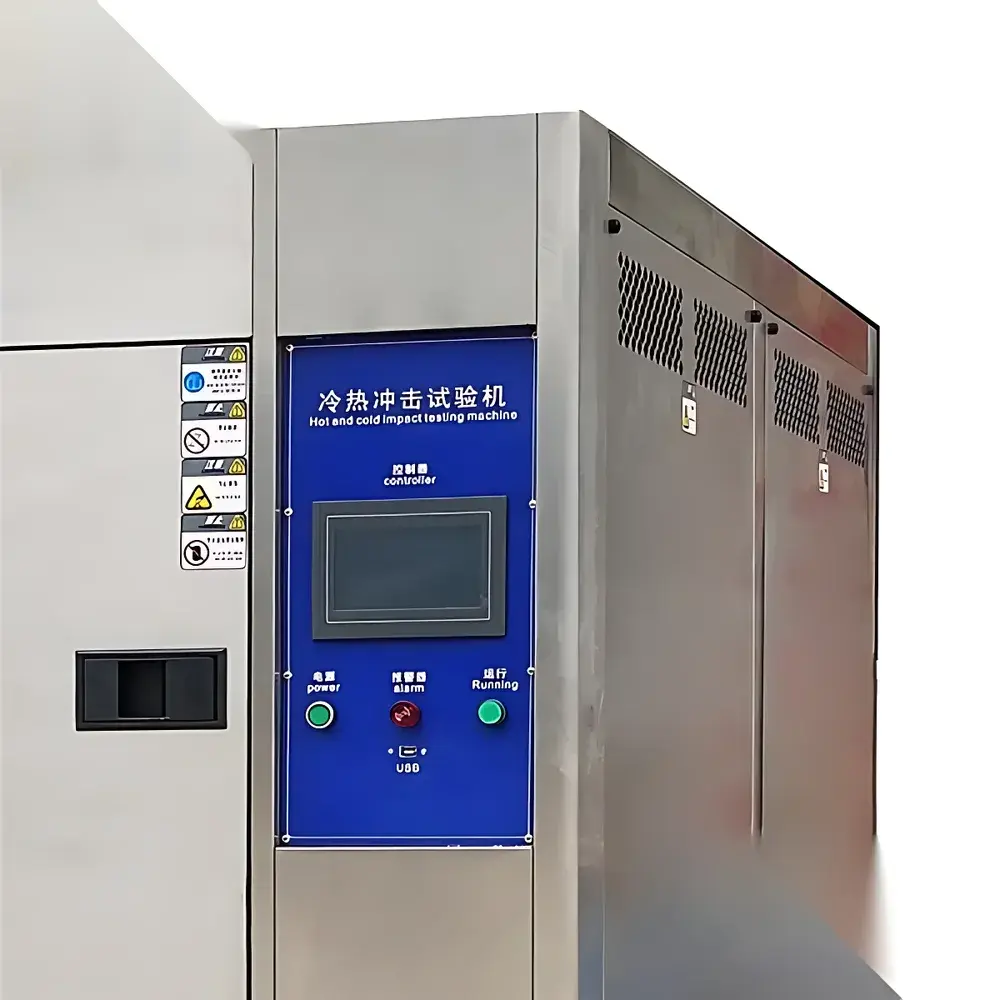
Thermal Shock Test Chamber – Dual-Chamber Rapid Temperature Transition Environmental Test System
| Brand | OEM / Custom Brand |
|---|---|
| Origin | Imported |
| Manufacturer Type | Authorized Distributor |
| Price | USD 11,200 (FOB) |
| Control Interface | 7-inch LCD with Bilingual (English/Chinese) UI |
| Program Storage | 120 user-defined profiles |
| Max Cycles | 9,999 |
| Max Segment Duration | 999 hrs 59 min |
| Communication | RS-232 with PC software for remote programming, data logging, and real-time monitoring |
| Temperature Transition Mode | Dual-chamber (hot/cold) or single-chamber with air flap switching |
| Recovery Time | ≤5 min (from −40 °C to +150 °C or vice versa) |
| Airflow Actuation | ≤10 s |
| Analog Output | 4–20 mA or 0–10 V DC for external recorder integration |
| Refrigeration | Twin-circuit cascade system with HFC-404A/HFC-134a eco-friendly refrigerant |
| Compressor | Imported semi-hermetic units (Europe/USA) |
Overview
The Thermal Shock Test Chamber is an engineered environmental test system designed to evaluate material reliability under rapid, repetitive thermal transitions between extreme high and low temperature extremes. Based on the dual-chamber (hot/cold) or single-chamber airflow-switching architecture, it subjects test specimens to controlled, accelerated thermal stress cycles—mimicking real-world operational or storage conditions where materials experience abrupt ambient shifts. Its core principle relies on precise chamber isolation, high-efficiency heat exchange, and sub-10-second airflow redirection to achieve ≤5-minute temperature recovery times, enabling rigorous validation of solder joint integrity, polymer dimensional stability, coating adhesion, and interfacial delamination resistance. This system complies with fundamental thermal shock test methodologies defined in MIL-STD-810H Method 503.7, JEDEC JESD22-A104F, IEC 60068-2-14, and ASTM D6277, serving as a critical tool in product qualification, failure mode analysis, and design validation across aerospace, automotive electronics, medical device manufacturing, and advanced packaging sectors.
Key Features
- 7-inch high-resolution LCD controller with bilingual (English/Chinese) interface, supporting intuitive program creation and real-time parameter visualization
- 120 programmable test profiles with up to 9,999 total cycles per profile; individual segment duration configurable up to 999 hours 59 minutes
- Dual-mode operation: selectable two-zone (separate hot/cold chambers) or single-zone (air-baffle switching) thermal shock configuration
- Pre-conditioning capability: automatic pre-heating or pre-cooling prior to scheduled test initiation; user-selectable start condition (high-temp or low-temp first)
- Intelligent defrost management: automated cycle-based defrost sequencing without interrupting test continuity
- Test chamber sensor placement conforms to ISO 16750-4 and IEC 60068-3-5 requirements—temperature sensors located directly within the test zone, not in ducts or plenums
- Integrated analog output (4–20 mA / 0–10 V DC) for seamless connection to external data loggers or SCADA systems
- Fail-safe monitoring: real-time fault detection with on-screen diagnostics, emergency power instability shutdown, and audible/visual alarms
- Cascade refrigeration architecture using dual independent compressors and environmentally compliant refrigerants (R-404A/R-134a), ensuring stable sub-65 °C low-temperature performance
Sample Compatibility & Compliance
This chamber accommodates standard test specimens up to 500 mm × 500 mm × 500 mm (W×D×H), with optional internal racks and non-reactive aluminum load verification plates for thermal mass calibration. It supports both active component testing (PCBs, IC packages, connectors) and passive materials (elastomers, composites, adhesives). Humidity control is not integrated, but two-chamber configurations maintain ≤30% RH during cold-phase exposure—meeting JEDEC’s requirement for tin whisker acceleration testing (JESD22-A121). The system meets structural and safety requirements per IEC 61000-6-2 (immunity) and IEC 61000-6-4 (emissions), and its control software architecture supports audit-ready operation when configured with optional GLP/GMP-compliant electronic signatures and 21 CFR Part 11–compatible data archiving modules.
Software & Data Management
The included Windows-based PC software enables full remote commissioning: program definition, live parameter streaming, time-stamped data export (CSV/Excel), and graphical overlay of multiple test runs. All logged data—including chamber setpoints, actual temperatures, cycle counters, and alarm events—are timestamped with millisecond resolution and stored locally with SHA-256 hash integrity verification. Optional firmware upgrades support CSV-based batch import/export of test protocols and automated report generation compliant with internal QA templates or customer-specific formats (e.g., AIAG CQI-17, IPC-9701). Data retention follows ISO/IEC 17025 Clause 7.5.2 guidelines, with encrypted local backup and network share synchronization capabilities.
Applications
- Accelerated life testing of lead-free solder joints per IPC-J-STD-020 and JEDEC JESD22-A104F
- Evaluation of coefficient of thermal expansion (CTE) mismatch in multilayer ceramic capacitors (MLCCs) and stacked-die packages
- Validation of conformal coating durability under cyclic thermal gradients
- Qualification of automotive ECUs per ISO 16750-4 and LV-124 specifications
- Assessment of optical lens housing warpage and adhesive bond strength in precision instrumentation
- Tin whisker growth acceleration for RoHS-compliant finish evaluation (JESD22-A121)
- Post-test specimen recovery protocol: automatic return to ambient temperature before door release, minimizing condensation-related damage
FAQ
What is the minimum achievable low temperature in the cold chamber?
The standard configuration achieves −65 °C; optional ultra-low variants reach −75 °C with enhanced cascade optimization.
Can this chamber be integrated into an existing factory MES or LIMS environment?
Yes—via RS-232 or optional RS-485/Ethernet gateway, supporting Modbus RTU/TCP and custom API integration for traceability workflows.
Does the system include validation documentation (IQ/OQ/PQ)?
Factory-installed calibration certificates (NIST-traceable sensors) are provided; full IQ/OQ/PQ protocol templates and execution services are available as add-on options.
Is humidity control available as an upgrade?
No—this is a dedicated thermal shock platform. For combined temperature/humidity stress, consider our ESS-TH series environmental stress screening chambers.
What maintenance intervals are recommended for the refrigeration system?
Compressor oil and filter dryer replacement every 24 months; annual refrigerant leak check and sensor recalibration advised per ISO/IEC 17025 maintenance schedules.



