
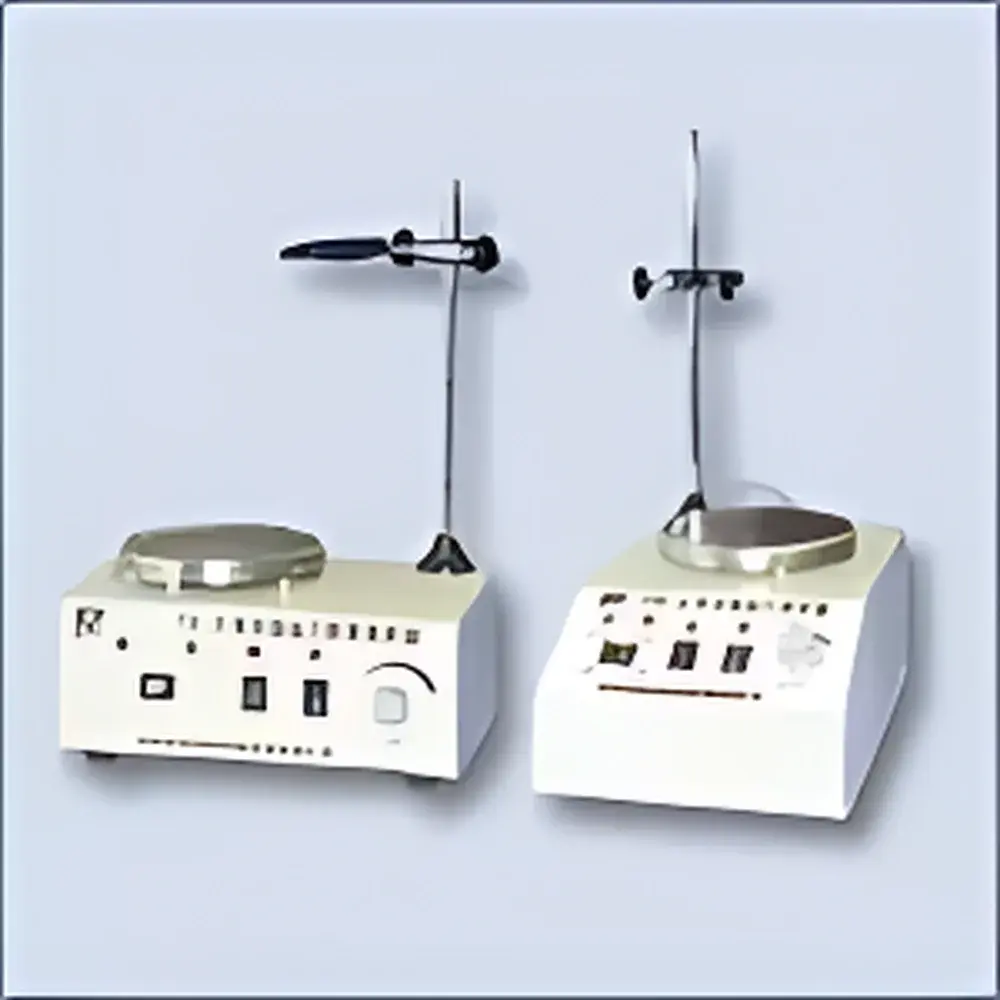
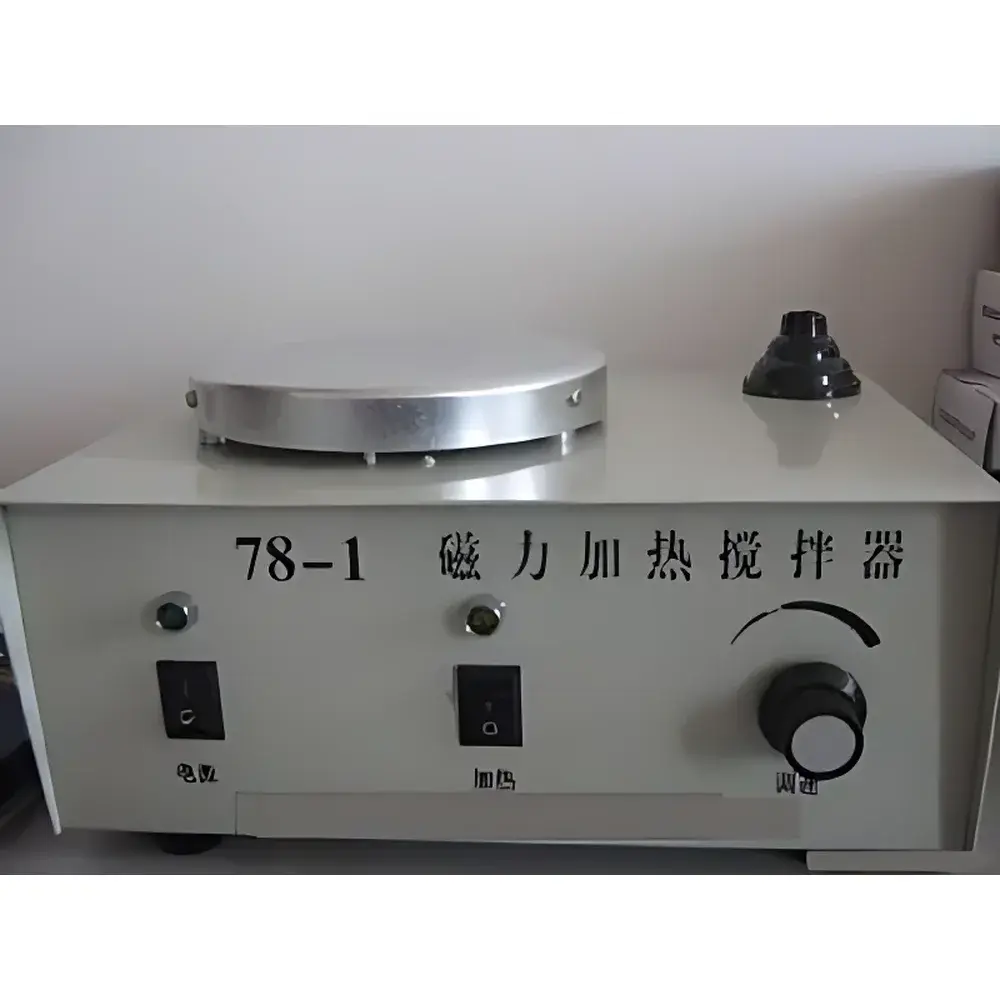
HJ-1 Magnetic Stirrer
| Origin | Jiangsu, China |
|---|---|
| Manufacturer Type | Distributor |
| Country of Origin | China |
| Model | HJ-1 |
| Maximum Stirring Volume | 1000 mL |
| Speed Range | 0–2400 rpm |
| Power Supply | 220 V AC, 50 Hz |
| Dimensions (W × D × H) | 160 × 160 × 100 mm |
| Weight | 2.8 kg |
| Material | Stainless Steel Plate + ABS Housing |
| Compliance | CE, RoHS |
Overview
The HJ-1 Magnetic Stirrer is a compact, reliable benchtop instrument engineered for consistent and contactless mixing of liquid samples in research laboratories, quality control environments, and educational institutions. It operates on the principle of magnetic coupling: a rotating permanent magnet or electromagnetic drive beneath the non-magnetic work surface induces synchronous rotation of a PTFE- or glass-coated magnetic stir bar immersed in the sample vessel. This design eliminates mechanical shaft penetration, ensuring leak-free operation, reduced contamination risk, and minimal maintenance—critical for sterile, corrosive, or volatile applications. Unlike overhead stirrers, the HJ-1 delivers uniform torque transmission at low to medium viscosities (up to ~500 mPa·s) without introducing shear gradients associated with impeller-based systems. Its fixed-speed architecture prioritizes operational simplicity and long-term stability over programmability, making it ideal for routine dissolution, reagent preparation, buffer equilibration, and pre-analytical homogenization tasks where reproducibility across shifts and users is essential.
Key Features
- Robust stainless steel top plate with scratch-resistant finish for chemical resistance and easy decontamination
- Precisely balanced DC motor delivering smooth, low-vibration rotation across the full 0–2400 rpm range
- Integrated thermal protection circuitry to prevent motor overheating during extended operation
- Ergonomic rotary knob with tactile feedback for intuitive speed adjustment and repeatable setting recall
- Compact footprint (160 × 160 mm) optimized for crowded fume hoods or shared bench spaces
- UL/CE-certified power supply with reinforced insulation and grounded chassis for electrical safety compliance
Sample Compatibility & Compliance
The HJ-1 accommodates standard laboratory glassware including beakers (50–1000 mL), Erlenmeyer flasks, and cylindrical vessels up to 100 mm in diameter. It supports stir bars ranging from 15 mm to 40 mm in length, with PTFE-coated variants recommended for acidic, alkaline, or oxidizing media; glass-coated bars are suitable for high-purity applications requiring zero metal leaching. The device meets ISO 13485-aligned manufacturing controls and conforms to IEC 61010-1:2010 for electrical safety in laboratory equipment. While not intrinsically rated for hazardous area use, its sealed motor housing and absence of sparking components permit deployment in general-purpose chemical labs under standard ventilation protocols. It is routinely validated for GLP-compliant workflows involving sample dilution, standard solution preparation, and QC reference material homogenization per ASTM D7215 and USP .
Software & Data Management
The HJ-1 is a stand-alone analog instrument with no embedded firmware, digital interface, or data logging capability—intentionally designed to minimize failure points and eliminate software validation requirements. All operational parameters are manually set and verified visually via the calibrated speed dial. For laboratories operating under FDA 21 CFR Part 11 or EU Annex 11, this architecture simplifies audit readiness: no electronic records require retention, no user access controls are needed, and no software change control documentation applies. Calibration verification is performed annually using a certified handheld tachometer traceable to NIST standards; a calibration certificate template is provided with each unit shipment. Maintenance logs are paper-based or entered into LIMS as manual entries, fully compatible with ALCOA+ data integrity principles.
Applications
- Preparation of calibration standards and stock solutions in environmental testing labs (e.g., EPA Method 200.7, 300.0)
- Homogenization of cell culture media and reagent buffers prior to filtration sterilization
- Accelerated dissolution testing of pharmaceutical excipients under USP
- Mixing of titration reagents and indicator solutions in analytical chemistry teaching labs
- Stabilization of emulsions and suspensions during method development for food and cosmetic QA
- Supporting ASTM D445 kinematic viscosity measurements by ensuring thermal equilibrium before capillary timing
FAQ
Does the HJ-1 include heating functionality?
No. The HJ-1 is a non-heating magnetic stirrer. For combined stirring and temperature control, consider the HJ-3 or HJ-13 series of thermostatically regulated models.
What is the maximum viscosity this unit can effectively stir?
Optimal performance is maintained for Newtonian liquids up to approximately 500 mPa·s at 1000 mL volume and 1500 rpm. Higher viscosities require larger-diameter stir bars or alternative agitation methods.
Is the unit compatible with corrosive solvents such as concentrated HCl or NaOH?
Yes—the stainless steel plate and PTFE-coated stir bars resist corrosion from common inorganic acids and bases when used within standard exposure durations and concentrations.
Can the HJ-1 be integrated into automated lab systems via RS-232 or USB?
No. It is an analog-only device with no digital communication ports or external control inputs.
What stir bar size is recommended for 500 mL beakers?
A 30 mm × 7 mm PTFE-coated stir bar provides optimal vortex formation and torque transfer for volumes between 250–750 mL.



