
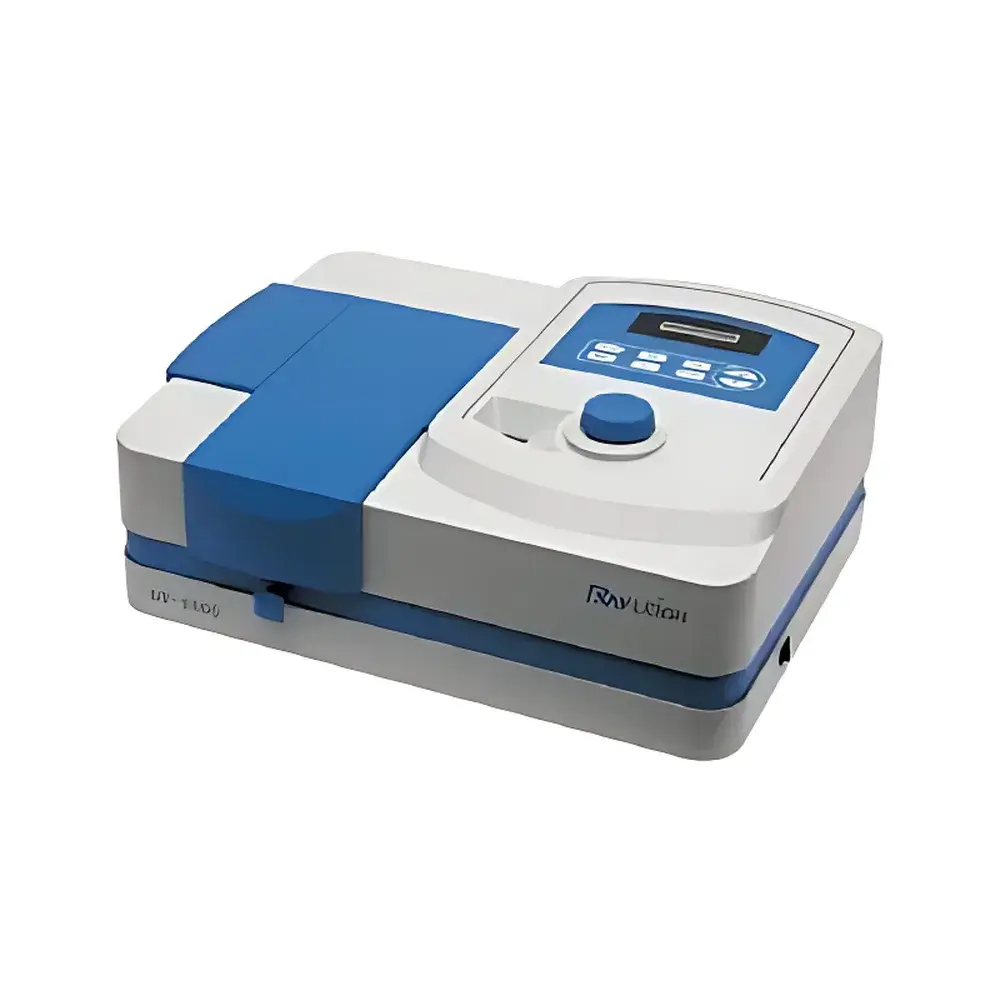
UV-9600 Ultraviolet-Visible Spectrophotometer
| Origin | Beijing, China |
|---|---|
| Manufacturer Type | Authorized Distributor |
| Origin Category | Domestic (PRC) |
| Model | UV-9600 |
| Price | USD 1,780 (FOB Beijing) |
| Wavelength Range | 190–1100 nm |
| Spectral Bandwidth | 5.0 nm (1/2/4 nm selectable) |
| Wavelength Accuracy | ±2.0 nm |
| Wavelength Repeatability | ≤1.0 nm |
| Photometric Accuracy (Transmittance) | ±0.5% τ |
| Photometric Repeatability (Transmittance) | ≤0.2% τ |
| Stray Light | ≤0.05% τ (at 220 nm with NaI |
| Baseline Stability | ≤0.001 A/30 min (at 500 nm, post 30-min warm-up) |
| Photometric Modes | Transmittance (%T), Absorbance (A), Concentration (C), Energy |
| Photometric Range | –0.3 to 3.0 A |
| Display | 16×2 character LCD |
| Detector | Imported silicon photodiode |
| Light Sources | Imported deuterium lamp (optional), imported tungsten-halogen lamp |
| Power Supply | AC 220 V / 50 Hz or 110 V / 60 Hz |
| Power Consumption | 120 W |
| Dimensions (W×D×H) | 530 × 410 × 210 mm |
| Net Weight | 16 kg |
Overview
The UV-9600 Ultraviolet-Visible Spectrophotometer is a dual-beam, microprocessor-controlled analytical instrument engineered for routine quantitative and qualitative analysis in chemistry, pharmaceuticals, environmental testing, food science, and academic research laboratories. It operates on the principle of Beer–Lambert law-based absorption spectroscopy, measuring the attenuation of ultraviolet and visible light as it passes through a sample solution. With a spectral coverage from 190 nm to 1100 nm, the system supports both deep-UV organic compound detection (e.g., nucleic acids, aromatic hydrocarbons) and near-infrared applications (e.g., polymer characterization, colorimetric assays). Its optical architecture employs a Czerny–Turner monochromator design with grating dispersion, ensuring consistent wavelength selection across the full range. The instrument integrates a stable tungsten-halogen lamp for the visible–NIR region and an optional high-stability deuterium lamp for UV performance—both automatically switched based on selected wavelength, minimizing manual intervention and lamp wear.
Key Features
- Microcontroller-based operation with real-time parameter monitoring via a dedicated 16×2 character LCD interface
- Automated zero-adjustment (zero absorbance) and 100% transmittance calibration routines—reducing operator dependency and improving inter-day reproducibility
- Motorized source switching between deuterium and tungsten lamps, synchronized with wavelength selection to ensure optimal signal-to-noise ratio across spectral regions
- Programmable slit-width selection (1 nm, 2 nm, 4 nm, or fixed 5 nm) enabling user-defined resolution–sensitivity trade-offs per application requirement
- Universal cuvette compartment accommodating pathlengths from 5 mm to 100 mm—including standard 10 mm quartz or glass cells, semi-micro, and macro configurations
- Integrated ten-point standard curve builder with linear and non-linear (e.g., quadratic) regression support; K and B factor entry for direct concentration calculation
- Non-volatile memory storage for up to ten independent calibration curves, each retaining full metadata (wavelength, bandwidth, date, operator ID)
- RS-232 serial interface as standard; optional RS-485 and USB 2.0 interfaces available for integration into centralized lab networks or LIMS environments
Sample Compatibility & Compliance
The UV-9600 accommodates liquid samples in standard spectrophotometric cuvettes (quartz, fused silica, or optical glass), as well as solid thin films mounted on transmission holders. It supports common solvent systems including water, methanol, ethanol, acetonitrile, and buffer solutions—provided UV cutoff limits are respected. For regulatory compliance, the instrument meets general requirements of ISO/IEC 17025 for method validation in testing laboratories. While not pre-certified for 21 CFR Part 11, its data export capabilities (ASCII, CSV), audit-ready measurement logs, and traceable calibration protocols facilitate alignment with GLP and GMP documentation standards when deployed with validated SOPs. All optical components comply with RoHS Directive 2011/65/EU restrictions on hazardous substances.
Software & Data Management
Although standalone operation is fully functional, the UV-9600 is compatible with optional PC-based control software (Windows 10/11, x64) that enables advanced functionality: automated wavelength scanning, kinetic time-course profiling, multi-wavelength quantitation, and spectral overlay comparison. Data files are exported in plain-text formats compatible with Excel, OriginLab, and MATLAB for statistical analysis or publication-grade figure generation. Measurement records include timestamp, wavelength, absorbance/transmittance values, instrument settings, and curve identification tags—supporting traceability in quality-controlled workflows. Print output (via parallel or thermal printer interface) includes header information, raw data tables, regression coefficients (R², slope, intercept), and plotted standard points—suitable for internal QA review or external audit submission.
Applications
- Quantitative determination of active pharmaceutical ingredients (APIs) per USP and EP 2.2.25 guidelines
- Enzyme kinetics (e.g., NADH/NADPH oxidation at 340 nm) and protein concentration assays (Bradford, Lowry, BCA)
- Water quality analysis: nitrate (220 nm), phosphate (880 nm), and COD estimation via dichromate reduction
- Food additive quantification (e.g., synthetic dyes, preservatives) in accordance with AOAC 973.42 and ISO 10565
- Material science: bandgap estimation of semiconductors via Tauc plot analysis of absorption edge data
- Educational use in undergraduate physical chemistry and analytical labs for teaching spectral interpretation and calibration methodology
FAQ
Is the UV-9600 compliant with FDA 21 CFR Part 11?
No—the instrument does not include built-in electronic signature, audit trail, or role-based access controls required for Part 11 compliance. However, its data export and logging features support implementation of compliant workflows when paired with validated third-party software and procedural controls.
What cuvette materials are recommended for UV measurements below 220 nm?
Fused silica or synthetic quartz cuvettes are required for reliable transmission below 220 nm; standard optical glass or plastic cuvettes absorb strongly in this region and must be avoided.
Can the UV-9600 perform kinetic measurements?
Yes—when operated via the optional PC software, the instrument supports time-scan mode with user-defined interval and duration, enabling enzyme activity or reaction rate studies.
How often should the deuterium lamp be replaced?
Typical service life is 1,000–2,000 hours under normal usage. Lamp status is monitored by intensity feedback during startup; replacement is advised when output drops below 70% of initial value or when baseline noise increases significantly.
Does the instrument support GLP-compliant reporting?
It provides essential elements—timestamped raw data, calibration history, and operator-identifiable curve parameters—but full GLP adherence requires supplementary documentation practices, such as controlled logbooks, version-controlled SOPs, and periodic instrument verification per ISO/IEC 17025 Clause 6.4.




