
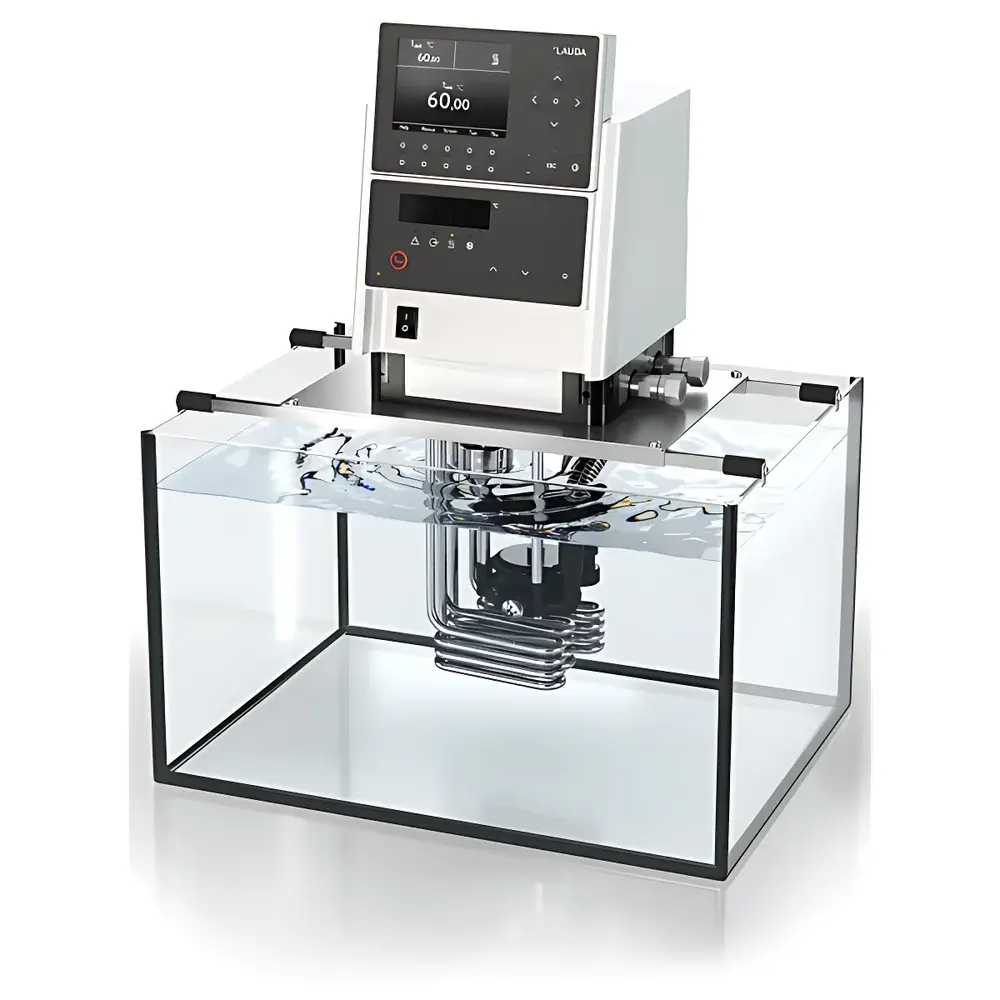
LAUDA Proline PBD C Bridge-Type Circulating Thermostat for Bath Applications
| Brand | LAUDA |
|---|---|
| Origin | Germany |
| Model | PBD C |
| Temperature Range | 30–300 °C (with external cooling: 20–300 °C |
| extended range | –30–300 °C) |
| Temperature Stability | ±0.01 K |
| Heating Power | 3.6 kW |
| Max. Pump Pressure | 1.1 bar |
| Max. Flow Rate | 32 L/min |
| Dimensions (W×D×H) | 320 × 185 × 576 mm |
| Weight | 8 kg |
| Pump Type | LAUDA Varioflex (8-stage adjustable, pressure/suction) |
| Interface Options | RS232/485 (standard optical decoupling), upgradable to Profibus, analog/digital I/O, Ethernet/USB modules |
| Programmable Steps | 150 temperature/time segments across 5 independent programs |
| Safety | Adjustable low-limit overtemperature protection with audible alarm |
| Compliance | Designed for GLP/GMP environments |
Overview
The LAUDA Proline PBD C is a high-precision bridge-type circulating thermostat engineered for demanding laboratory and industrial applications requiring stable, programmable temperature control of external liquid baths. Unlike conventional immersion or bath-integrated units, the PBD C employs a robust bridge architecture—mounted directly across the bath rim—to deliver consistent thermal energy transfer without compromising bath accessibility or sample integrity. Its core operating principle relies on closed-loop circulation: a high-efficiency Varioflex pump draws fluid from the bath, passes it through an optimized heat exchanger (electrically heated and optionally cooled via external chiller integration), and returns conditioned fluid at precisely regulated flow and temperature. This design enables uniform thermal distribution even in deep (up to 320 mm) and wide (310–550 mm) baths—critical for rheology, material testing, stability studies, and calibration workflows where spatial temperature homogeneity exceeds ±0.01 K.
Key Features
- Microprocessor-based PID controller with adaptive tuning and PowerAdapt technology—dynamically adjusts heating output to match available supply capacity while maintaining setpoint accuracy.
- Dual-control interface: Fixed front-panel with backlit graphical LCD (high-resolution, multi-mode display) + detachable remote LCD unit with ergonomic cursor and numeric soft keys—enabling intuitive operation from benchtop or adjacent workstations.
- Varioflex pump system with eight-stage pressure/suction adjustment—optimized for variable head resistance across diverse bath geometries and fluid viscosities (including silicone oils and heat-transfer fluids up to 300 °C).
- Comprehensive programmability: 150-step temperature/time scheduler across five independent programs; timer functions for automatic startup, standby entry, and sequence execution.
- Integrated safety architecture: Adjustable low-limit overtemperature protection with audible alarm, compliant with IEC 61000-6-2/6-4 for electromagnetic compatibility and EN 61010-1 for laboratory equipment safety.
- Expandable digital connectivity: Standard optically decoupled RS232/485 port; field-upgradeable to Profibus DP, analog voltage/current outputs (0–10 V / 4–20 mA), dry-contact modules, or Ethernet/USB communication—facilitating integration into SCADA, LIMS, or centralized lab automation platforms.
- Self-diagnostic assistant with real-time status reporting and error-code guidance—reducing downtime and supporting preventive maintenance planning.
Sample Compatibility & Compliance
The PBD C is compatible with a broad spectrum of bath media—including water, ethylene glycol/water mixtures, silicone oils (e.g., DC200 series), and specialized heat-transfer fluids—across its full operational range (–30 °C to 300 °C). Its sealed, corrosion-resistant wetted path (stainless steel pump housing, fluoropolymer seals) ensures long-term reliability with aggressive or high-boiling-point solvents. The unit meets CE marking requirements and conforms to ISO/IEC 17025-relevant environmental controls for calibration laboratories. When configured with optional data-logging firmware and timestamped parameter-change records, it supports FDA 21 CFR Part 11 compliance for electronic records and signatures in regulated pharmaceutical and biotech QC/QA settings.
Software & Data Management
While the PBD C operates autonomously via its embedded controller, LAUDA’s PC-based software suite (ThermoSoft Proline Edition) enables advanced configuration, real-time monitoring, and export of time-stamped temperature/flow/pump-speed datasets in CSV or XML formats. All parameter modifications—including setpoints, program steps, PID gains, and alarm thresholds—are logged with user ID, timestamp, and pre-/post-change values—providing full traceability for GLP audits. Optional Ethernet module enables HTTP-based status polling and SNMP trap generation for enterprise-level infrastructure monitoring.
Applications
- Calibration of thermometers, RTDs, and thermocouples per ASTM E74 and ISO 17025 requirements.
- Temperature-controlled rheological testing (e.g., rotational viscometry, dynamic mechanical analysis) requiring bath depth >250 mm.
- Accelerated stability studies (ICH Q1A–Q1E) for pharmaceutical formulations under controlled thermal stress.
- Material testing per ASTM D638, ISO 527, or DIN 53445 where specimen conditioning at elevated temperatures must precede tensile or impact evaluation.
- Controlled evaporation rate studies for coatings and adhesives using large-format solvent baths.
- Integration into automated synthesis platforms requiring precise bath temperature ramping and hold profiles.
FAQ
What is the minimum external bath width supported by the PBD C’s telescopic mounting rod?
The telescopic rod is adjustable from 310 mm to 550 mm—ensuring secure bridge installation across standard and custom bath configurations.
Can the PBD C operate below ambient temperature without external refrigeration?
No—it requires connection to an external chiller for sub-ambient operation; its base specification covers 30–300 °C, extendable to 20–300 °C with chiller integration and –30–300 °C with appropriate low-temp fluid and chiller.
Is the RS232/485 interface optically isolated by default?
Yes—the standard interface includes galvanic isolation via optical decoupling to prevent ground-loop interference in sensitive measurement environments.
How does the PowerAdapt system enhance operational safety in shared electrical circuits?
PowerAdapt continuously monitors line voltage and current draw, automatically limiting heater output to stay within the configured circuit’s maximum allowable load—preventing breaker trips during multi-instrument lab deployments.
Does the unit support password-protected parameter locking for SOP compliance?
Yes—user-access levels (Operator, Technician, Administrator) can be assigned with configurable password protection for critical settings including PID parameters, safety limits, and program editing rights.



