
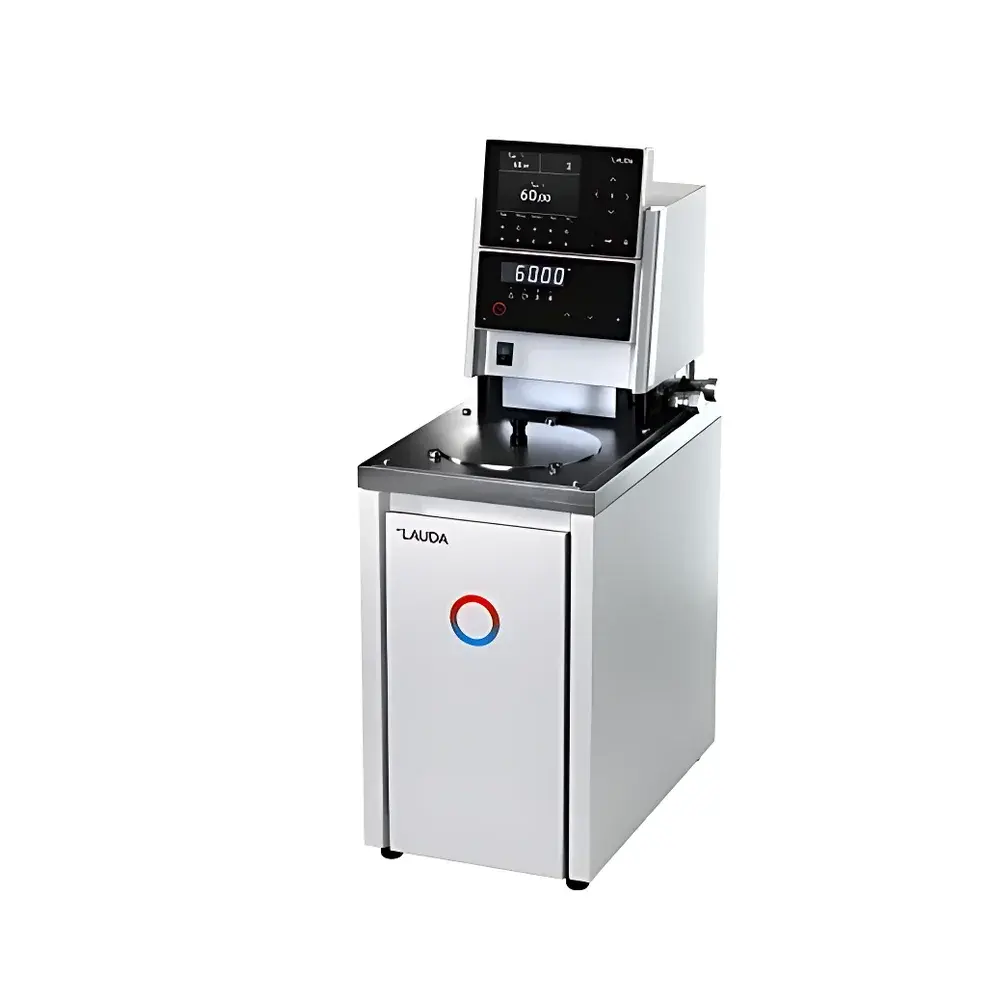
LAUDA Proline PJ 12 C Temperature Calibration Bath (30–300 °C)
| Brand | LAUDA |
|---|---|
| Origin | Germany |
| Model | PJ 12 C |
| Bath Volume | 13.5 L |
| Temperature Range | 30–300 °C |
| Temperature Stability | ±0.01 °C |
| Max. Heating Power | 3.6 kW |
| Max. Pump Pressure | 0.8 bar |
| Max. Flow Rate (Pressure Mode) | 25 L/min |
| Bath Dimensions (Ø × H) | 120 × 320 mm |
| Overall Dimensions (W × D × H) | 220 × 360 × 630 mm |
| Weight | 19 kg |
| Interface | RS232/485 (standard), USB (standard), optional Ethernet/Profibus/analog modules |
Overview
The LAUDA Proline PJ 12 C is a high-precision, microprocessor-controlled temperature calibration bath engineered for metrological traceability in laboratory and industrial calibration environments. Designed specifically for the verification and calibration of contact thermometers—including liquid-in-glass thermometers, platinum resistance thermometers (PRTs), thermistors, and digital probes—the PJ 12 C operates on the principle of convective thermal equilibrium within a highly homogeneous fluid medium. Its cylindrical stainless-steel bath features an adjustable immersion height mechanism, enabling precise alignment of the liquid surface with the thermometer’s reference point (e.g., immersion depth mark or sensing junction), thereby minimizing stem conduction error—a critical requirement per ISO/IEC 17025 and ASTM E77. The unit achieves exceptional thermal stability of ±0.01 °C across its full operational range (30–300 °C), verified under steady-state conditions at defined setpoints per DIN 12876-1. When coupled with an external chiller (e.g., LAUDA RE series), the effective operating range extends down to 0 °C, supporting cold-point calibration protocols required for multi-point thermometer validation.
Key Features
- Full-electronic PID controller with dual-loop capability—supports both internal bath temperature regulation and external process loop control via analog or digital interfaces.
- Varioflex pressure pump with 8-step adjustable output (0.1–0.8 bar), optimized for consistent flow delivery to external devices or circulation manifolds without cavitation risk.
- Modular communication architecture: standard RS232/485 and USB ports; optional upgrade paths include Profibus DP, Ethernet/IP, 0–10 V / 4–20 mA analog I/O, and dry-contact modules for integration into automated calibration workstations.
- Detachable backlit graphical LCD operator panel with green LED auxiliary display—enables remote operation up to 2 m from the bath, improving ergonomics during long-duration calibration sequences.
- Dual-chamber overflow design maintains constant fluid level at the bath surface regardless of thermal expansion or evaporation, ensuring repeatable immersion depth for NIST-traceable calibrations.
- PowerAdapt adaptive power management system dynamically adjusts heating output based on line voltage fluctuations and load conditions—ensuring compliance with IEC 61000-3-2 harmonic emission limits while maximizing energy efficiency.
- Configurable safety architecture: dual-stage overtemperature protection (Tmax key + independent mechanical cutoff), audible alarm, and low-level thermal cutout validated for both flammable (e.g., silicone oil) and non-flammable heat transfer fluids.
- Self-diagnostic assistant with real-time fault logging, sensor validation routines, and firmware update support via USB—facilitating GLP-compliant maintenance records.
Sample Compatibility & Compliance
The PJ 12 C accommodates a wide range of immersion-type temperature sensors with stem diameters ≤12 mm and lengths up to 300 mm. Its open-top cylindrical bath (Ø120 × H320 mm) allows unobstructed access for manual probe insertion and visual verification of meniscus alignment. Compatible heat transfer media include water (30–99 °C), glycol–water mixtures (0–120 °C), and high-temperature silicone oils (up to 300 °C). All materials in contact with the fluid—including the insulated stainless-steel bath, drain valve, and sealing gaskets—comply with FDA 21 CFR 177.2600 for indirect food contact and meet RoHS 2011/65/EU requirements. The system supports audit-ready documentation workflows aligned with ISO/IEC 17025:2017 Clause 6.4.10 (equipment verification), USP , and EURAMET cg-18 guidelines for thermometer calibration uncertainty budgets.
Software & Data Management
The PJ 12 C integrates seamlessly with LAUDA’s proprietary WinVisu software (Windows-based), enabling full remote control, real-time data logging (≥1 Hz sampling), and automated calibration sequence execution. Logged parameters include bath setpoint, actual temperature, pump status, heater duty cycle, and diagnostic flags—all timestamped with UTC synchronization. Data export formats include CSV, XML, and PDF reports compliant with 21 CFR Part 11 requirements when used with optional electronic signature and audit trail modules. Firmware updates are performed via signed USB payloads with SHA-256 checksum validation. The built-in 150-segment programmable timer supports complex multi-step profiles (up to 5 nested programs), including ramp-hold-cool cycles essential for hysteresis testing of thermocouples and RTDs.
Applications
- Primary and secondary calibration laboratories performing accredited thermometer verification per ISO/IEC 17025.
- Pharmaceutical QC labs validating temperature probes used in autoclaves, stability chambers, and lyophilizers (per FDA Annex 15 and EU GMP Annex 15).
- National metrology institutes conducting inter-laboratory comparisons and reference thermometer characterization.
- Automotive and aerospace suppliers verifying thermocouple assemblies prior to engine test cell deployment.
- Research facilities requiring stable thermal environments for material property measurements (e.g., viscosity vs. temperature, thermal expansion coefficient determination).
FAQ
What is the minimum immersion depth required for accurate calibration?
For optimal accuracy, the sensing element must be immersed at least 15× its diameter—or ≥75 mm for typical 5-mm-diameter probes—to minimize stem conduction error. The PJ 12 C’s adjustable bath height ensures this criterion is met across all common probe configurations.
Can the PJ 12 C be used with flammable heat transfer fluids?
Yes—its Tmax safety system includes a dedicated low-setpoint thermal cutoff and audible alarm certified for use with silicone oils and other Class II combustible fluids per DIN EN 60529 IP20 and ATEX Category 3G.
Is the unit suitable for ISO 17025 accreditation audits?
Yes—the PJ 12 C provides full traceability through factory calibration certificates (NIST-traceable Pt100 sensor), documented uncertainty budgets (<0.005 °C k=2 at 100 °C), and configurable audit trails when paired with WinVisu and 21 CFR Part 11 add-ons.
How does the overflow design improve calibration repeatability?
By maintaining a fixed liquid level relative to the bath rim—regardless of thermal expansion or minor fluid loss—the overflow chamber eliminates variability in immersion depth, directly reducing Type B uncertainty components associated with meniscus positioning.
What is the maximum allowable ambient temperature for continuous operation?
The specified ambient operating range is 5–40 °C. Sustained operation above 35 °C may reduce cooling efficiency when using external chillers and requires derating of maximum heating power per DIN 12876-1 Annex C.



