
LAUDA Scientific TD 5 Surface Tensiometer
| Brand | LAUDA |
|---|---|
| Origin | Germany |
| Model | TD 5 |
| Measurement Range | 0.75–2000 mN/m (Du Noüy ring) / 0.1–999 mN/m (Wilhelmy plate) |
| Resolution | 0.007 mN/m |
| Accuracy | ±0.007 mN/m |
| Temperature Range | 5–80 °C |
| Temperature Accuracy | ±0.1 K |
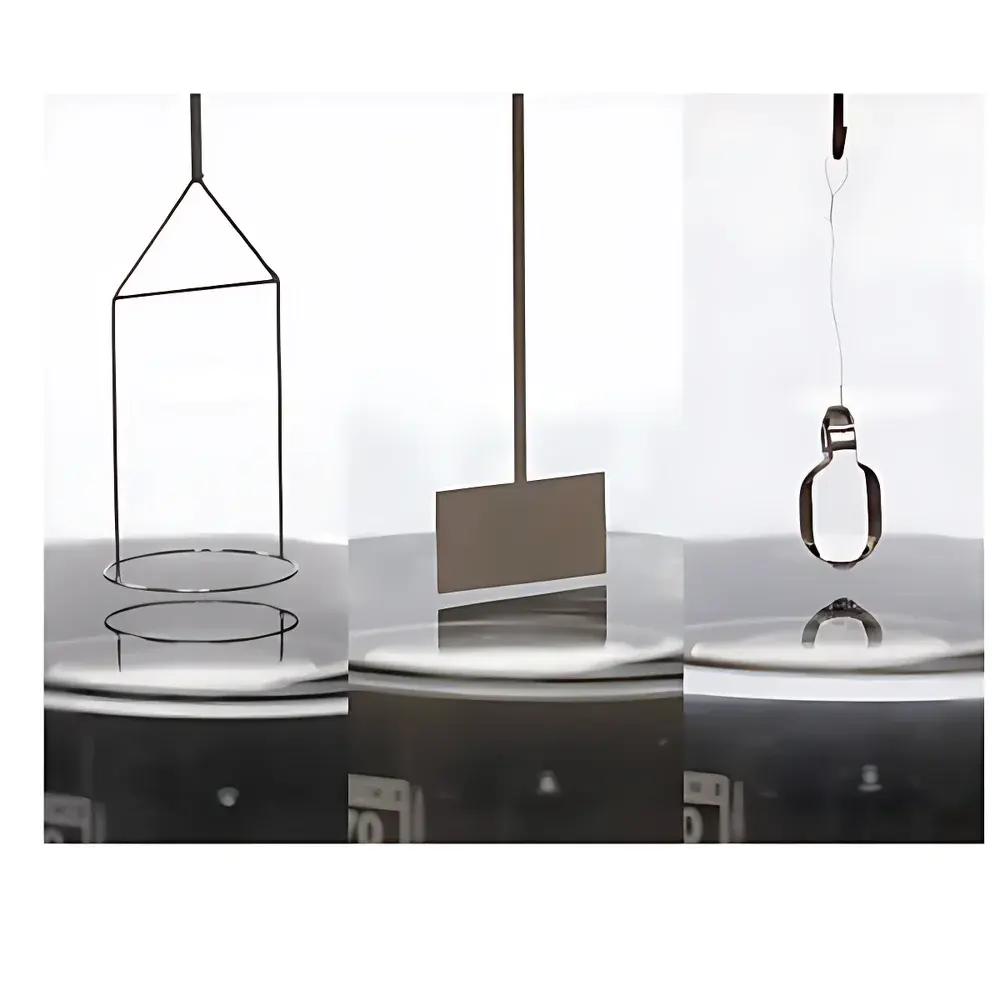
| Measurement Methods | Du Noüy Ring Method, Wilhelmy Plate Method, Drop Adhesion Force Measurement, Density Determination |
Overview
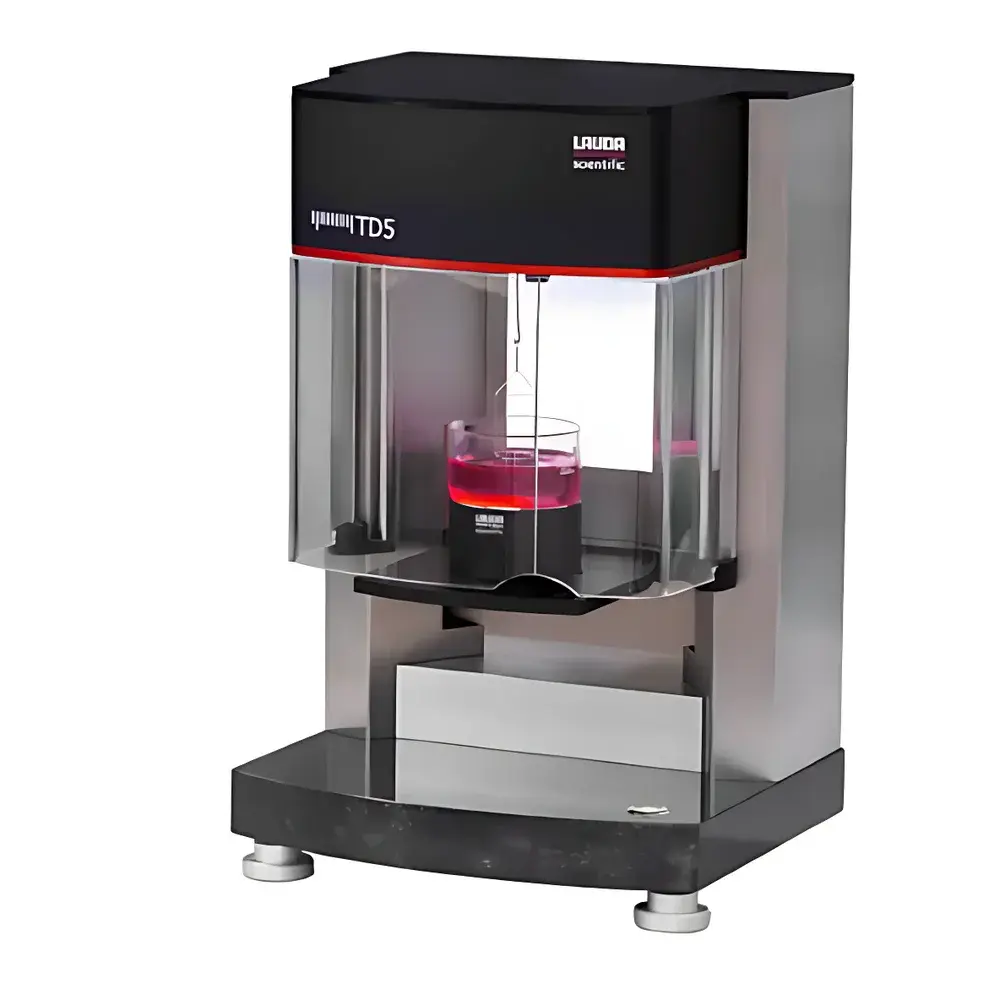
The LAUDA Scientific TD 5 Surface Tensiometer is a precision-engineered, benchtop instrument designed for high-accuracy measurement of surface tension, interfacial tension, drop adhesion force, and liquid density. Based on classical tensiometric principles—specifically the Du Noüy ring and Wilhelmy plate methods—the TD 5 quantifies the force exerted at liquid–air or liquid–liquid interfaces via calibrated platinum–iridium rings or plates mounted on a high-resolution microbalance. Its modular architecture supports both static and dynamic measurements under controlled thermal conditions (5–80 °C), making it suitable for fundamental research in colloid science, formulation development in pharmaceuticals and coatings, and routine QC testing of surfactants, emulsions, and functional fluids. The system operates on the principle of force balance: surface tension (γ) is derived from the maximum pull force required to detach a ring or plate from the interface, corrected using standardized geometric and wetting factor algorithms (e.g., Zuidema–Waters correction for ring geometry).
Key Features
- Compact, space-efficient design (226 × 189 × 360 mm) with low power consumption (15 W) and net weight of 11.3 kg—optimized for shared lab environments and ISO-classified cleanrooms.
- High-resolution electromagnetic balance with 0.1 mg mass resolution and 0.007 mN/m surface tension resolution, enabling detection of subtle interfacial phenomena such as surfactant adsorption kinetics and micelle formation thresholds.
- Motor-driven, computer-controlled vertical stage ensures precise, repeatable immersion and withdrawal profiles—critical for reproducible Wilhelmy plate measurements and dynamic interfacial tension acquisition.
- Dual-method capability: simultaneous support for Du Noüy ring (0.75–2000 mN/m) and Wilhelmy plate (0.1–999 mN/m) protocols, compliant with ASTM D971, ISO 4789, and DIN 53914 standards.
- Integrated drop adhesion force module: measures normal force between liquid drops and solid substrates—enabling quantitative evaluation of solid–liquid interaction energy, contact angle hysteresis, and wettability mapping without optical assumptions.
- Automated ring correction routines per Zuidema–Waters methodology; optional external calibration using certified weights traceable to national metrology institutes (e.g., PTB, NIST).
Sample Compatibility & Compliance
The TD 5 accommodates a broad range of sample types—including aqueous surfactant solutions, hydrocarbon oils, polymer melts, ionic liquids, and biological fluids—within standard 6 cm diameter sample cups (EG 011-1). Its enclosed draft shield minimizes air current interference, while interchangeable probe geometries (rings, plates, custom tips) allow adaptation to viscous, volatile, or corrosive media. All measurement workflows adhere to GLP/GMP documentation requirements: full audit trail logging, user access control, electronic signatures, and data integrity compliance with FDA 21 CFR Part 11 when operated with validated Surface.Meter software configurations. Temperature control is compatible with external circulators (e.g., LAUDA LOOP 100) for ISO 27677-compliant thermal stabilization across the full 5–80 °C operating range.
Software & Data Management
Surface.Meter software serves as the central control and analysis platform—fully integrated with the TD 5’s hardware via USB 2.0. It provides real-time force–time curve visualization, automated parameter scripting (immersion depth, speed, dwell time), and batch processing for multi-sample series. Key capabilities include:
- On-the-fly calculation of surface/interfacial tension with automatic buoyancy and meniscus correction.
- Built-in liquid property database (density, viscosity, surface tension references) for cross-validation and method optimization.
- Drop adhesion force analysis with peak-force extraction, baseline drift compensation, and hysteresis loop generation.
- Export options for CSV, Excel, and PDF reports—with customizable templates meeting internal SOP or regulatory submission formats (e.g., ICH M4, USP ).
- Integrated calibration manager supporting both internal self-check routines and external weight-based verification with timestamped records.
Applications
The TD 5 supports diverse applications across R&D and production environments:
- Surfactant characterization: CMC determination, adsorption isotherms, and formulation stability screening.
- Pharmaceutical development: excipient–API interfacial compatibility assessment, liposome and nanoemulsion stability analysis.
- Coatings & inks: wetting behavior prediction on substrates, pigment dispersion stability, and rheo-tensiometric response under shear.
- Enhanced oil recovery (EOR): interfacial tension reduction profiling for surfactant flooding agents.
- Materials science: surface energy estimation of polymers and thin films via inverse gas chromatography coupling.
- Quality control: release testing of cleaning agents, disinfectants, and personal care products per ISO 14683 and EN 1276 protocols.
FAQ
What standards does the TD 5 comply with for surface tension measurement?
The TD 5 implements Du Noüy ring and Wilhelmy plate methods in accordance with ASTM D971, ISO 4789, DIN 53914, and GB/T 6541—ensuring global method equivalence and regulatory acceptance.
Can the TD 5 perform temperature-controlled interfacial tension measurements?
Yes—via integration with external thermostats (e.g., LAUDA LOOP 100), the system maintains sample temperature within ±0.1 K across 5–80 °C, enabling thermodynamic analysis of interfacial phase transitions.
Is drop adhesion force measurement traceable to SI units?
All force measurements are referenced to calibrated electromagnetic transducers with traceability to national standards; adhesion force values are reported in millinewtons (mN) with documented uncertainty budgets.
How is data integrity ensured during regulated testing?
Surface.Meter supports 21 CFR Part 11–compliant operation when configured with role-based user accounts, electronic signatures, immutable audit trails, and encrypted raw data storage.
Does the TD 5 support density measurement of liquids?
Yes—the system includes dedicated density determination functionality using the sinker method, delivering resolution of 0.001 g/cm³ and compatibility with ASTM D1298 and ISO 16750 protocols.
Related Products



