
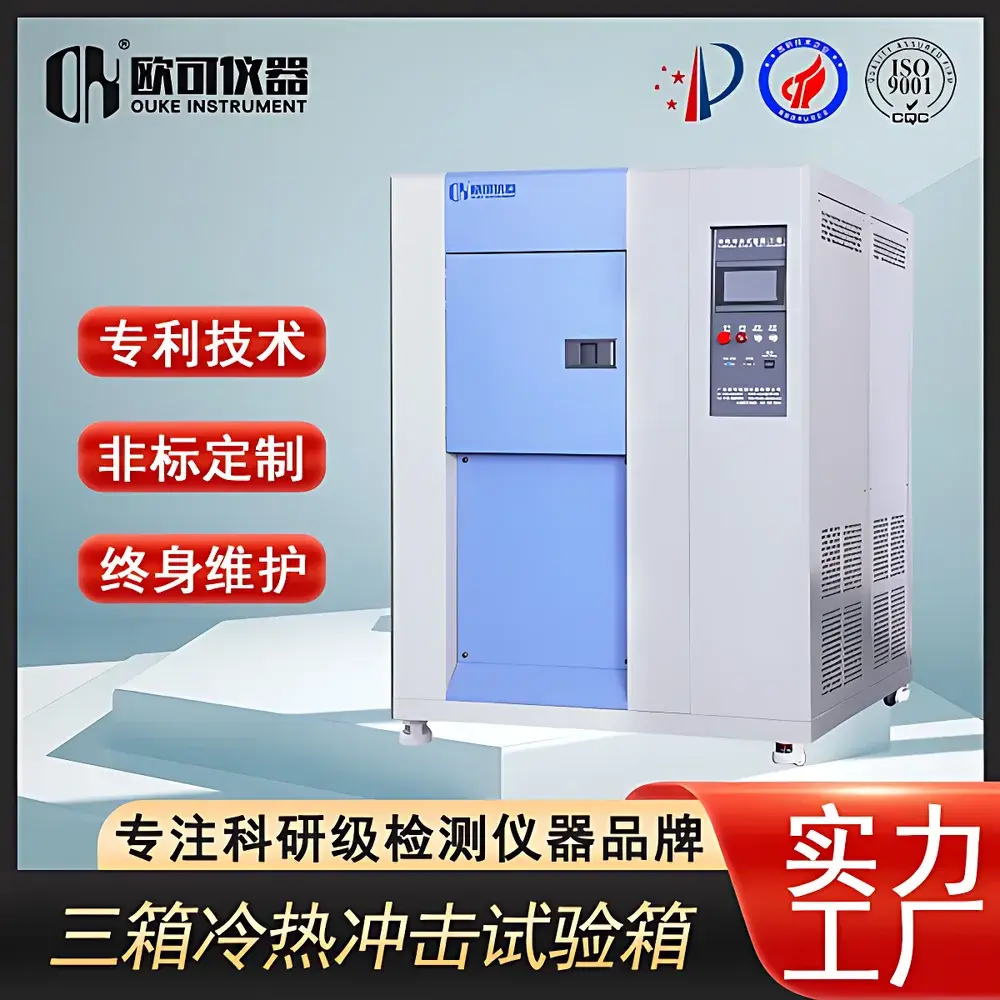
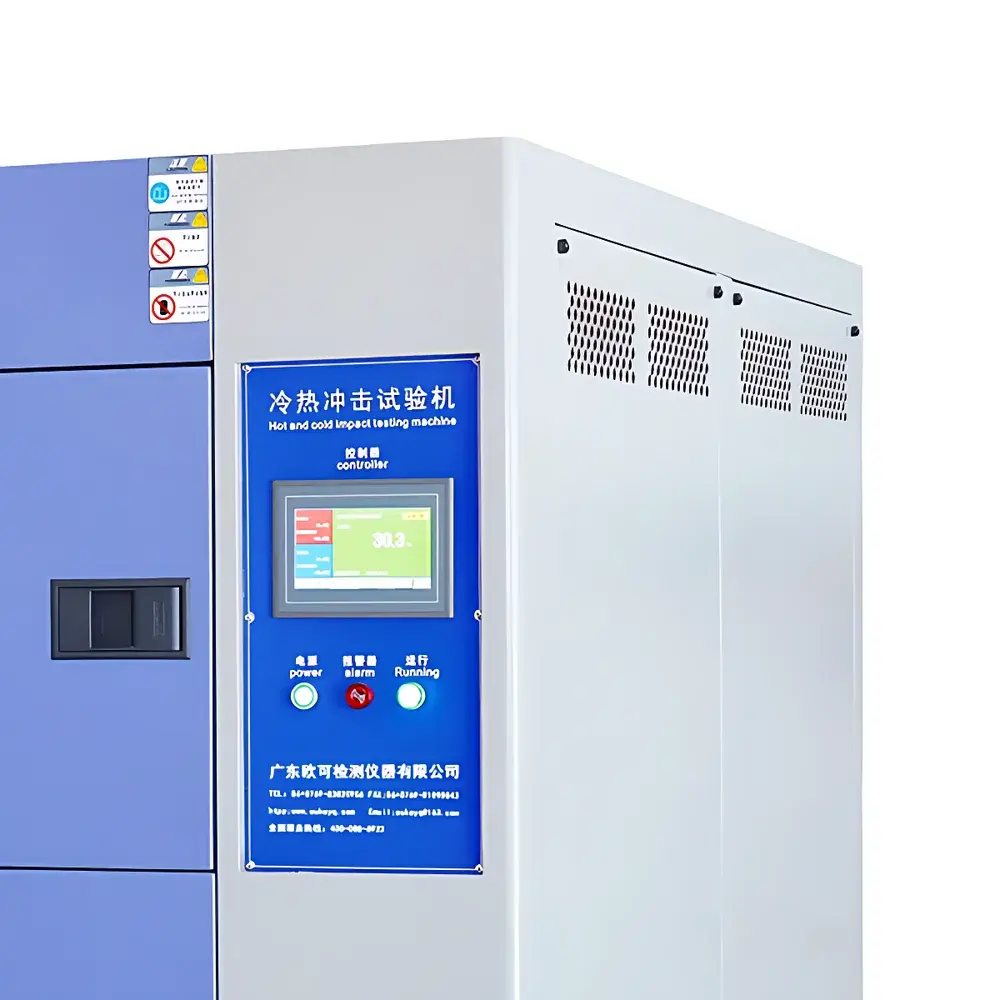
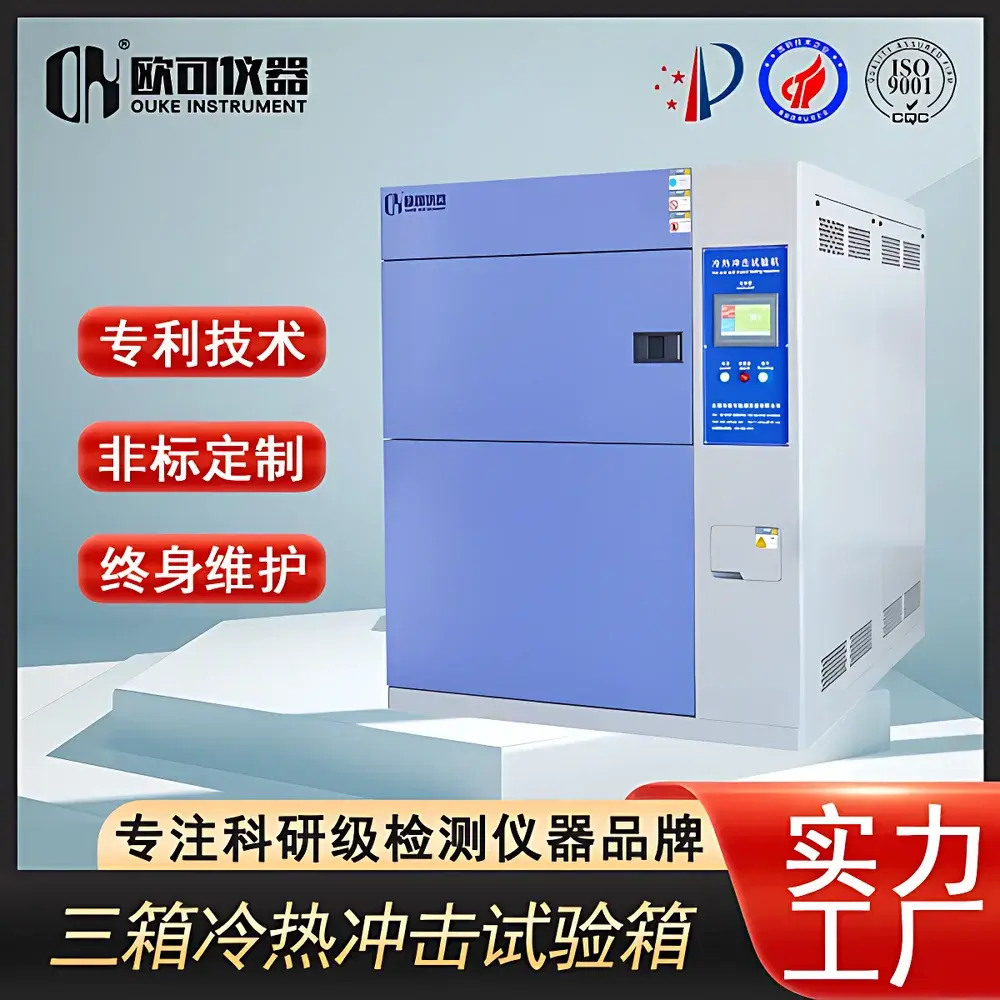
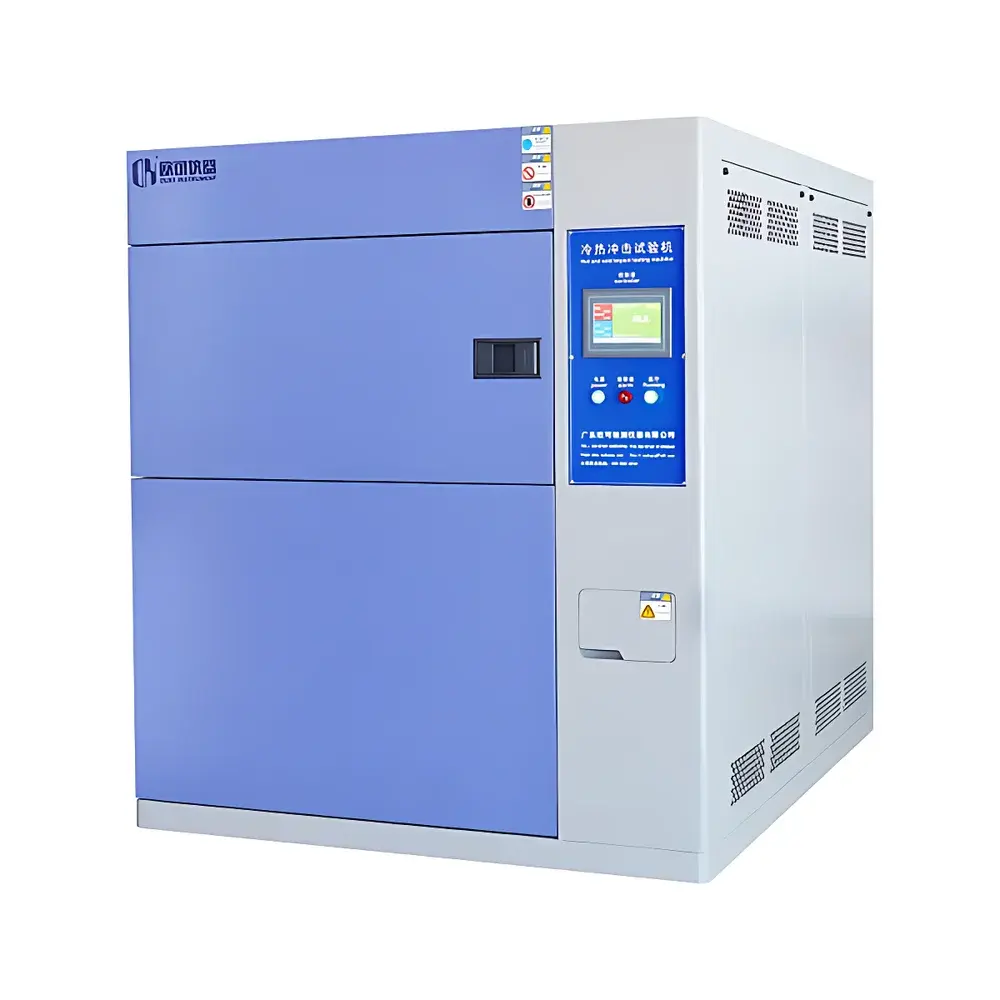
OK-TS-49.22 LED Thermal Shock Test Chamber
| Brand | OK Instruments |
|---|---|
| Origin | Guangdong, China |
| Manufacturer Type | Direct Manufacturer |
| Model | OK-TS-49.22 |
| Price | USD 12,500 (FOB Guangdong) |
| High-Temperature Range | +150 °C |
| Low-Temperature Range | −50 °C |
| Thermal Shock Range | −50 °C to +150 °C |
| Temperature Stability | ±2 °C |
| Temperature Transition Time | ≤10 s (typical) |
| Configuration | Two-Zone Basket-Transfer Design |
Overview
The OK-TS-49.22 LED Thermal Shock Test Chamber is an engineered environmental test system designed to perform rapid, high-fidelity thermal shock testing in strict accordance with MIL-STD-883 Method 1010.8, IEC 60068-2-14 (equivalent to GB/T 2423.22), and JESD22-A104. Unlike temperature cycling or rapid thermal transition chambers—which impose gradual, linear thermal profiles—this chamber delivers true *step-change* thermal stress by physically relocating test specimens between two independently stabilized temperature zones. Its core operational principle relies on a dual-chamber, basket-transfer architecture: a high-temperature zone (+150 °C) and a low-temperature zone (−50 °C), with a pneumatically actuated specimen carrier that achieves full thermal zone transition in ≤10 seconds. This mechanical transfer mechanism subjects samples to abrupt thermal gradients—simulating real-world conditions such as immediate exposure of outdoor-mounted LED modules from sub-zero ambient to heated vehicle cabins or aerospace avionics during rapid ascent/descent. The resulting thermo-mechanical strain reveals latent defects including interfacial delamination, solder joint fracture, coefficient-of-thermal-expansion (CTE) mismatch-induced cracking, and hermetic seal failure—failures often undetectable under static or ramped thermal conditions.
Key Features
- Dual-zone, basket-transfer configuration optimized for LED packaging, PCB assemblies, and optoelectronic modules requiring high-fidelity shock replication.
- Independent PID-controlled high-temperature (+150 °C) and low-temperature (−50 °C) chambers, each maintaining ±2 °C stability over full operational load.
- Pneumatic lift-and-transfer mechanism enabling ≤10-second specimen transition between thermal zones—meeting the most stringent transition-time requirements of JEDEC and military standards.
- Stainless-steel insulated chamber construction with multi-layer vacuum-sealed doors and low-thermal-conductivity gasketing to minimize cross-zone heat leakage and ensure thermal fidelity.
- Integrated over-temperature, over-pressure, and phase-failure protection circuits compliant with IEC 61000-6-2/6-4 EMC directives and UL 61010-1 safety certification prerequisites.
- Modular refrigeration system utilizing environmentally compliant R-404A/R-23 cascade cooling, rated for continuous operation at full thermal range without derating.
Sample Compatibility & Compliance
The OK-TS-49.22 accommodates specimens up to 400 mm × 400 mm × 300 mm (W×D×H) and supports maximum payload of 25 kg per cycle. Its basket-transfer design is particularly suited for discrete LED packages (e.g., SMD 2835, 3030, COB arrays), driver ICs, and small-format lighting modules. The chamber meets functional compliance with ISO/IEC 17025-accredited laboratory requirements when operated within documented procedures. Test execution adheres to traceable calibration protocols aligned with NIST-traceable reference thermocouples (Type T, Class 1). Full audit trails—including chamber setpoints, actual zone temperatures, transfer timestamps, and alarm logs—are retained for GLP/GMP environments. While not inherently 21 CFR Part 11 compliant, optional software add-ons support electronic signature, user access control, and data integrity features required for regulated pharmaceutical or medical device validation.
Software & Data Management
The embedded controller runs OK’s proprietary TS-Control v3.2 firmware, supporting up to 99 programmable test profiles with nested cycles, dwell times, and conditional branching (e.g., “if temperature deviation > ±1.5 °C, pause and log”). Real-time monitoring includes dual-channel thermocouple inputs (sample surface and chamber air), motor position feedback, and refrigerant pressure diagnostics. Data export is available via USB 2.0 or Ethernet (TCP/IP) in CSV or XML format. Optional PC-based OK-DataLink Suite provides advanced analysis: shock severity indexing (ΔT/Δt), statistical trend tracking across batches, and automated report generation compliant with ASTM E29 and ISO/IEC 17025 clause 7.8. All logged parameters are time-stamped with microsecond resolution and synchronized to internal RTC (battery-backed).
Applications
- Qualification testing of LED luminaires and automotive headlamp assemblies per AEC-Q102 stress requirements.
- Failure mode analysis of encapsulated GaN-on-Si power devices subjected to CTE-driven interfacial stress.
- Reliability screening of conformally coated PCBAs prior to field deployment in telecom base stations.
- Validation of thermal interface materials (TIMs) used in high-power LED heat sinks under repeated shock loading.
- Process capability assessment of reflow-soldered joints in high-density LED backplanes per IPC-J-STD-001 and J-STD-020.
FAQ
What distinguishes thermal shock testing from temperature cycling?
Thermal shock applies instantaneous, step-function temperature transitions between two stable extremes—inducing mechanical stress via differential expansion. Temperature cycling uses controlled ramp rates (e.g., 10 °C/min) to assess cumulative fatigue over hundreds of cycles.
Is this chamber suitable for powered-in testing of LED drivers?
Yes—optional through-wall feedthroughs (up to 12 AWG, 300 VAC-rated) and isolated DC power ports enable live functional monitoring during shock transitions.
Does the system support liquid nitrogen assist for faster cooldown?
No—the OK-TS-49.22 relies exclusively on mechanical cascade refrigeration; LN₂ integration is not supported due to condensation and dew-point control constraints inherent in LED package testing.
How is temperature uniformity verified across the test volume?
Per IEC 60068-3-5, uniformity is validated using a 9-point sensor array (per ASTM E2297) during IQ/OQ; typical deviation is ±1.2 °C at center and ±1.8 °C at corners.
Can the basket transfer mechanism be disabled for static high/low-temperature soak tests?
Yes—manual lockout mode permits independent operation of either chamber as a standalone thermal soak station, with full PID control and data logging retained.



