
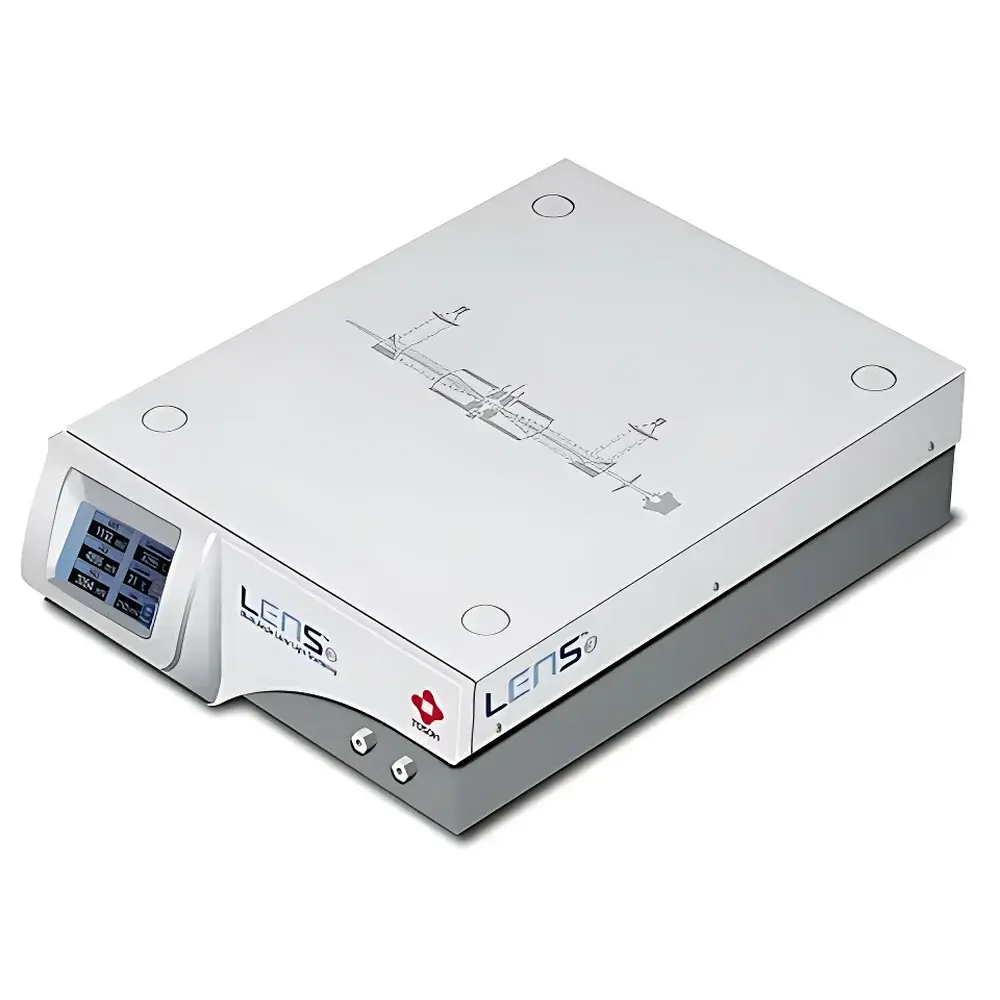
TOSOH LENS3 Multi-Angle Light Scattering (MALS) Detector for HPLC/UHPLC Systems
| Brand | TOSOH |
|---|---|
| Origin | USA |
| Model | LENS3 |
| Detection Angles | 10° (LALS), 90° (RALS), 170° (HALS) |
| Laser Wavelength | 505 nm |
| Molecular Weight Range | 200–10⁷ Da |
| Radius of Gyration (Rg) Range | 2 nm–>50 nm |
| Dimensions | 36.5 × 48.5 × 13 cm (W×D×H) |
| Weight | 16 kg |
Overview
The TOSOH LENS3 Multi-Angle Light Scattering (MALS) Detector is an advanced, chromatography-integrated analytical instrument engineered for absolute molecular weight (Mw) and radius of gyration (Rg) determination of macromolecules in solution. Unlike conventional single-angle or flow-cell-based MALS systems, the LENS3 employs a fixed-angle, extended-flow-path optical architecture—eliminating traditional cuvette-style flow cells to minimize band broadening and enhance light-matter interaction efficiency. It operates on the fundamental principle of static light scattering (SLS), where intensity and angular dependence of scattered light are directly related to molar mass and conformation via the Zimm equation and its angular asymmetry extensions. The detector integrates seamlessly with HPLC and UHPLC platforms—including TOSOH’s EcoSEC GPC systems—enabling online, size-exclusion chromatography (SEC) coupled with real-time, angle-resolved scattering detection. Its 505 nm green diode laser delivers ~3× higher Rayleigh scattering intensity than legacy 660 nm red lasers, significantly improving signal-to-noise ratio (SNR) and enabling reliable characterization of low-concentration or low-Mw species.
Key Features
- Triple-angle detection at precisely calibrated positions: Low-Angle Light Scattering (LALS) at 10°, Right-Angle Light Scattering (RALS) at 90°, and High-Angle Light Scattering (HALS) at 170°—optimized for robust Rg calculation across diverse macromolecular architectures.
- Extended-flow optical path design eliminates refractive index mismatch artifacts and reduces hydrodynamic dispersion, preserving chromatographic resolution while maximizing scattering collection efficiency.
- Proprietary angular asymmetry analysis algorithm enables accurate Rg determination down to <2 nm—critical for characterizing small proteins, oligonucleotides, and compact synthetic polymers where conventional MALS fails due to insufficient angular spread.
- High-stability 505 nm diode laser with thermoelectric cooling ensures long-term wavelength consistency and minimal thermal drift—essential for GLP/GMP-compliant method validation and routine QC applications.
- Compact benchtop footprint (36.5 × 48.5 × 13 cm) and 16 kg mass support flexible integration into existing chromatography workflows without requiring dedicated optical tables or vibration isolation.
Sample Compatibility & Compliance
The LENS3 is validated for use with aqueous and organic mobile phases compatible with standard HPLC/UHPLC hardware, including SEC columns packed with cross-linked polystyrene-divinylbenzene, silica-based, or agarose matrices. It supports analysis of synthetic polymers (e.g., PMMA, PS), natural biopolymers (e.g., hyaluronic acid, dextran), therapeutic proteins (mAbs, ADCs), viral vectors, and extracellular vesicles. Data acquisition and processing comply with regulatory expectations for analytical instrumentation: SECview™ software supports audit trails, electronic signatures, and user-access controls aligned with FDA 21 CFR Part 11 requirements. All measurements adhere to ISO 16014-4 (polymers—determination of molecular weight distributions by SEC) and ASTM D7215 (light scattering detection for polymer characterization).
Software & Data Management
Controlled exclusively via TOSOH’s SECview™ software, the LENS3 leverages a unified platform for instrument control, multi-channel data acquisition (including UV, RI, and light scattering signals), and advanced post-run analysis. SECview performs real-time Debye plot generation, Zimm extrapolation, and conformational analysis (e.g., Mark–Houwink plots). Raw scattering intensity files are saved in vendor-neutral .csv format; processed results export to PDF, Excel, or XML for LIMS integration. The software includes built-in calibration routines using certified NIST-traceable standards (e.g., bovine serum albumin, pullulan), and supports batch processing for high-throughput QC labs operating under ISO/IEC 17025 or pharmaceutical GMP frameworks.
Applications
- Determination of absolute Mw, polydispersity index (Đ), and Rg for quality control of polymer raw materials per USP and Ph. Eur. 2.2.48.
- Higher-order structure assessment of monoclonal antibodies and biosimilars—detecting aggregation, fragmentation, and conformational variants without labeling.
- Characterization of lipid nanoparticles (LNPs) and gene therapy vectors, where Rg/Rh ratios inform encapsulation efficiency and structural integrity.
- Method development and validation for regulatory submissions (e.g., IND, BLA), supported by full traceability of instrument parameters, calibration history, and raw scattering profiles.
- Academic and industrial research on macromolecular folding, self-assembly, and supramolecular interactions in native or near-native solution conditions.
FAQ
Is the LENS3 compatible with non-TOSOH HPLC systems?
Yes—the detector features standard 1/16″ stainless steel tubing connections and analog/digital I/O interfaces (RS-232, Ethernet) for synchronization with third-party pumps, autosamplers, and data systems via TTL triggers or software APIs.
Does the LENS3 require column calibration standards?
No—LENS3 provides absolute Mw and Rg without reliance on column calibration curves, eliminating errors associated with column aging, solvent effects, or conformational differences between standards and samples.
Can it be used for batch-mode (non-chromatographic) measurements?
While optimized for SEC-coupled operation, the LENS3 supports static injection mode for direct solution analysis when paired with a manual injector and appropriate flow cell adapter—subject to system pressure and dwell volume constraints.
What maintenance is required for long-term stability?
Routine maintenance is limited to periodic laser power verification using the integrated reference photodiode, quarterly cleaning of optical windows with spectroscopic-grade solvents, and annual verification of angular alignment using NIST-traceable angular calibration kits.





