
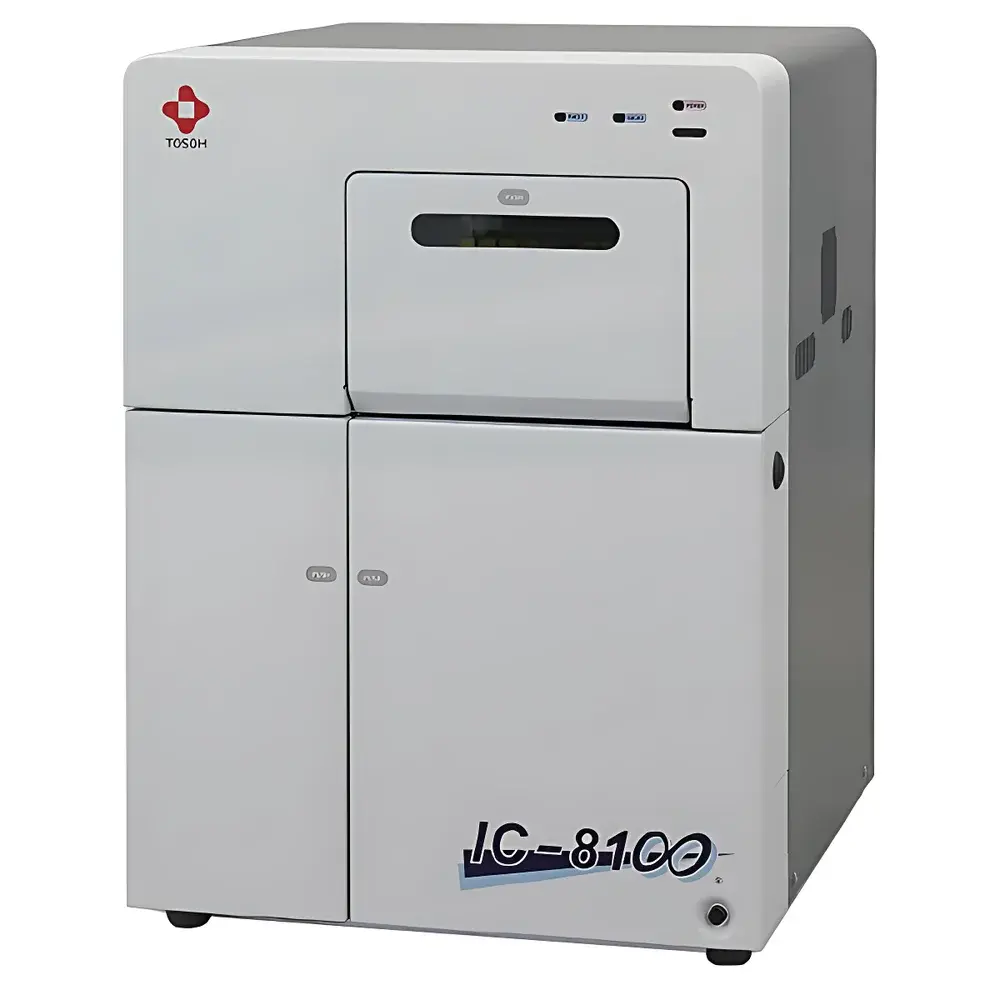
TOSOH IC-8100 High-Throughput Ion Chromatograph
| Brand | TOSOH |
|---|---|
| Origin | Japan |
| Model | IC-8100 |
| Instrument Type | Laboratory |
| Application | General-purpose |
| Pump Pressure Rating | 35 MPa |
| Flow Rate Range | 0.1–5 mL/min |
| Eluent Flow Rate | 0.1–5 mL/min |
| Maximum Operating Pressure | 35 MPa |
| Operating Temperature Range | Ambient to 45 °C |
| Temperature Reproducibility | ±0.1 °C |
| Eluent Concentration Range | 0–500 mM (salt basis) |
Overview
The TOSOH IC-8100 is a high-throughput, modular ion chromatography (IC) system engineered for precision, reproducibility, and operational efficiency in modern analytical laboratories. Based on suppressed conductivity detection and optimized eluent delivery architecture, the IC-8100 implements a proprietary gel-based suppression mechanism—distinct from traditional membrane or electrolytic suppressors—to deliver stable baseline performance, low background noise, and extended suppressor lifetime. Designed for routine and regulated environments—including QC labs, environmental testing facilities, and pharmaceutical R&D—the system supports both anion and cation analysis with sub-5-minute run times when paired with TSKgel HS-series high-efficiency ion-exchange columns. Its dual-platform configuration (IC-8100EX with autosampler and IC-8100ST with manual injector) enables flexible deployment across throughput requirements while maintaining identical core fluidic and detection architecture.
Key Features
- High-speed analysis: Anion and cation separations completed in ≤5 minutes using TSKgel HS columns, significantly reducing sample-to-report cycle time.
- Gel-based suppression technology: Integrates suppressor gel cartridges (30 mL and 60 mL options) with automated gel exchange synchronized to injection timing—eliminating manual regeneration and minimizing downtime.
- Low dead-volume flow path design: Minimizes band broadening and improves peak shape fidelity, particularly critical for trace-level ion quantification.
- Integrated eluent auto-preparation unit (IC-8100EX only): Dilutes concentrated eluent stock solutions with ultrapure water on-demand; delivers consistent eluent composition independent of storage duration or ambient conditions.
- Temperature-controlled column compartment: Maintains isothermal operation between ambient and 45 °C with ±0.1 °C reproducibility—essential for retention time stability and method transfer compliance.
- Autosampler with on-board dilution (IC-8100EX): Enables unattended serial dilution of high-concentration samples prior to injection, extending dynamic range without manual intervention.
Sample Compatibility & Compliance
The IC-8100 accommodates aqueous samples containing inorganic anions (e.g., F⁻, Cl⁻, NO₂⁻, PO₄³⁻, SO₄²⁻), cations (e.g., Li⁺, Na⁺, NH₄⁺, K⁺, Ca²⁺, Mg²⁺), and low-molecular-weight organic acids. It meets foundational requirements for ISO/IEC 17025-accredited testing and supports method validation per ASTM D4327 (anion analysis in water), EPA Method 300.1, and USP . The system’s hardware architecture—including non-metallic fluidic paths (PEEK, PTFE), low-drift conductivity detector, and traceable temperature control—ensures compatibility with GLP and GMP workflows. Audit trail functionality (via optional software modules) satisfies FDA 21 CFR Part 11 data integrity requirements when deployed with compliant LIMS integration.
Software & Data Management
Controlled via TOSOH’s IC Navigator software, the IC-8100 provides intuitive method development tools, real-time chromatogram visualization, and automated peak integration with customizable reporting templates. Data files conform to AIA (.cdf) format for cross-platform compatibility with third-party processing tools (e.g., Chromeleon, OpenLab CDS). Software supports electronic signatures, user access levels, and full audit trail logging—including method changes, calibration events, and sequence modifications. Optional instrument qualification packages include IQ/OQ documentation aligned with pharmaceutical validation standards.
Applications
- Environmental monitoring: Quantification of anions and cations in drinking water, wastewater, and leachates per regulatory methods.
- Pharmaceutical quality control: Testing of counterions in APIs, residual chloride in excipients, and ionic impurities in parenteral formulations.
- Food & beverage safety: Detection of nitrate/nitrite in processed meats, sulfite in wines, and phosphate additives in dairy products.
- Battery electrolyte analysis: Measurement of Li⁺, PF₆⁻, and impurity ions in lithium-ion battery research and production.
- Power generation: Monitoring of chloride and sulfate in boiler feedwater to prevent corrosion-related failures.
FAQ
What suppression method does the IC-8100 use, and how does it differ from conventional suppressors?
The IC-8100 employs a regenerable gel-based suppression system that combines packed suppressor gel cartridges with timed automatic exchange—avoiding the pressure sensitivity and limited capacity of membrane suppressors.
Can the IC-8100 analyze both anions and cations on the same instrument?
Yes—by switching columns, eluents, and detector settings, the system supports both anion-exchange and cation-exchange modes without hardware modification.
Is the eluent auto-preparation unit compatible with all common eluents?
It is validated for carbonate/bicarbonate, hydroxide, methanesulfonic acid (MSA), and pyridine carboxylic acid systems; custom concentration profiles require method-specific verification.
Does the IC-8100 support UV-Vis detection?
UV-Vis detection is available as an optional module (IC-800 series interface); the IC-8100 base configuration uses conductivity detection exclusively.
What is the maximum eluent concentration the system can handle?
The fluidic system is rated for eluent concentrations up to 500 mM (salt basis), with pump and detector compatibility verified across this full range.







