
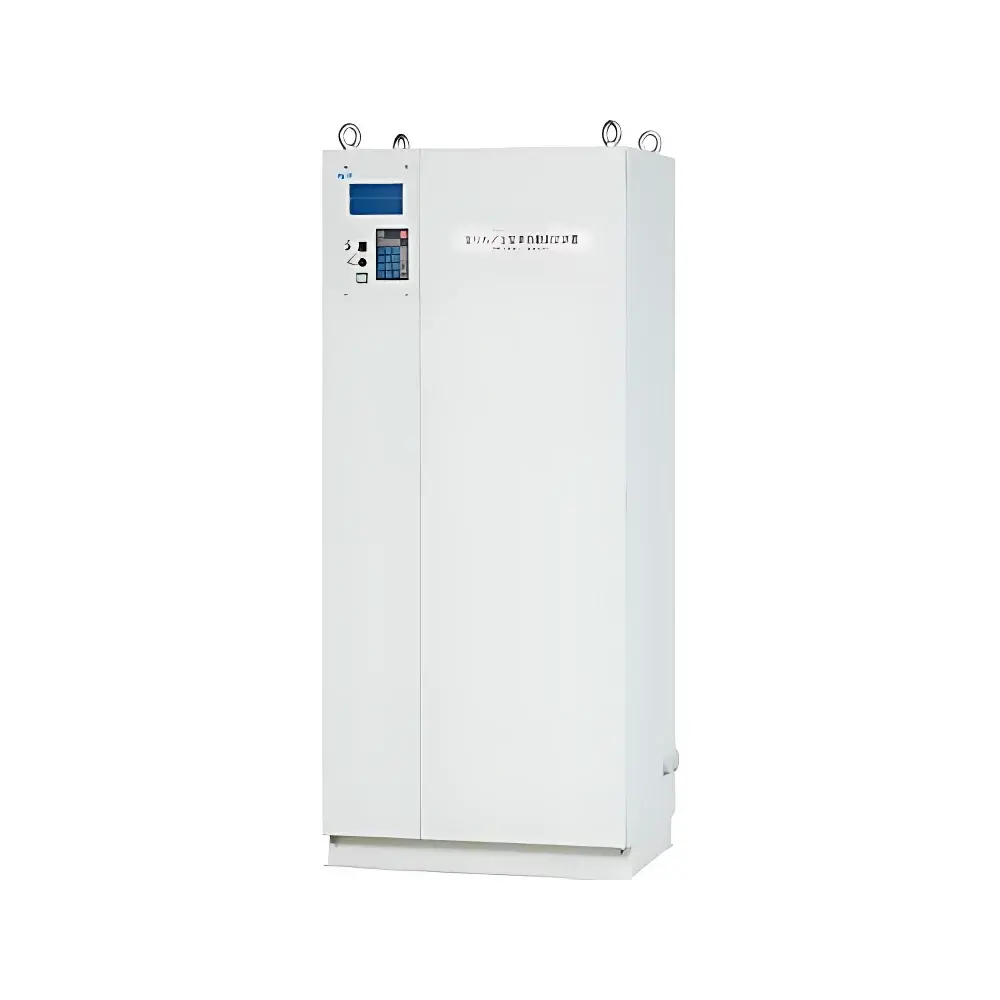
KEM WPA-1000 Total Phosphorus and Total Nitrogen Online Water Quality Analyzer
| Brand | KEM (Kyoto Electronics Manufacturing) |
|---|---|
| Origin | Japan |
| Manufacturer Type | Original Equipment Manufacturer (OEM) |
| Product Category | Imported Instrument |
| Model | WPA-1000 |
| Measurement Parameters | Total Phosphorus (TP) and Total Nitrogen (TN) |
| Instrument Type | Online Continuous Analyzer |
| Measurement Principle | Spectrophotometry (Molybdate Blue for TP |
| Measurement Range | TP: 0–0.5 mg P/L or 0–1 mg P/L (standard) |
| TN | 0–2 mg N/L or 0–5 mg N/L (standard) |
| Accuracy | ±2% of full scale (FS) |
| Detection Limit | 0.01 mg/L |
| Resolution | 0.001 mg/L |
| Optional Dilution Ratio | 2× to 500× |
| Sample Inlet Capacity | Up to 3 independent sample streams via automated selector valve |
| Waste Separation | Integrated dual-waste channel system |
| Reagent Delivery | Positive-displacement peristaltic pumping with quick-change cartridge design |
| Onboard Calculation | Real-time pollutant load estimation (kg/day) based on flow rate integration |
Overview
The KEM WPA-1000 Total Phosphorus and Total Nitrogen Online Water Quality Analyzer is an industrial-grade, fully automated spectrophotometric analyzer engineered for continuous, unattended monitoring of total phosphorus (TP) and total nitrogen (TN) in surface water, municipal wastewater effluent, and industrial discharge streams. It implements two standardized environmental measurement protocols: the molybdate blue method (JIS K 0102, ISO 6878, and EPA 365.1) for TP quantification following acid digestion, and the alkaline potassium persulfate digestion coupled with ultraviolet (UV) spectrophotometric detection (JIS K 0102, ISO 11905-1, and EPA 351.2) for TN. The instrument complies with Japan’s Ministry of the Environment Notification No. 59 (2003) for automatic water quality analyzers and satisfies performance criteria outlined in the Fifth Water Pollution Control Total Load Regulation. Its architecture supports long-term operational stability under variable ambient conditions typical of wastewater treatment plant environments—featuring corrosion-resistant fluidic pathways, temperature-controlled optical cells, and self-diagnostic routines for lamp intensity, baseline drift, and reagent depletion.
Key Features
- Simultaneous dual-parameter analysis: TP and TN measured sequentially within a single analytical cycle without cross-contamination or manual intervention.
- Integrated high-ratio dilution module (2×–500×, optional): Enables accurate quantification across wide concentration spans—from trace-level compliance monitoring (e.g., 0.01 mg/L TP in receiving waters) to high-strength industrial effluents (up to 500 mg P/L and 2500 mg N/L).
- Automated multi-stream sampling: Supports up to three independent inlet lines via programmable solenoid selector valve—ideal for comparative monitoring across influent, effluent, and bypass channels.
- Reagent management system: Cartridge-based reagent delivery with snap-fit connectors ensures rapid, error-free replacement while minimizing downtime and operator exposure.
- Onboard pollutant load calculation: Real-time mass loading (kg TP/day, kg TN/day) computed using user-input or Modbus-integrated flow rate data—essential for regulatory reporting under total load control frameworks.
- Dual-waste separation architecture: Physically segregated acidic and alkaline waste streams reduce neutralization requirements and simplify disposal logistics in accordance with local hazardous waste classification guidelines.
- Optical integrity assurance: Dual-beam photometer with deuterium and tungsten lamps, thermally stabilized cuvette holder, and auto-zeroing reference channel ensure <±0.5% absorbance repeatability over 72-hour continuous operation.
Sample Compatibility & Compliance
The WPA-1000 accepts raw, filtered, or centrifuged aqueous samples with suspended solids <50 mg/L. It accommodates sample temperatures from 5°C to 40°C and pH 4–10 without pre-conditioning. All wetted components—including digestion coils, reaction chambers, and optical flow cells—are constructed from PTFE, quartz, and 316L stainless steel to resist chemical degradation during repeated persulfate and sulfuric acid exposures. The analyzer meets Japanese JIS B 7981 (2019) for automatic water quality analyzers and aligns with ISO/IEC 17025:2017 method validation requirements when operated under documented SOPs. Its measurement outputs satisfy data integrity expectations under GLP and GMP-aligned environmental monitoring programs, including audit-ready calibration logs, reagent lot traceability, and timestamped raw absorbance records.
Software & Data Management
The embedded firmware (v4.2+) provides a web-accessible interface supporting HTTP/HTTPS, Modbus TCP, and OPC UA protocols for SCADA integration. Calibration curves are stored with NIST-traceable standard references (SRM 2123 for phosphate, SRM 2124 for nitrate/nitrite). All measurement events—including digestions, blank corrections, peak integrations, and dilution triggers—are time-stamped and archived with checksum-verified integrity. Audit trails comply with FDA 21 CFR Part 11 requirements when deployed with external identity management and electronic signature modules. Data export formats include CSV, XML, and JSON; historical datasets can be queried via RESTful API endpoints for LIMS or cloud-based analytics platforms.
Applications
- Continuous compliance monitoring at municipal wastewater treatment plants (WWTPs) subject to national total load regulations.
- Industrial pretreatment verification for facilities discharging to public sewers (e.g., food processing, semiconductor manufacturing, pharmaceutical production).
- Environmental impact assessment (EIA) and post-construction monitoring of lake and river restoration projects.
- Research-grade nutrient flux studies in mesocosm systems and pilot-scale bioreactors.
- Calibration verification and performance auditing of laboratory benchtop analyzers using field-collected matrix-matched standards.
FAQ
What digestion methods does the WPA-1000 use for TP and TN determination?
It applies acid digestion with sulfuric acid and potassium antimonyl tartrate for TP, and alkaline digestion with potassium persulfate under UV-assisted thermal activation for TN—fully aligned with JIS K 0102 and ISO 11905-1.
Can the WPA-1000 operate unattended for extended periods?
Yes—designed for 30-day maintenance intervals with optional reagent reservoirs (≥5 L), onboard diagnostics, and remote alarm notification via SMTP or SNMP.
Is the analyzer compatible with third-party flow meters for load calculation?
Yes—Modbus RTU/TCP input allows direct integration with pulse-output or 4–20 mA flow transmitters; flow data is synchronized at sub-second resolution with each analytical result.
How is data integrity ensured during power interruptions?
Non-volatile flash memory retains all configuration, calibration, and measurement history; system resumes analysis from last completed cycle upon power restoration without data loss.
Does the WPA-1000 support remote firmware updates?
Yes—secure OTA (over-the-air) updates are supported via HTTPS with SHA-256 signature verification and rollback capability to prior stable versions.
Related Products







