
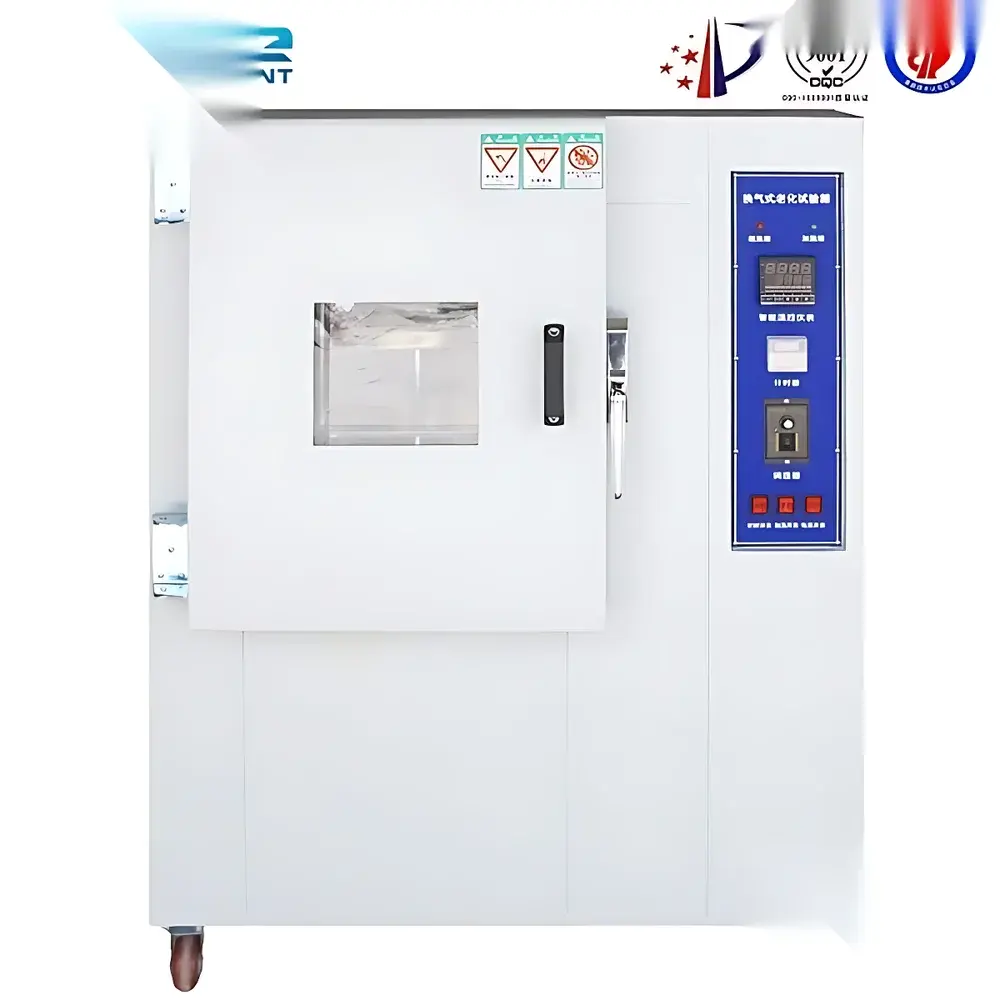
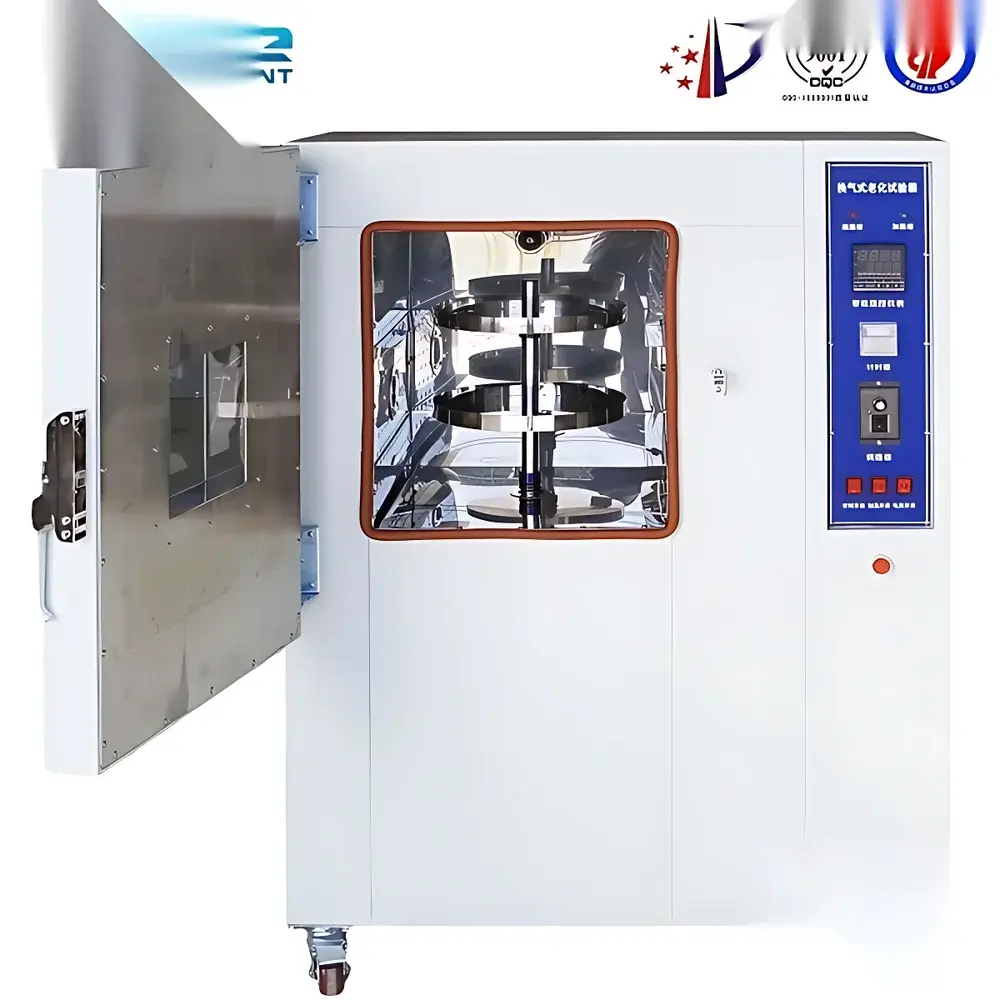
OK-HQ Series Forced-Air Thermal Aging Test Chamber
| Brand | Other Brands |
|---|---|
| Origin | Imported |
| Manufacturer Type | Authorized Distributor |
| Price | USD 2,600 (Reference Only) |
| Temperature Range | RT +10°C to 200°C / 300°C |
| Temperature Uniformity | ±2°C |
| Temperature Stability | ±0.5°C |
| Air Exchange Rate | 2–100 cycles/hour |
| Adjustable Air Exchange Interval | 1 min – 99 h |
| Internal Chamber Dimensions (L×W×H, mm) | 450×450×500 to 800×1000×1000 |
| Power Rating | 4.0–9.0 kW |
| Rotating Turntable Diameter | Φ250–Φ700 mm |
| Compliance | ASTM D5423-09 (Type II), ASTM D5374-93 (2005), UL 1581, GB/T 2951, IEC 60811, VDE 0472, JIS C 3005 |
Overview
The OK-HQ Series Forced-Air Thermal Aging Test Chamber is an engineered environmental test system designed for accelerated thermal aging evaluation of polymeric and elastomeric materials under controlled, ventilated high-temperature conditions. It operates on the principle of forced convection with programmable air exchange—enabling precise simulation of long-term thermal degradation mechanisms in electrical insulation, wire & cable sheathing, rubber compounds, textile fabrics, and plastic components. Unlike static ovens, this chamber maintains a defined volumetric air exchange rate (2–100 cycles/hour) to replicate real-world oxidative aging environments where ambient oxygen replenishment drives chemical chain scission and crosslinking. Its compliance with ASTM D5423-09 (Type II) ensures adherence to standardized laboratory oven specifications for electrical insulating materials, including airflow velocity, temperature uniformity, and thermal stability requirements.
Key Features
- Precision-engineered forced-air circulation system with high-temperature-resistant centrifugal blower and optimized baffle-guided airflow path, achieving ±2°C temperature uniformity across the working chamber.
- Digital microprocessor-based PID controller with SSR output, offering 0.1°C resolution for both setpoint and display, and integrated timer functionality (1–9999 minutes).
- Stainless steel (SUS304) interior chamber with argon-arc welded seams and electropolished mirror finish; exterior cabinet constructed from A3 cold-rolled steel with durable epoxy powder coating.
- Adjustable horizontal air exchange mechanism with calibrated orifice plates and digital flow monitoring capability—supporting traceable determination of actual air change rate per hour.
- Integrated rotating turntable (Φ250–Φ700 mm, depending on model) to ensure uniform thermal exposure of vertically mounted specimens such as insulated wires or cable segments.
- High-efficiency thermal insulation using 100 mm thick ultra-fine glass fiber棉, minimizing heat loss and improving energy efficiency during prolonged aging cycles.
- Large observation window with tempered double-layer glass and built-in LED lighting for real-time visual inspection without compromising chamber integrity.
- Standard 50 mm diameter test port on left side wall for external signal/power feedthrough, compatible with thermocouple arrays, data loggers, or load cells.
Sample Compatibility & Compliance
The OK-HQ chamber accommodates flat, cylindrical, and suspended samples—including insulated conductors, rubber hoses, PVC films, silicone elastomers, and textile laminates—under standardized thermal stress protocols. It meets critical regulatory and industry-specific requirements: ASTM D5423-09 (Type II forced-ventilation oven classification), ASTM D5374-93 (2005) for thermal aging of electrical insulation, UL 1581 Section 1000 series (wire and cable testing), IEC 60811-1-2 (polymeric insulations), GB/T 2951.12 (Chinese national standard for cable aging), VDE 0472 Part 812, and JIS C 3005. All models support GLP-aligned operation when paired with validated calibration records and audit-trail-capable data acquisition systems.
Software & Data Management
While the base configuration features a standalone LED-PID controller, optional RS485/Modbus RTU interface enables integration with third-party SCADA or LIMS platforms. Users may log temperature profiles, runtime, and air exchange events via external USB data loggers or industrial PLCs. For regulated environments (e.g., ISO 17025-accredited labs or GMP-compliant QC facilities), the system supports 21 CFR Part 11-compliant electronic records when deployed with validated software extensions—ensuring user authentication, audit trails, and immutable data storage.
Applications
This chamber is routinely employed in R&D laboratories and quality control departments for: evaluating oxidation resistance of polymer formulations; validating shelf-life predictions for automotive wiring harnesses; assessing thermal endurance of aerospace-grade elastomers; conducting comparative aging studies per IEC 60216; performing pre-qualification testing of photovoltaic module encapsulants; and supporting failure analysis of degraded insulation in power distribution equipment. Its reproducible air exchange control makes it particularly suitable for comparative aging trials where oxygen diffusion kinetics must remain consistent across test batches.
FAQ
What standards does this chamber specifically comply with?
It conforms to ASTM D5423-09 (Type II), ASTM D5374-93 (2005), UL 1581, IEC 60811-1-2, GB/T 2951.12, VDE 0472, and JIS C 3005.
Can the air exchange rate be verified independently?
Yes—the chamber includes provisions for installing calibrated anemometers or mass flow sensors at the exhaust/intake ducts to validate actual air change frequency against setpoint.
Is the turntable speed adjustable?
No—the turntable rotates at fixed low speed (typically <1 rpm) to avoid mechanical stress; its purpose is spatial averaging, not dynamic loading.
Does the chamber support continuous unattended operation?
Yes—equipped with dual over-temperature cutoffs, motor thermal protection,漏电 protection (RCD), and short-circuit interrupters for extended aging cycles up to 1000 hours.
How is temperature uniformity validated?
Per ASTM D5423, uniformity is assessed using nine calibrated PT100 sensors placed at specified locations within the working volume, with maximum deviation limited to ±2°C at any setpoint between RT+10°C and 300°C.



